































Ready Right Triangle Hypotenuse Worksheet | Grade 8 Math

Paste this activity's link or code into your existing LMS (Google Classroom, Canvas, Teams, Schoology, Moodle, etc.).
Students can open and work on the activity right away, with no student login required.
You'll still be able to track student progress and results from your teacher account.
Mastering right triangle relationships requires students to connect geometric concepts with algebraic computation. This comprehensive geometry worksheet guides Grade 8 learners through calculating unknown hypotenuse and leg lengths, determining side length triples, and applying the distance formula across 16 structured problems to build procedural fluency and conceptual understanding.
At a Glance
- Grade: 8 · Subject: Math
- Standard: Geometry — Apply the Pythagorean Theorem to determine unknown side lengths and coordinate distances
- Skill Focus: Right Triangles and the Hypotenuse
- Format: 5 pages · 16 problems · Answer key included · PDF
- Best For: Geometry skill practice and coordinate review
- Time: 40–50 minutes
What's Inside
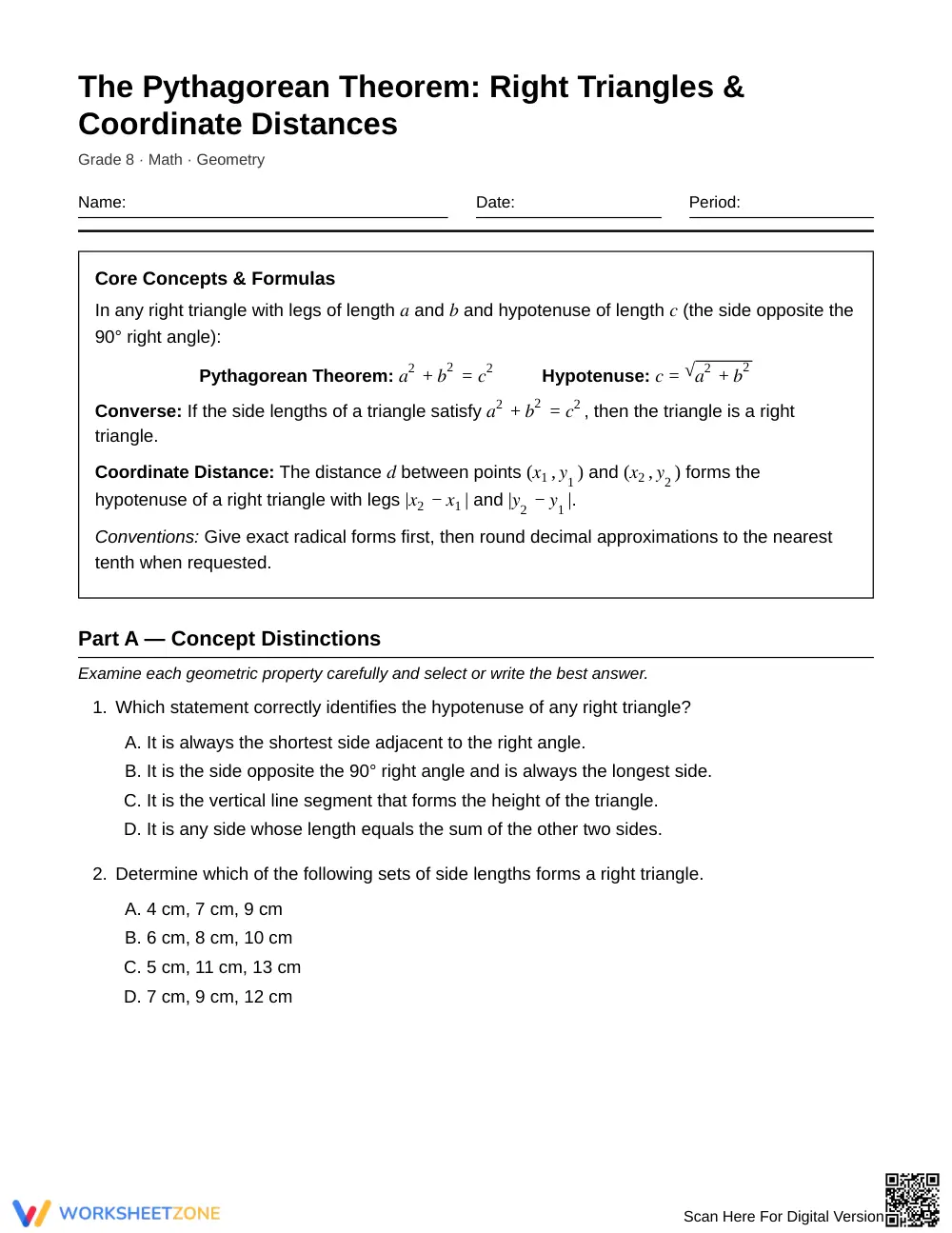
This 5-page worksheet opens with a core formula review box outlining the theorem, converse properties, and coordinate distance relationship. Students encounter 4 concept evaluation items, 8 computation and word problem applications, and 4 multi-step explanation tasks with coordinate geometry figures, supported by a 2-page detailed answer key showing full algebraic steps.
Skill Progression
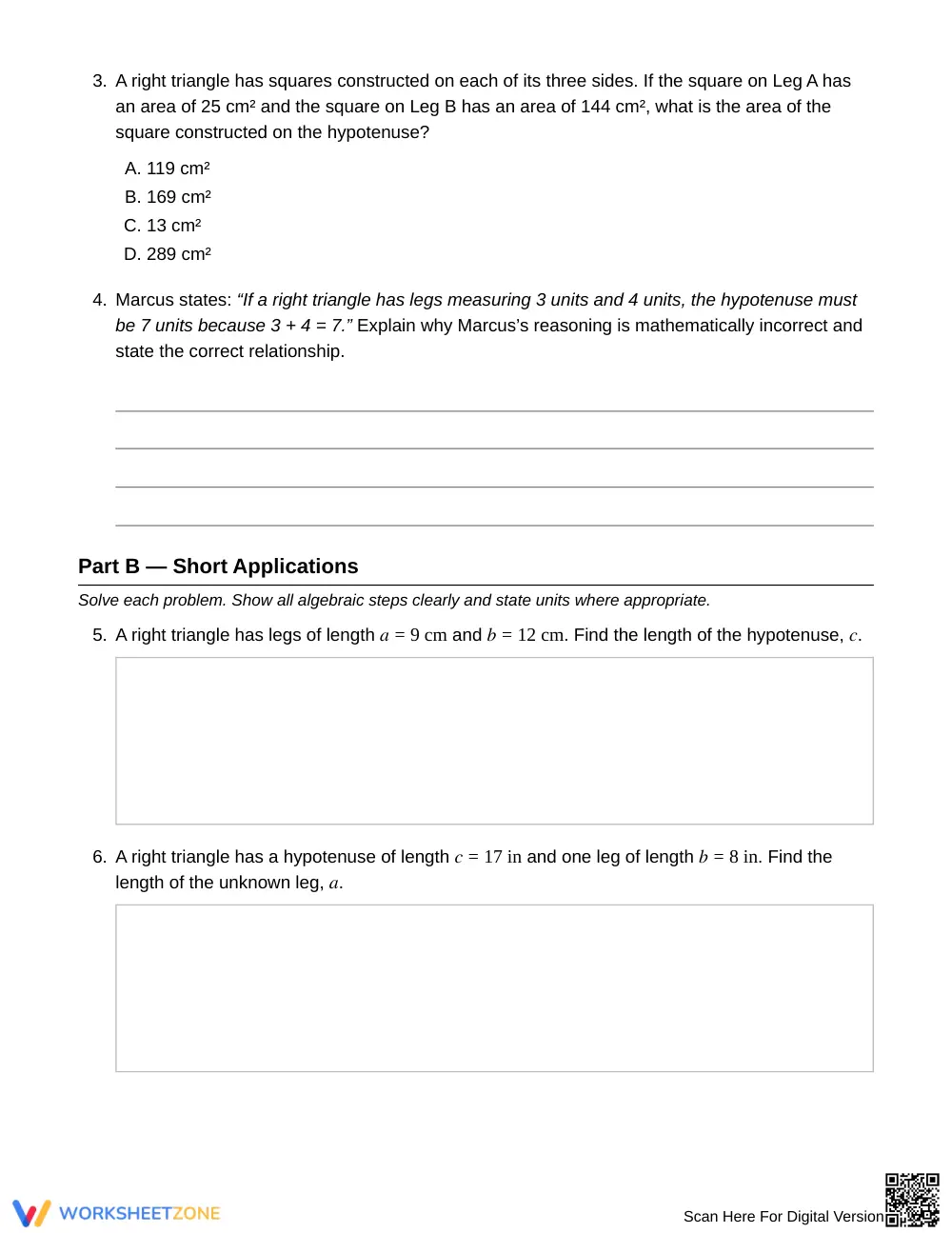
- Guided Practice (Part A): 4 conceptual diagnostic questions target side relationships, the hypotenuse definition, Pythagorean triples identification, and analyzing common misconceptions.
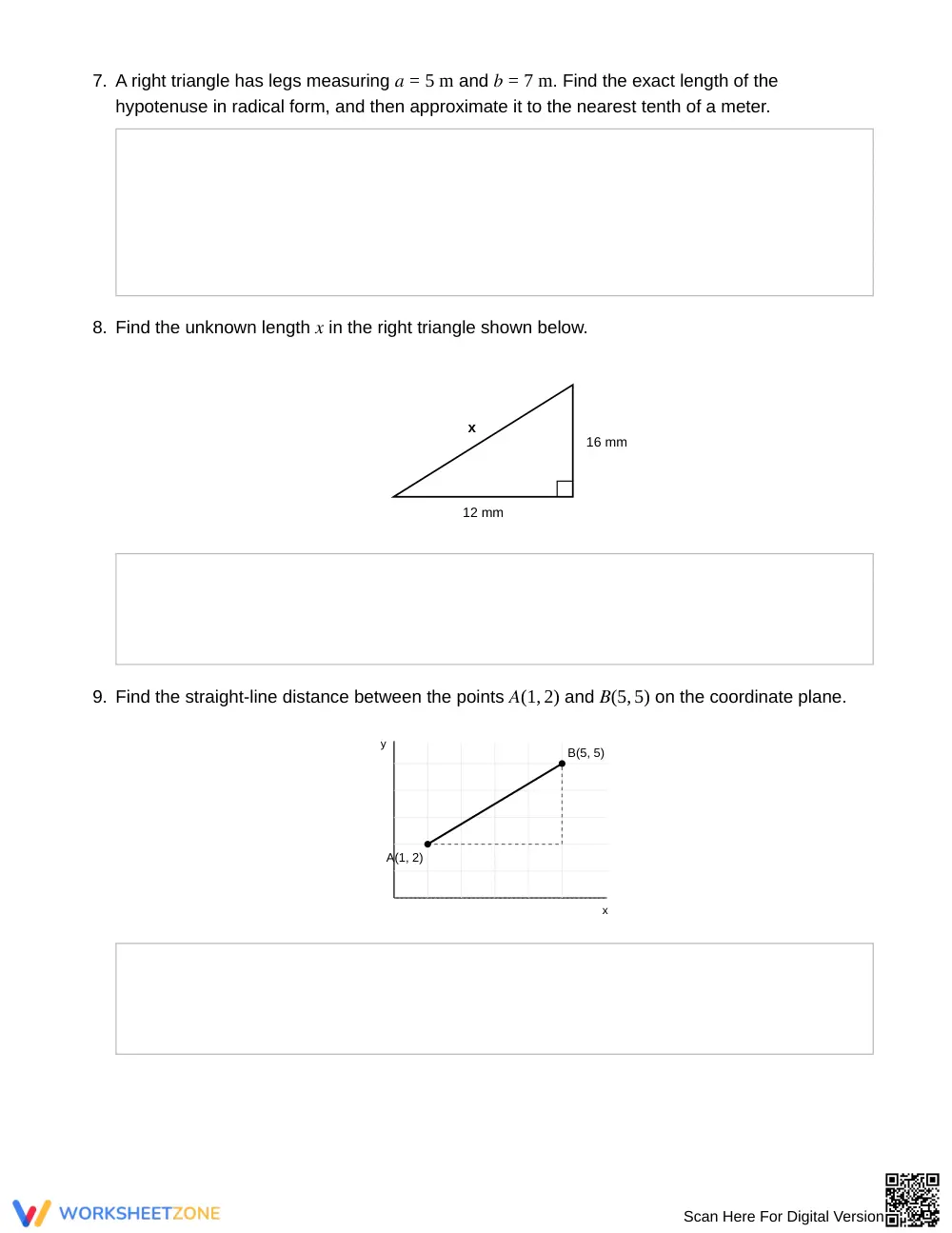
- Supported Practice (Part B): 8 targeted computational problems calculate missing legs, hypotenuses in exact radical and rounded forms, coordinate segment lengths, and real-world ladder heights.
- Independent Practice (Part C): 4 rigorous transfer items challenge learners to determine 2D perimeters, calculate 3D interior space diagonals, and derive the coordinate distance formula.
This sequence follows a gradual-release instructional model that transitions learners from foundational recall to complex multi-step spatial reasoning.
Standards Alignment
The activities align directly with Grade 8 geometry standards requiring students to explain proofs of the Pythagorean Theorem, apply it to determine unknown side lengths in real-world contexts, and calculate distances between points in a coordinate system. These curriculum objectives integrate directly into lesson plans, IEP goals, or district curriculum mapping tools.
How to Use It
Deploy this resource during independent practice following direct instruction on right triangle formulas, or assign Parts A and B as a structured mid-unit formative check. While students work through Part B, observe whether they correctly square legs before taking the square root rather than adding linear lengths. The full 16-item resource is designed for a 40 to 50 minute class session or split homework assignment.
Who It's For
This worksheet serves Grade 8 geometry students and high school review classes. The embedded formula box provides essential access for emerging bilingual learners and students requiring reference accommodations. Pair this activity with an interactive coordinate grid lesson or 3D geometric solid models to reinforce spatial visualization.
According to research synthesized by Fisher & Frey (2014) on the gradual release of responsibility, structured progression from conceptual identification to independent multi-step modeling significantly strengthens mathematical retention and problem-solving transfer. This 16-task resource operationalizes right triangle geometry and hypotenuse calculations across three progressive tiers. By first evaluating foundational triangle properties, progressing through 8 targeted computational tasks including coordinate distance formulas, and concluding with 4 complex real-world and 3D spatial transfer items, learners develop both procedural accuracy and conceptual depth. The resource reinforces core geometric principles, equipping Grade 8 students to justify geometric arguments, avoid common additive misconceptions, and calculate exact radical distances with precision. Educators can utilize the included multi-step solutions to provide immediate corrective feedback during classroom practice.


