































Ready Parks & Rec Word Search | Grades 6–7 Social Studies

Paste this activity's link or code into your existing LMS (Google Classroom, Canvas, Teams, Schoology, Moodle, etc.).
Students can open and work on the activity right away, with no student login required.
You'll still be able to track student progress and results from your teacher account.
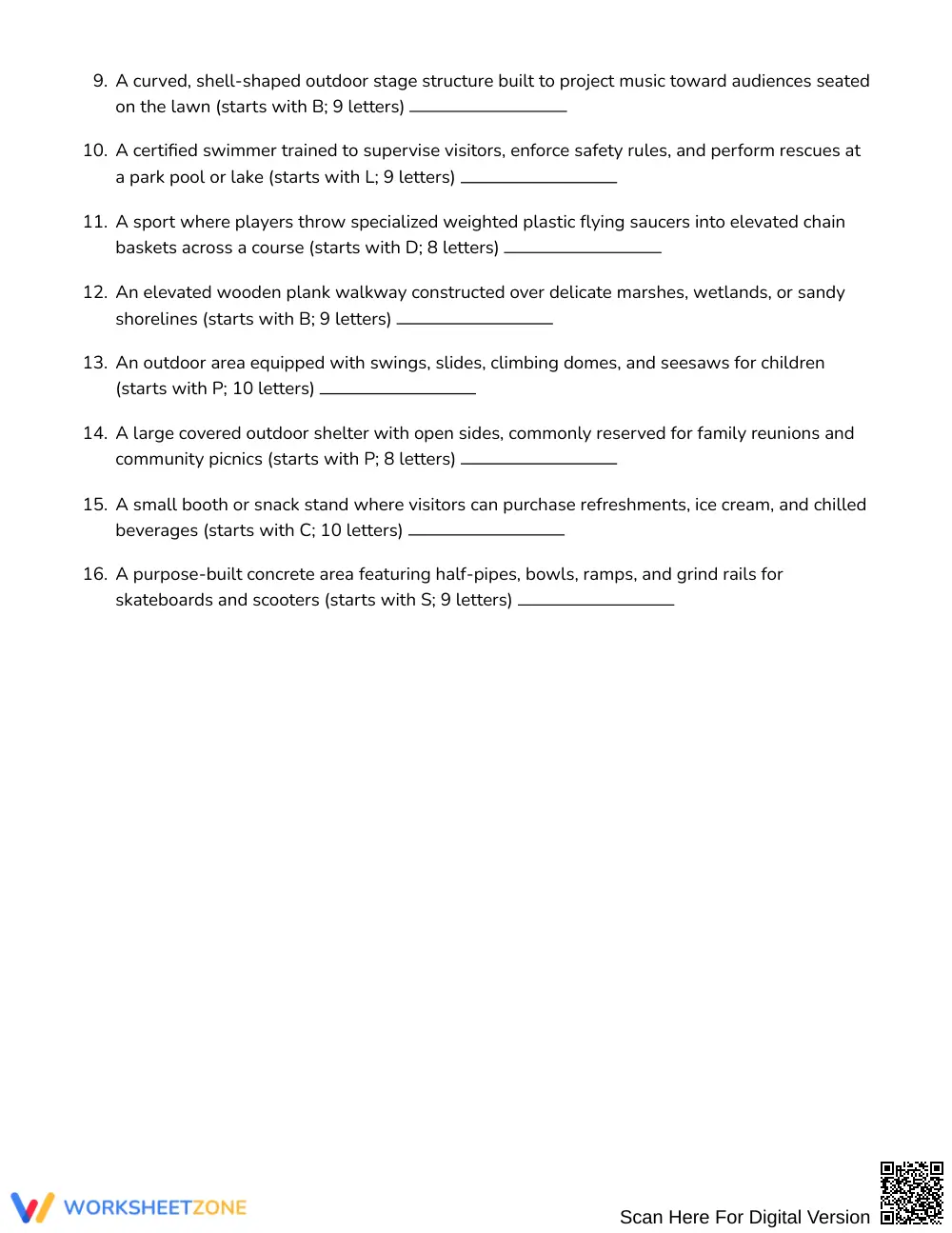
This community and culture word search engages Grades 6–7 students in discovering 16 essential local parks and recreation terms. Learners read descriptive definitions to deduce target vocabulary before scanning the puzzle grid. The activity reinforces civic geography and public infrastructure knowledge while developing critical reading comprehension and spatial recognition skills.
At a Glance
- Grade: Grades 6–7 · Subject: Middle School Social Studies
- Standard: Not standards-assessed — vocabulary enrichment and civic space recognition
- Skill Focus: Local parks and recreation vocabulary and concepts
- Format: 3 pages · 16 words · Full answer key included · Printable PDF
- Best For: Independent practice, vocabulary enrichment, and early finisher work
- Time: 25–35 minutes
What's Inside
This 3-page printable PDF features an engaging vocabulary challenge paired with a comprehensive 4-page answer key. Rather than relying on a simple word bank, the activity presents 16 clue-based definitions describing civic spaces and amenities, such as splashpads, arboretums, and greenways. Students must analyze each clue to identify the correct vocabulary term before searching the grid.
Puzzle Mechanics
The puzzle features a challenging 18-by-18 letter grid containing 16 hidden words. To promote active recall, no word bank is provided; students rely entirely on content clues to determine each term. Words are hidden in all eight directions: north, northeast, east, southeast, south, southwest, west, and northwest, providing an engaging cognitive workout that rewards sustained attention.
Standards Alignment
This activity serves as supplemental vocabulary enrichment and is not aligned to a specific state or national content standard. It is designed to reinforce social studies literacy, civic geography concepts, and environmental awareness by introducing middle school learners to the specialized terminology used in community park management and public recreation infrastructure.
How to Use It
Deploy this word search during a community institutions unit to reinforce new terminology after direct instruction, or assign it as an independent extension task for early finishers. During work time, circulate to observe whether students deduce terms directly from the contextual clues or need scaffolded hints. The activity typically takes between 25 and 35 minutes to complete.
Who It's For
This puzzle is tailored for middle school learners in Grades 6–7 studying community infrastructure and local culture. To support striving readers, teachers can highlight key clue phrases or supply the first letter of each term. Pair this resource with a local municipal map analysis or a civic park planning project to extend student learning.
Clue-based vocabulary puzzles foster active retrieval practices that strengthen domain-specific vocabulary acquisition and contextual reading comprehension. According to Fisher & Frey (2014), intentional exposure to specialized academic language across content areas substantially improves student comprehension of complex social studies texts. When middle school students decipher descriptive clues to deduce civic terminology—such as identifying arboretums, greenways, and nature centers—they engage in deeper semantic processing than traditional rote memorization promotes. The August Local Parks and Recreation Word Search provides Grades 6–7 students with targeted practice identifying 16 key recreational infrastructure terms within an 18-by-18 grid. Eliminating the word bank requires learners to actively generate answers from conceptual definitions before scanning multiple letter orientations, which consolidates spelling patterns and lexical memory. This balanced approach to vocabulary enrichment supports independent learning and builds foundational civic literacy across diverse educational settings.


