































Ready Parallel Circuit Steps Worksheet | Grade 8-12 Science

Paste this activity's link or code into your existing LMS (Google Classroom, Canvas, Teams, Schoology, Moodle, etc.).
Students can open and work on the activity right away, with no student login required.
You'll still be able to track student progress and results from your teacher account.
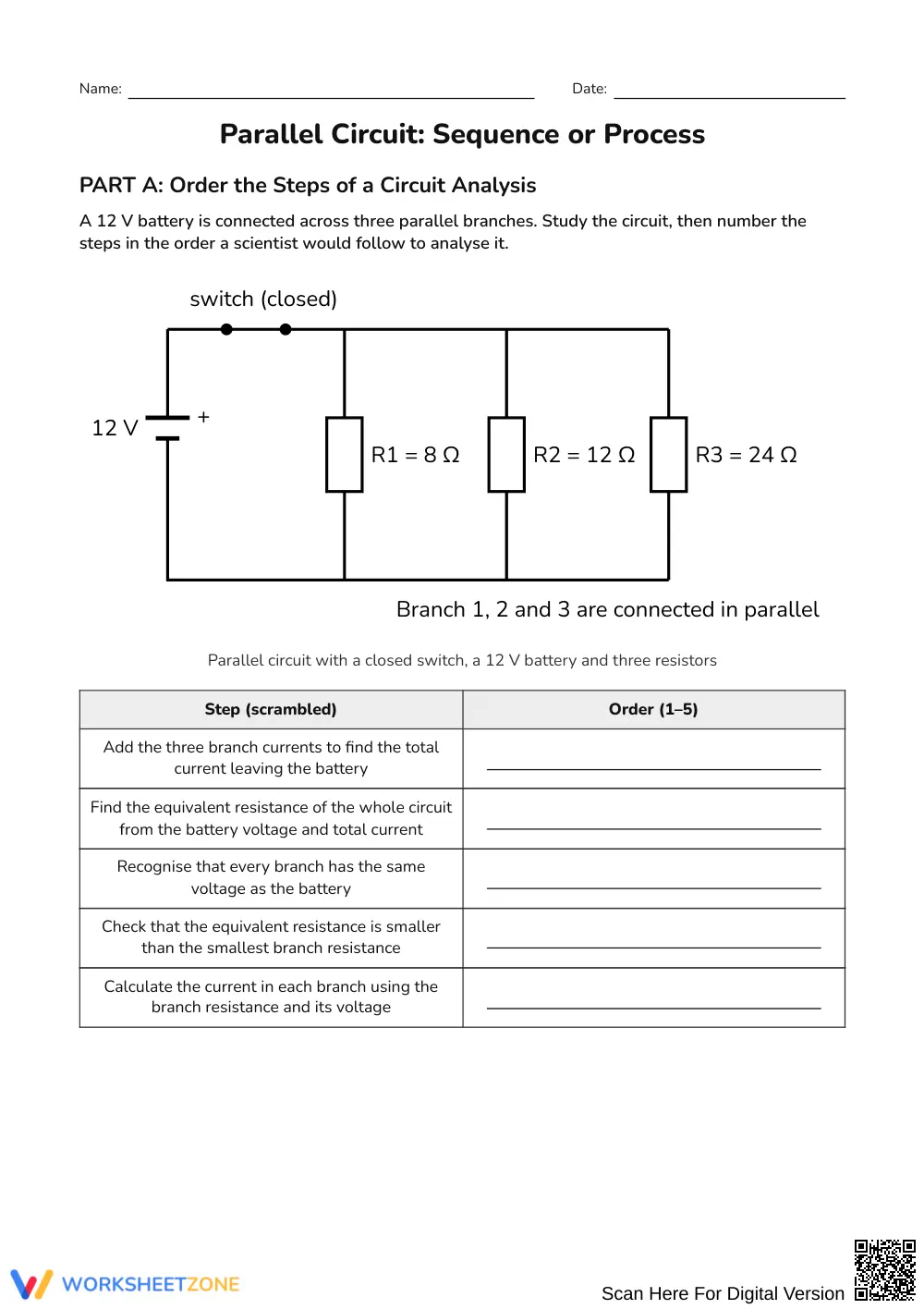
This 3-page science worksheet equips Grade 8–12 students to analyze parallel circuits through an explicit, multi-step process. Across 25 structured tasks, students sequence analysis stages, apply Ohm's law to branch circuits, and calculate equivalent resistance. The resource ensures learners understand why branch voltage remains constant before calculating currents.
At a Glance
- Grade: Grades 8–12 · Subject: Science
- Standard: Physical Science — Order circuit analysis stages, compute branch currents, and calculate equivalent resistance
- Skill Focus: Parallel Circuit Sequence and Process Analysis
- Format: 3 pages · 25 problems · Answer key included · PDF
- Best For: Secondary physics guided practice and review
- Time: 40–50 minutes
What's Inside
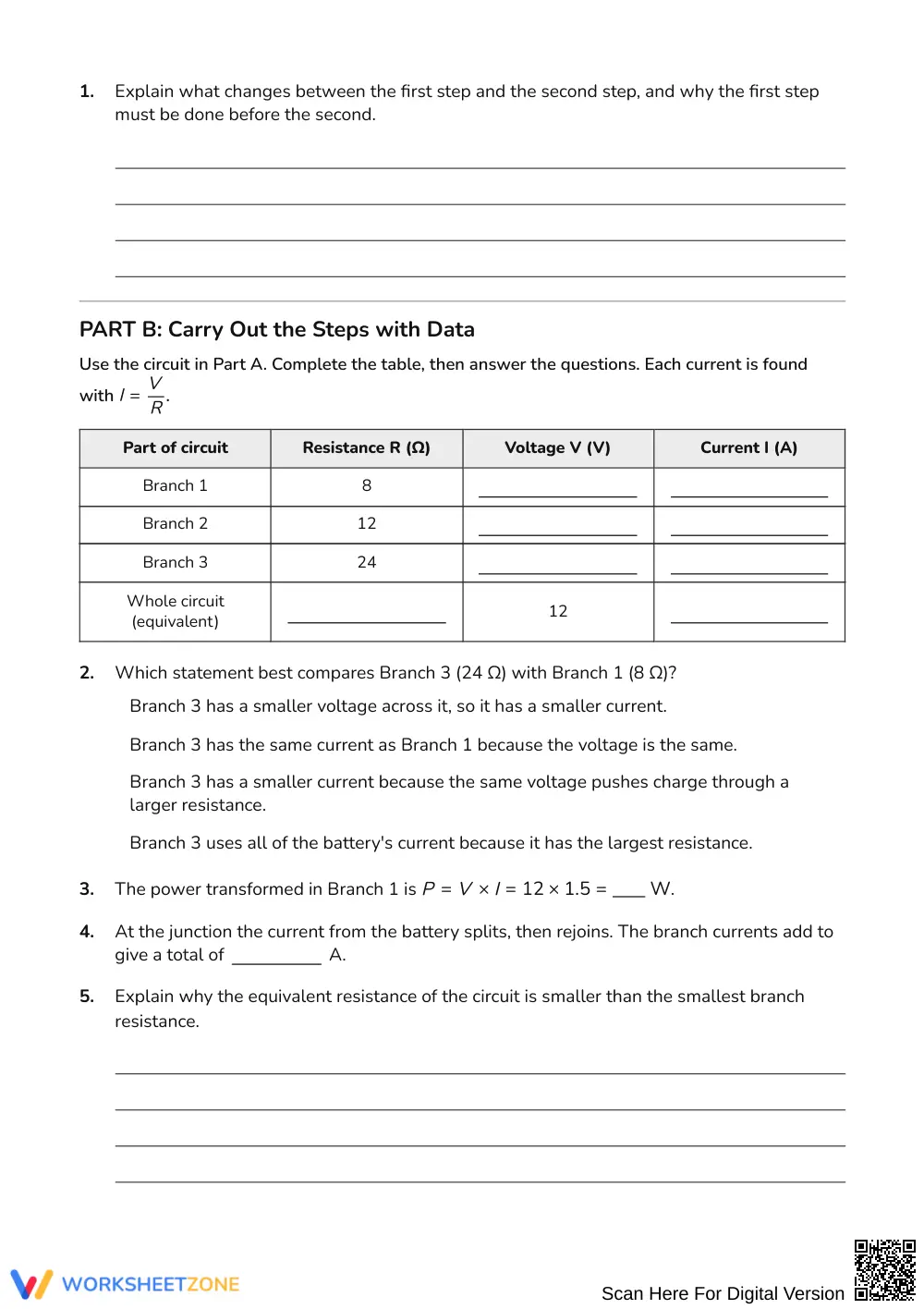
The worksheet contains 25 problems organized across three student pages, paired with a complete 3-page answer key. Part A presents a scrambled five-step analytical procedure for students to sequence and justify. Part B provides a structured data table using Ohm's law (I = V/R) across three circuit branches, coupled with comparative multiple-choice items and power calculations. Part C features a cause-and-effect chain evaluating how adding branches alters total resistance and current.
Skill Progression
- Guided practice (Part A, 6 tasks): Students order the five procedural steps of parallel circuit analysis and write short responses explaining why identifying branch voltage must precede current calculations.
- Supported practice (Part B, 10 tasks): Students complete guided calculations in a branch data table, determine equivalent resistance, and analyze power transformations using given circuit values.
- Independent practice (Part C, 9 tasks): Students independently trace a cause-and-effect sequence when an additional branch is added, calculating new circuit totals and explaining why existing branch currents remain unchanged.
This progression mirrors the gradual-release framework, moving learners from conceptual sequencing to quantitative execution and independent systemic reasoning.
Standards Alignment
This worksheet addresses secondary physical science standards on electric circuits, Ohm's law, and conservation of energy. Students investigate how current divides across parallel paths while branch voltage remains identical to source potential. Both standard codes can be copied directly into lesson plans, IEP goals, or district curriculum mapping tools.
How to Use It
Use this worksheet following direct instruction on circuit terminology and Ohm's law. For whole-class practice, guide students through Part A before assigning Parts B and C for collaborative or independent completion. For formative assessment, examine student responses explaining why total resistance decreases when branches are added. Expected completion time is 40 to 50 minutes.
Who It's For
This resource is designed for Grade 8–12 physical science and physics students studying direct-current circuits. To support struggling learners, provide a circuit diagram with labeled junction nodes. Pair this activity with a virtual circuit simulator or hands-on breadboard lab to reinforce concrete physical connections.
Research on cognitive instructional design by Fisher & Frey (2014) highlights that structuring multi-step scientific procedures into explicit, sequential phases significantly enhances conceptual understanding and procedural retention. This 3-page science worksheet targets parallel circuit analysis across 25 scaffolded tasks for Grade 8–12 classrooms. Students learn the foundational sequence of circuit analysis, establishing uniform branch voltage before applying Ohm's law to determine individual branch currents and calculate equivalent resistance. By moving from procedural ordering to quantitative table completion and cause-and-effect predictions, learners connect mathematical calculations to physical circuit properties. Students analyze why equivalent resistance drops below individual branch values and why adding new branches leaves existing currents unchanged. Accompanied by a 3-page answer key with step-by-step solutions, this resource delivers an authoritative, standards-aligned practice tool for secondary physics instruction, targeted remediation, and formative assessment across district science curricula.


