

































Ready Organizing Information Worksheet | Grade 9 English I

Paste this activity's link or code into your existing LMS (Google Classroom, Canvas, Teams, Schoology, Moodle, etc.).
Students can open and work on the activity right away, with no student login required.
You'll still be able to track student progress and results from your teacher account.
This Grade 9 informational writing worksheet equips students to organize archival evidence according to reader need. Simulating a museum curation scenario, learners evaluate audience cognitive load, draft qualified claims, and sequence informational panels to convert dense historical records into an accessible, cohesive community exhibit guide.
At a Glance
- Grade: 9 · Subject: English I
- Standard: Informational Writing — Organize complex ideas and evidence clearly to meet audience cognitive needs
- Skill Focus: Organize Information by Reader Need
- Format: 6 pages · 8 problems · Answer key included · PDF
- Best For: Curating evidence in informational essays
- Time: 45–60 minutes
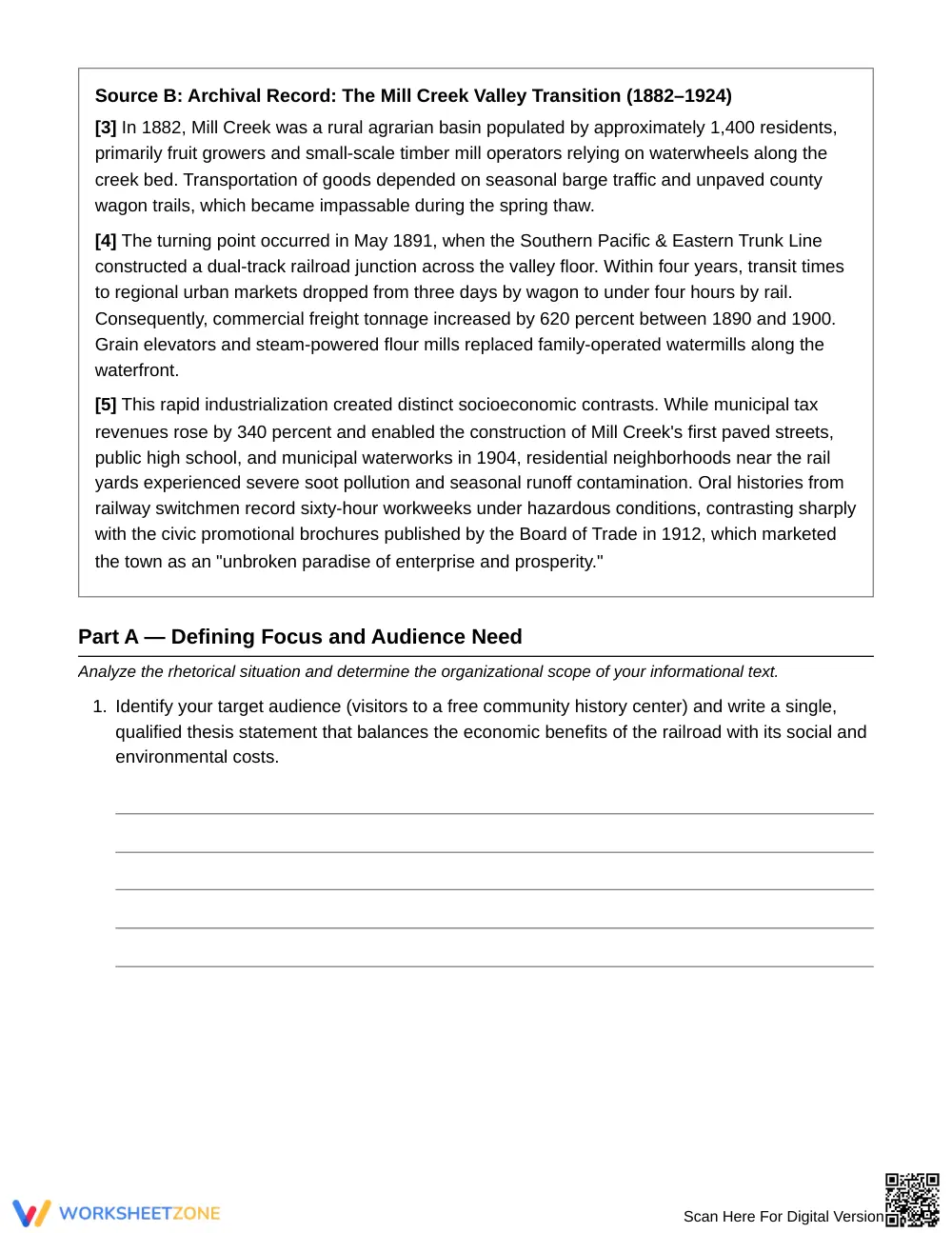
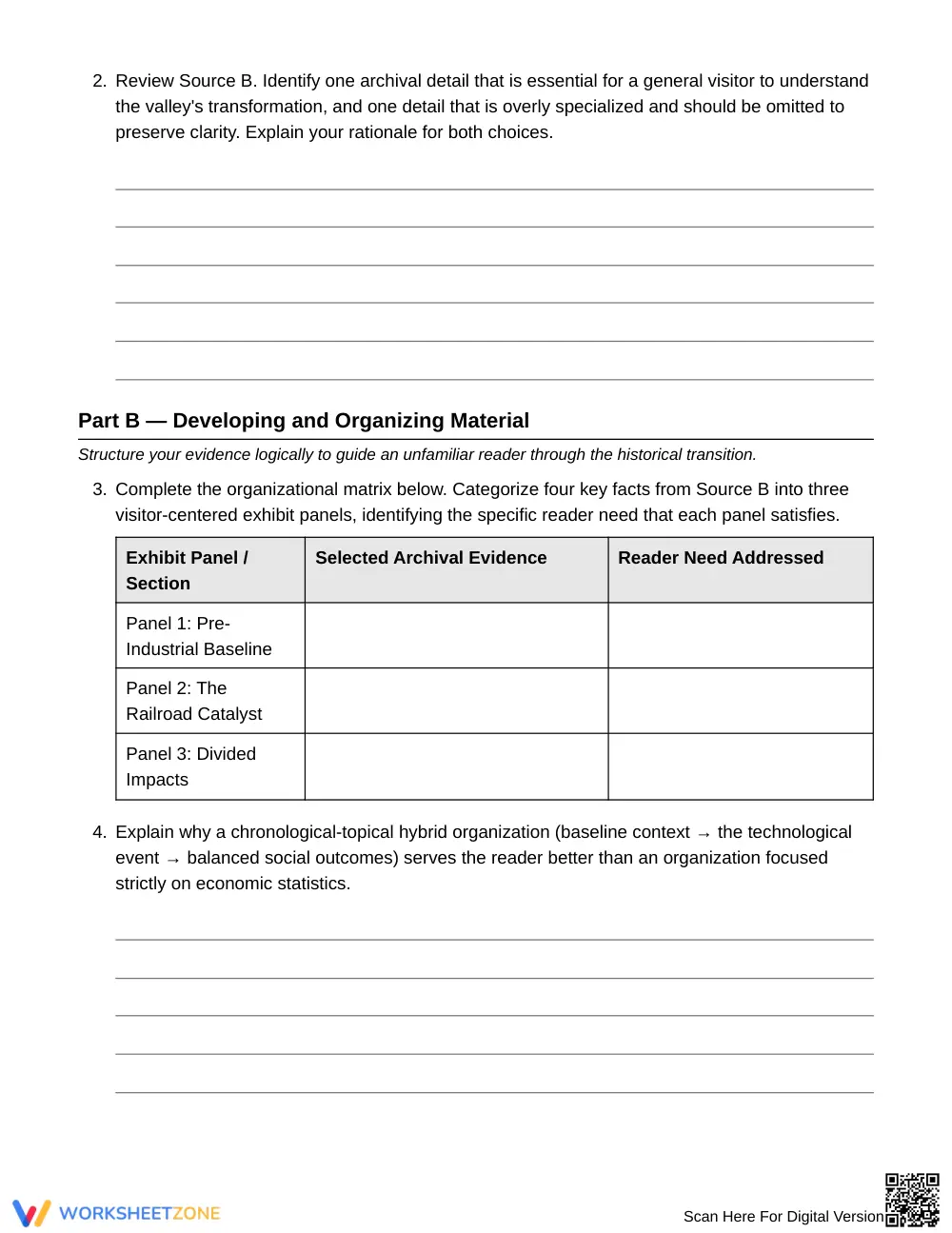
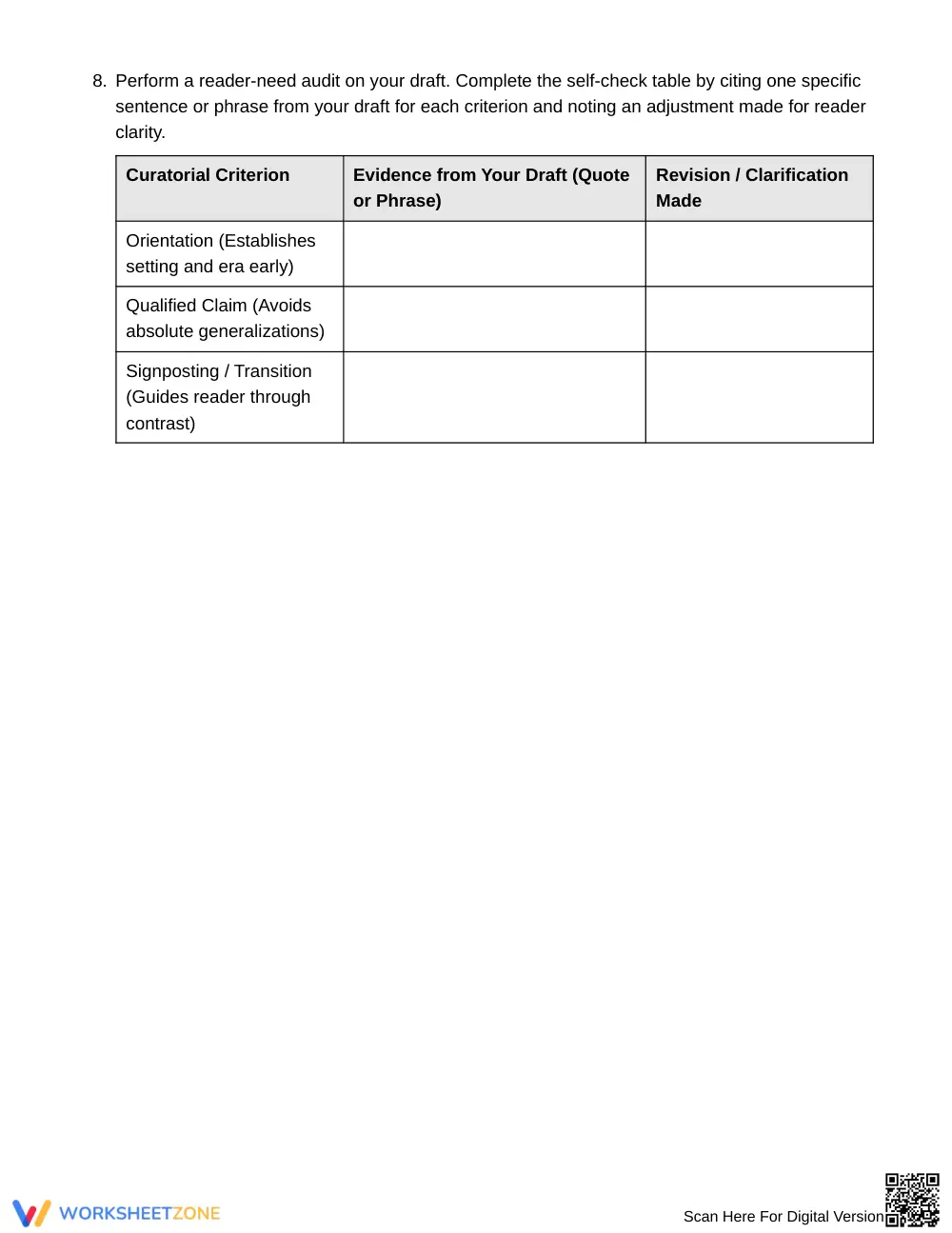
What's Inside features a curatorial framework paired with two source texts: a guide on exhibit curation and an archival history of Mill Creek Valley. Across 6 pages, students complete 8 tasks spanning prompt deconstruction, an exhibit matrix, sentence revision, and extended writing. The worksheet incorporates planning reminders, a self-assessment audit table, and an annotated 6-page answer key with model responses.
Skill Progression
- Guided practice (Part A, Tasks 1–2): Students analyze audience cognitive thresholds using curation principles, establishing a focused thesis and distinguishing essential historical context from specialized clutter.
- Supported practice (Part B, Tasks 3–6): Learners complete a visitor-centered matrix, justify chronological-topical sequencing, rewrite absolute claims into qualified assertions, and craft transitional topic sentences.
- Independent practice (Part C, Tasks 7–8): Students draft a 300–400 word gallery guide and execute a reader-need audit using text-based self-assessment criteria.
This progression embodies gradual release, shifting evaluative decision-making from guided rhetorical analysis to autonomous informational synthesis.
Standards Alignment
This resource aligns with Grade 9 informational writing standards requiring students to organize complex ideas and evidence clearly so that each element builds toward a unified whole. It targets audience awareness, structural signposting, and qualified argumentation. Both standard concepts can be copied directly into lesson plans, IEP goals, or district curriculum mapping tools.
How to Use It
Deploy this activity during the drafting phase of an informational writing unit. First, use Parts A and B as a collaborative workshop following instruction on text organization; observe how student pairs balance historical contrasts in the matrix. Second, assign Part C as an independent writing task. Expected completion time is 45 to 60 minutes.
Who It's For
This worksheet serves Grade 9 English I classrooms and secondary writers who struggle to synthesize research without oversimplifying or dumping data. Structured matrices and revision prompts support developing writers, while high-level analytical curation challenges advanced learners. Pair this activity with an anchor chart on transitional signposting.
Secondary literacy research underscores that novice informational writers frequently struggle to prioritize information based on audience comprehension, often defaulting to chronological narration or indiscriminate data listing. According to Fisher & Frey (2014), intentional writing instruction requires guided analytical frameworks that prompt students to evaluate audience knowledge states before and during text production. This Grade 9 instructional resource operationalizes those findings by immersing learners in a curation model where they must deliberately sequence historical baselines, catalytic events, and divided social outcomes. Through eight scaffolded tasks, students practice selecting essential evidence, rejecting extraneous technical details, qualifying causal assertions, and evaluating their own drafts against objective clarity benchmarks. By coordinating structural signposting with audience awareness, the lesson develops disciplined informational composition skills that directly improve essay coherence and evidentiary synthesis across secondary language arts curricula.


