































Ready North Capitals Word Search | Grades 4–5 Social Studies

Paste this activity's link or code into your existing LMS (Google Classroom, Canvas, Teams, Schoology, Moodle, etc.).
Students can open and work on the activity right away, with no student login required.
You'll still be able to track student progress and results from your teacher account.
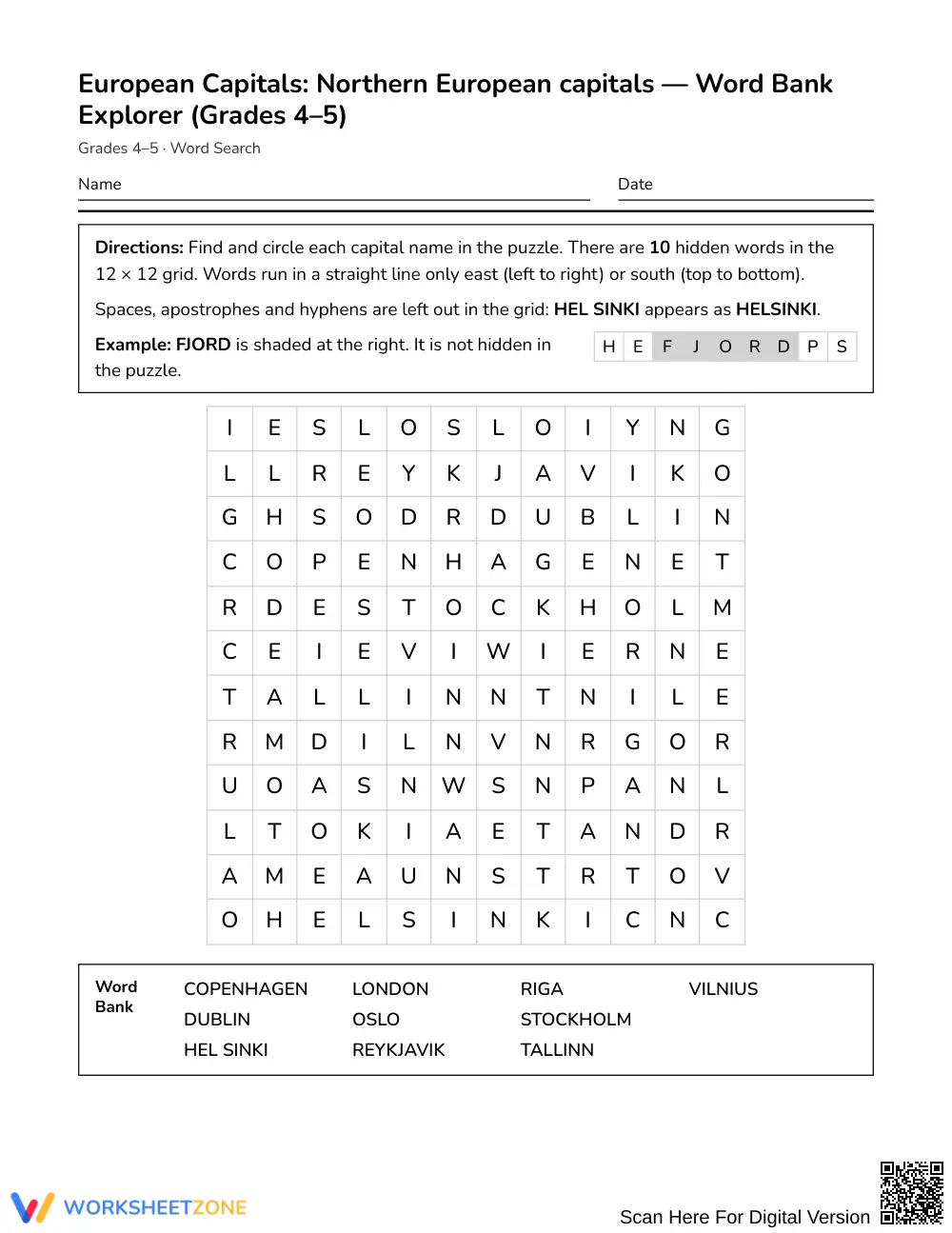
This Grades 4–5 geography word search builds regional spatial awareness by challenging students to locate 10 Northern European capitals. Learners search for key national capitals across Scandinavia, the Baltic region, and the British Isles, reinforcing correct place-name spelling and European geography knowledge through focused visual scanning and active vocabulary recognition.
At a Glance
- Grade: Grades 4–5 · Subject: Social Studies
- Standard: Not standards-assessed — vocabulary enrichment
- Skill Focus: Northern European capitals
- Format: 1 page · 10 words · Answer key included · PDF
- Best For: Fast-finisher enrichment and sub plans
- Time: 15–20 minutes
Inside, educators will find a clean, ready-to-print one-page activity sheet featuring an alphabetical word bank and a clearly formatted letter grid. The resource targets 10 Northern European capitals, accompanied by a detailed two-page answer key that highlights exact letter placements so teachers or peer checkers can verify student work in seconds.
Designed for independent accessibility, this puzzle features a 12 × 12 letter grid. Hidden vocabulary terms run in two primary orientations: horizontally from left to right (East) and vertically downward (South). An alphabetical word bank lists all 10 target capitals, ensuring elementary learners can systematically track their progress while scanning rows and columns without getting frustrated by backwards or diagonal placements.
This educational activity is designed strictly for vocabulary enrichment and spatial orientation in upper-elementary geography; it is not formally aligned to Common Core State Standards or tested state benchmarks. Teachers can incorporate the activity alongside regional mapping units to strengthen country-and-capital associations without the burden of complex formal rubric criteria.
Deploy this puzzle during a regional geography unit as an introductory discovery task before direct instruction or as an independent review station directly following a continent-mapping lesson. As students search, observe whether they locate initial letters or scan systematic rows, noting which learners need additional scaffolding with country-capital pairs. Expect the puzzle to take between 15 and 20 minutes.
This resource serves fourth and fifth graders developing foundational European geography literacy, as well as English language learners practicing multisyllabic place names. Pair this activity with a physical political map of Europe or an atlas reference sheet to reinforce real-world geographical context as students identify each capital city.
According to Fisher & Frey (2014), purposeful vocabulary acquisition relies on multiple low-stakes exposures that connect unfamiliar domain-specific terminology with active visual processing. While standard-aligned direct instruction provides primary conceptual delivery, supportive enrichment activities like word puzzles offer essential repetition that solidifies orthographic memory and domain-specific lexicon retention. In upper-elementary geography, students frequently struggle to memorize and accurately spell foreign place names such as Reykjavik, Copenhagen, and Vilnius due to atypical phonemic structures. Engaging with a dedicated 12 by 12 letter matrix enables fourth- and fifth-grade learners to repeatedly analyze letter clusters in context without cognitive overload. This targeted exposure reinforces spelling accuracy, builds cognitive automaticity, and anchors spatial recall when paired with classroom maps. By providing structured print-and-go practice, this enrichment worksheet supports independent retention and ensures that foundational global geography terms become familiar, lasting components of each student's functional academic vocabulary.


