































Ready Net Ionic Equations Worksheet | Grades 9-12 Science

Paste this activity's link or code into your existing LMS (Google Classroom, Canvas, Teams, Schoology, Moodle, etc.).
Students can open and work on the activity right away, with no student login required.
You'll still be able to track student progress and results from your teacher account.
This chemistry worksheet helps high school students master writing net ionic equations and interpreting aqueous reactions through visual and quantitative evidence. Students progress from solubility recall to interpreting submicroscopic particle diagrams, stoichiometric precipitation data, and thermochemical neutralization measurements, building a complete conceptual understanding of ionic processes.
At a Glance
- Grade: Grades 9–12 · Subject: Science (Chemistry)
- Standard: Write balanced net ionic equations and explain precipitation and neutralization changes
- Skill Focus: Net ionic equations and particle representations
- Format: 4 pages · 21 problems · Answer key included · PDF
- Best For: Guided chemistry practice and data analysis
- Time: 45–60 minutes
What's Inside
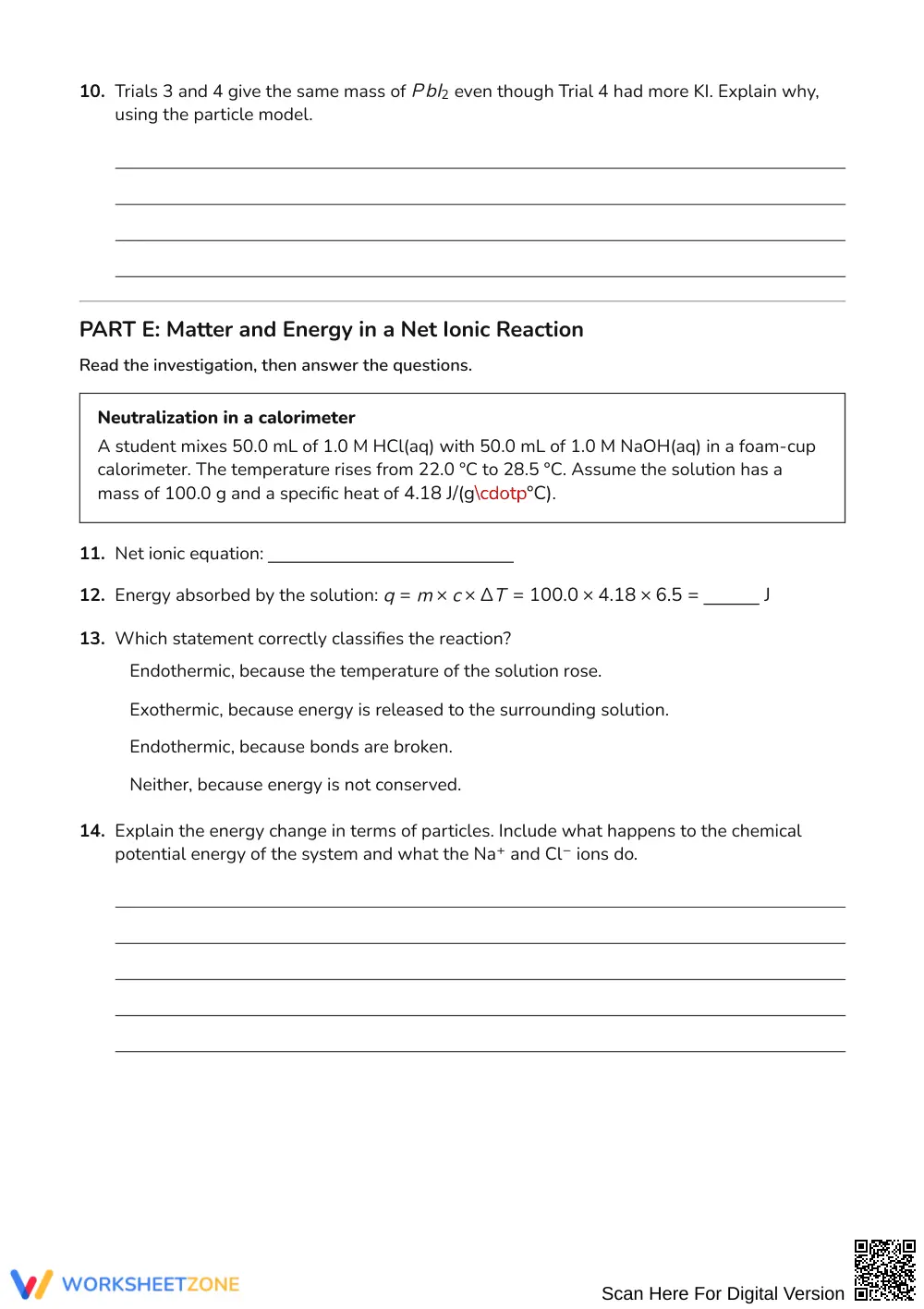
This 4-page worksheet includes 21 scaffolded tasks organized into five parts, supported by a 4-page answer key with worked solutions. Students use an embedded solubility table and worked examples before predicting products and drafting net ionic equations. Tasks feature submicroscopic particle diagrams, gravimetric precipitation data tables, and a coffee-cup calorimeter investigation.
Skill Progression
- Guided practice (Tasks 1–4): Students review solubility rules and complete scaffolded equations using a three-step framework that identifies spectator ions.
- Supported practice (Tasks 5–12): Students analyze particulate diagrams and predict reaction products, explaining why specific ion mixtures yield no net reaction.
- Independent practice (Tasks 13–21): Students analyze gravimetric data to establish stoichiometric ratios and evaluate calorimeter data to explain energy conservation.
This sequence implements a gradual-release model, advancing learners from direct recall to independent scientific explanation.
Standards Alignment
This worksheet aligns directly with high school physical science standards for chemical reactions. Students construct molecular, complete ionic, and net ionic equations demonstrating that matter and charge are conserved. Learners also correlate macroscopic observations with microscopic particulate diagrams and thermodynamic principles. Both standard codes can be copied directly into lesson plans, IEP goals, or district curriculum mapping tools.
How to Use It
Deploy this activity following direct instruction on solubility rules and chemical equations. For formative assessment, check student responses on Part C to confirm they understand that spectator ions remain unbonded in solution. The worksheet requires 45 to 60 minutes and works effectively as guided classwork or an independent assignment.
Who It's For
This resource supports regular and honors high school chemistry students mastering solution chemistry. Built-in scaffolds support emerging bilingual learners and students requiring accommodations, while the limiting reactant calculations provide meaningful enrichment. Pair this worksheet with an aqueous precipitation laboratory or a solubility anchor chart.
Mastering net ionic equations requires students to bridge symbolic chemical notation, macroscopic laboratory observations, and submicroscopic particle models. Educational research by Fisher & Frey (2014) emphasizes that scaffolded cognitive architecture—shifting deliberately from structured modeling to evidence-based analysis—significantly improves student conceptual understanding in advanced secondary STEM coursework. By engaging with 21 structured tasks across four pages, learners articulate why spectator ions remain dissolved, predict precipitation outcomes using systematic solubility principles, and evaluate real experimental data from gravimetric analysis and solution calorimetry. This instructional sequence reinforces essential scientific competencies: conserving charge and mass, linking macroscopic evidence to particulate behavior, and calculating mole ratios from limiting reactants. High school educators can implement this rigorous printable packet during aqueous reaction units to prepare chemistry students for complex multi-step laboratory analyses and end-of-course assessments with verifiable academic success.


