































Ready Net Ionic Equations Worksheet | Grades 9-12 Science

Paste this activity's link or code into your existing LMS (Google Classroom, Canvas, Teams, Schoology, Moodle, etc.).
Students can open and work on the activity right away, with no student login required.
You'll still be able to track student progress and results from your teacher account.
This high school chemistry worksheet guides students through writing net ionic equations for precipitation reactions. Learners analyze solubility rules, remove spectator ions, interpret particulate diagrams, and evaluate lab data across 32 structured problems. This systematic approach connects microscopic particle interactions directly to balanced symbolic equations.
At a Glance
- Grade: Grades 9–12 · Subject: Chemistry / Science
- Standard: High School Chemistry — Order reaction stages and explain particulate changes in precipitation equations
- Skill Focus: Net ionic equations and particulate models
- Format: 4 pages · 32 problems · Full answer key · PDF
- Best For: Precipitation and stoichiometry review
- Time: 45–60 minutes
What's Inside
This 4-page worksheet contains 32 scaffolded tasks across five sections. Students use a solubility reference table to order equation steps, complete molecular and net ionic equations, interpret beaker particle models, analyze precipitation lab data for limiting reactants, and calculate reaction enthalpy. A full 4-page answer key provides complete solutions.
Skill Progression
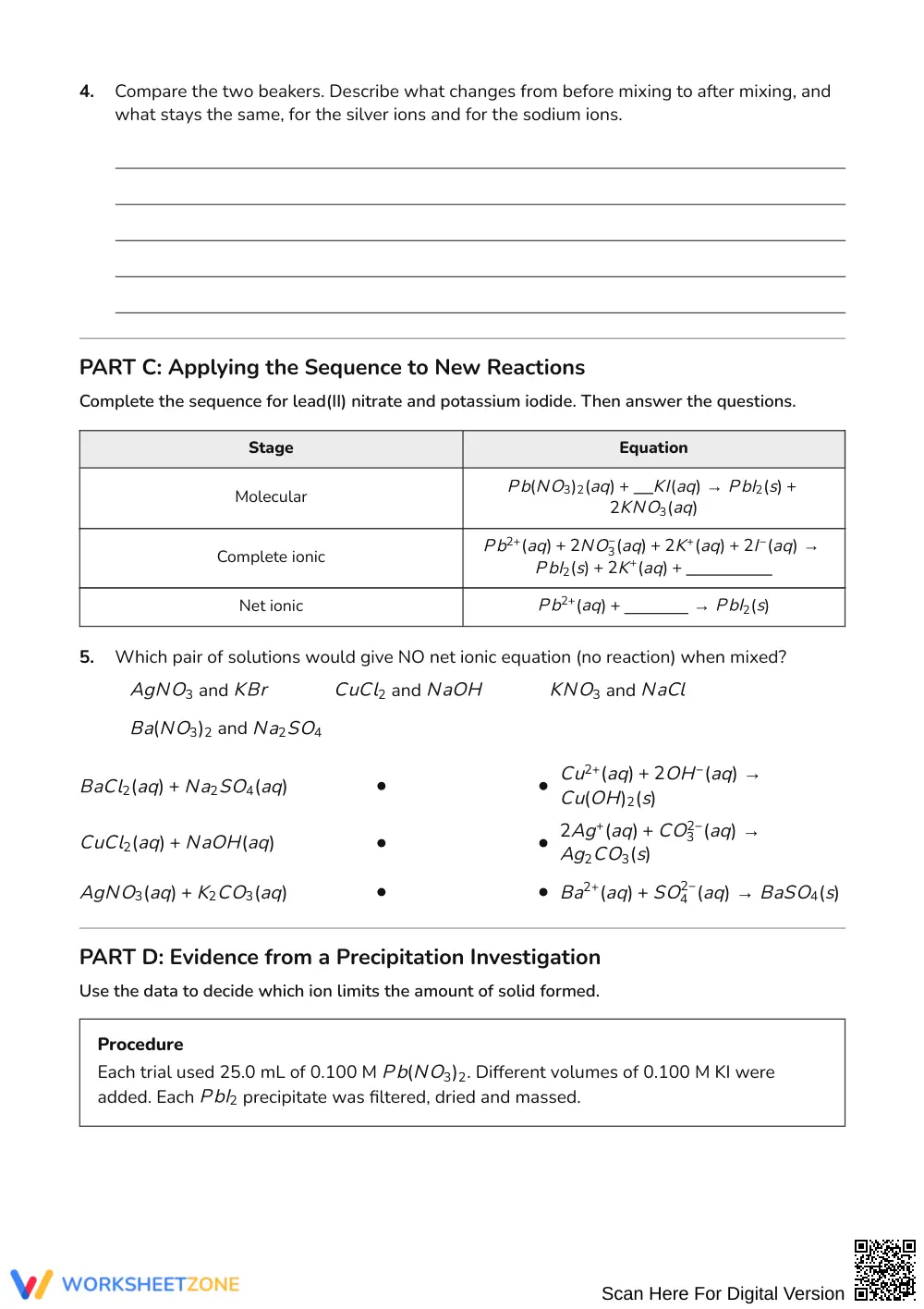
- Guided practice (Tasks 1–6): Students reference solubility rules to sequence the five procedural steps for writing net ionic equations.
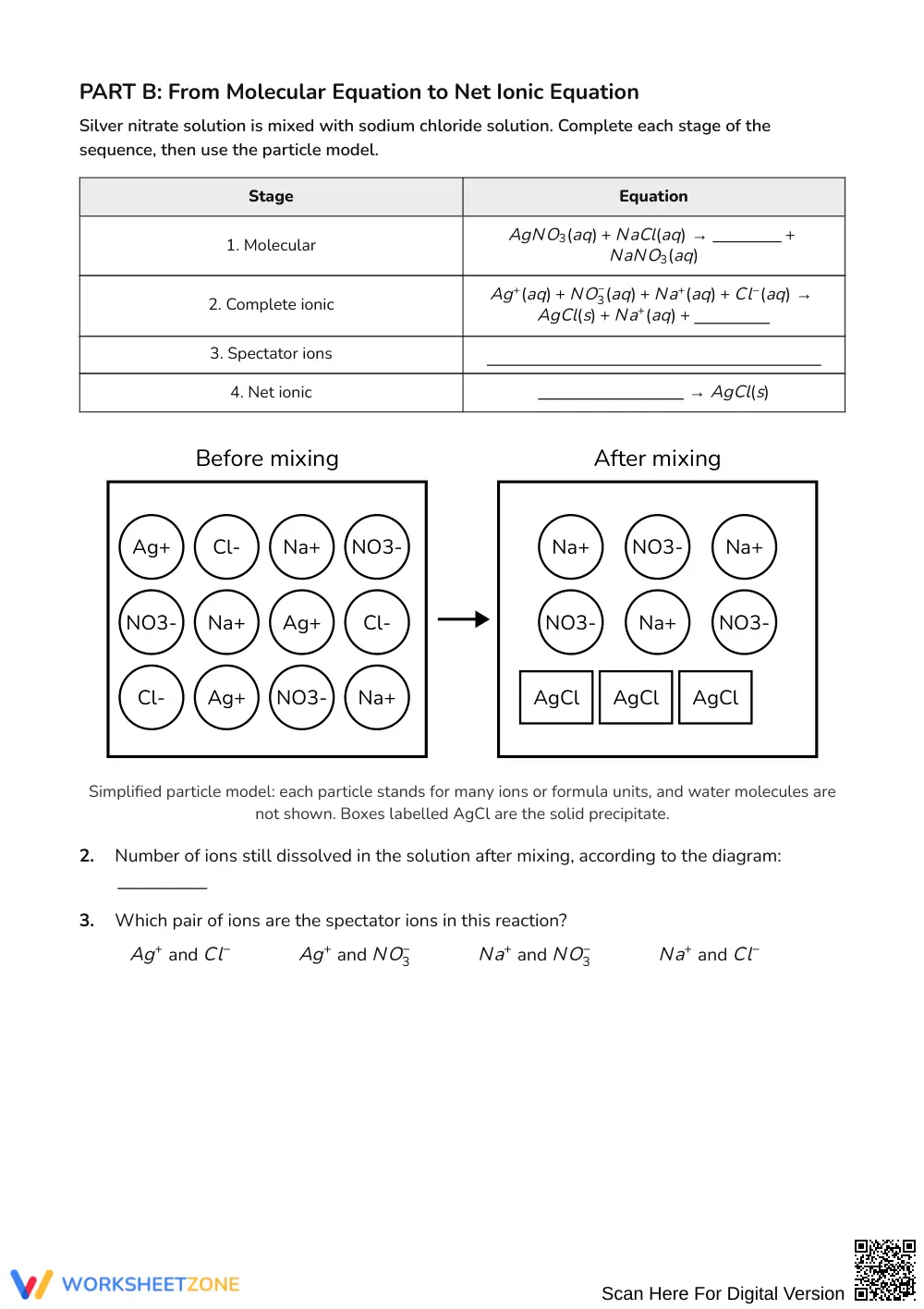
- Supported practice (Tasks 7–16): Learners complete full ionic equations, eliminate spectators, and analyze dissolved versus solid ions using particle models.
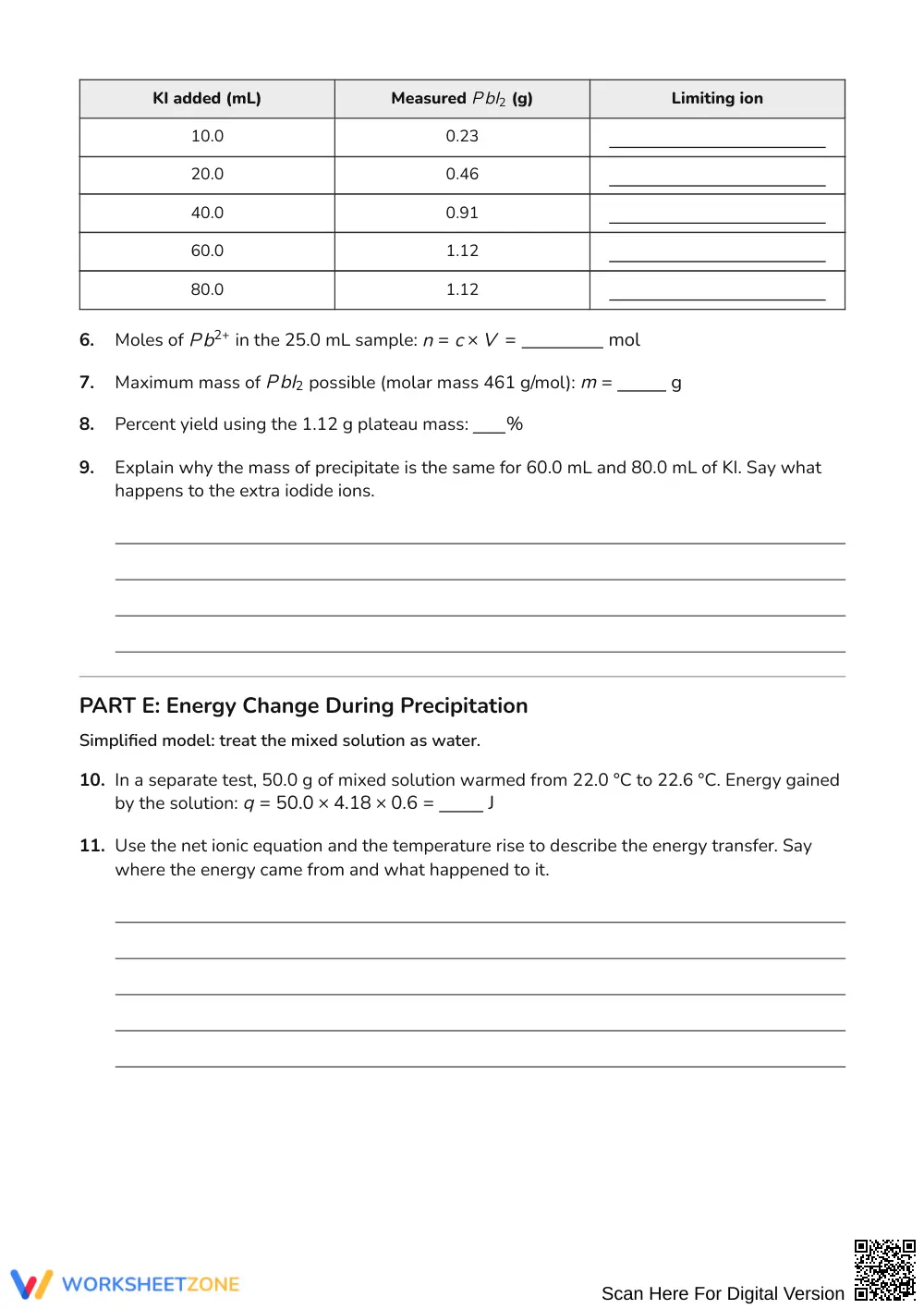
- Independent practice (Tasks 17–32): Students formulate equations independently, calculate limiting reactants and percent yield from experimental data, and explain thermochemical transfers.
This gradual release framework transitions students from procedural sequencing to authentic chemical data analysis.
Standards Alignment
This resource aligns with high school chemistry expectations governing matter interactions and chemical reactions. Tasks require students to balance charge, track spectator ions, and apply the law of conservation of matter. Both standard codes can be copied directly into lesson plans, IEP goals, or district curriculum mapping tools.
How to Use It
Assign Parts A and B during direct instruction to reinforce solubility rules and particulate representations. Then assign Parts C through E as independent practice or a lab extension. Check whether students split precipitates instead of keeping them solid. Completion requires 45 to 60 minutes.
Who It's For
This activity is designed for on-level and advanced high school chemistry students. Built-in solubility tables and step-by-step scaffolds support emerging chemists, while yield calculations challenge advanced learners. Pair this printable with a double replacement lab investigation or solubility anchor chart.
According to Fisher & Frey (2014), structured instructional frameworks that transition students from guided rule sequencing to independent conceptual transfer significantly enhance problem-solving retention in secondary science. High school chemistry curricula demand that learners bridge macro-level observations, symbolic chemical equations, and submicroscopic particle behaviors. This 4-page worksheet operationalizes that research by providing 32 scaffolded tasks focused on aqueous precipitation reactions and net ionic equations. Students progress from unscrambling methodological steps to evaluating empirical lab data, calculating stoichiometric yields, and explaining system enthalpy changes. By linking molecular, complete ionic, and net ionic representations with concrete particulate diagrams, the resource prevents common misconceptions surrounding spectator ions and precipitate stability. Educators can utilize this rigorous practice tool to verify standards-aligned mastery during double replacement reaction units while maintaining high academic expectations across diverse learning environments.


