































Ready Net Ionic Equations Worksheet | Grades 9-12 Science

Paste this activity's link or code into your existing LMS (Google Classroom, Canvas, Teams, Schoology, Moodle, etc.).
Students can open and work on the activity right away, with no student login required.
You'll still be able to track student progress and results from your teacher account.
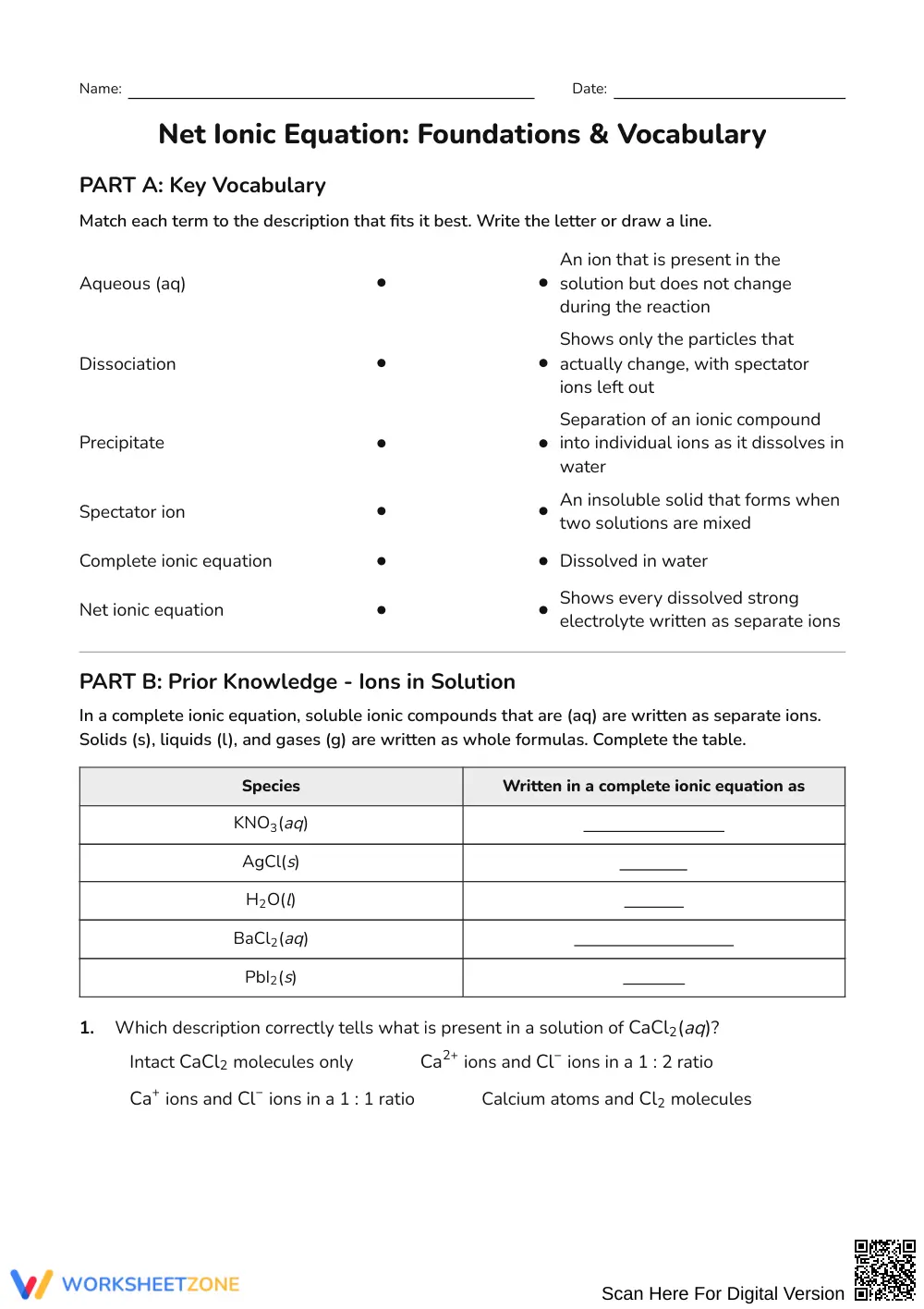
This comprehensive chemistry worksheet guides high school students through the core mechanics of precipitation reactions and net ionic equations. Learners build foundational knowledge by distinguishing soluble ions from precipitates, eliminating spectator ions, and confirming charge conservation across 29 focused tasks designed to secure prerequisite chemistry skills before advanced stoichiometry.
At a Glance
- Grade: Grades 9–12 · Subject: Science
- Standard: High School Chemistry — Write balanced net ionic equations and identify spectator ions in solution
- Skill Focus: Net ionic equation vocabulary, solubility rules, and dissociation
- Format: 4 pages · 29 problems · Answer key included · PDF
- Best For: First-time instruction and guided chemistry review
- Time: 45–60 minutes
What's Inside
This 4-page student packet features 29 structured items spanning six targeted sections. Students encounter term-matching exercises, dissociation tables, a solubility reference chart, a three-step worked example, particle-level diagram analysis, and an explicit misconception check. A complete 4-page teacher answer key provides full chemical formulas and written justifications.
Skill Progression
- Guided practice (Parts A–B, 7 tasks): Students match foundational terms and complete an ion-dissociation table with explicit formatting rules provided directly on the page.
- Supported practice (Parts C–D, 11 tasks): Learners reference an on-page solubility table and annotated particle model to identify spectator ions and write net equations.
- Independent practice (Parts E–F, 11 tasks): Students predict precipitation products, select reacting pairs, and correct a persistent conceptual error regarding spectator ion persistence.
This structured sequence follows the gradual-release model, shifting learners systematically from structured recall to unprompted chemical evaluation.
Standards Alignment
Aligned with high school physical science standards for chemical reactions, this resource requires learners to model matter conservation and ionic interactions in aqueous solutions. Students demonstrate how total charge and atom counts remain conserved across state changes. Both standard codes can be copied directly into lesson plans, IEP goals, or district curriculum mapping tools.
How to Use It
Implement this worksheet during initial instruction on aqueous reactions or directly after introducing double replacement reactions. As students complete Part D, check whether they confuse spectator ions with dissolved neutral salts. The complete packet is designed for a single 45- to 60-minute class period or two shorter targeted stations.
Who It's For
This resource supports on-level high school chemistry students, honors classes reviewing reaction fundamentals, and introductory college prep courses. Scaffolded reference tables assist struggling readers, while the particle diagram bridges abstract formulas for visual learners. Pair this packet with a microscale precipitation lab demonstration.
Mastering net ionic equations requires students to represent chemical reactions by separating dissolved electrolytes into constituent ions while eliminating spectator ions that remain unchanged throughout the aqueous reaction. According to Fisher & Frey (2014), gradual-release instructional designs that pair worked examples with sub-skill decomposition significantly reduce cognitive load during multi-step procedural tasks in high school science. This worksheet exemplifies that pedagogical approach across 29 structured items by establishing core ionic vocabulary, providing reference solubility rules, and scaffolding the translation from molecular formulas to complete and net ionic equations. By integrating a sub-microscopic particle model alongside symbolic equations, the task progression directly addresses documented misconceptions concerning matter destruction in precipitates. Consequently, secondary educators obtain verifiable formative data on whether students genuinely understand charge and mass conservation in solution chemistry, ensuring rigorous preparation before advanced stoichiometry and equilibrium units.


