































Ready Multiply by 6s Error Analysis Worksheet | Grade 3 Math

Paste this activity's link or code into your existing LMS (Google Classroom, Canvas, Teams, Schoology, Moodle, etc.).
Students can open and work on the activity right away, with no student login required.
You'll still be able to track student progress and results from your teacher account.
This Grade 3 math worksheet strengthens multiplication fluency by guiding students through error analysis for multiplying by 6s. Rather than completing rote calculations, learners examine common misconceptions across arrays, skip-counting, and fact families to correct mistakes. By diagnosing flawed reasoning, third graders build durable conceptual understanding and fact accuracy.
At a Glance
- Grade: Grade 3 · Subject: Math
- Standard:
3.OA.C.7— Fluently multiply and divide within 100 using properties of operations and mental strategies- Skill Focus: Multiplication by 6s error analysis
- Format: 3 student pages · 20 problems · Full answer key included · Printable PDF
- Best For: Small-group intervention and error analysis practice
- Time: 30–45 instructional minutes
What's Inside
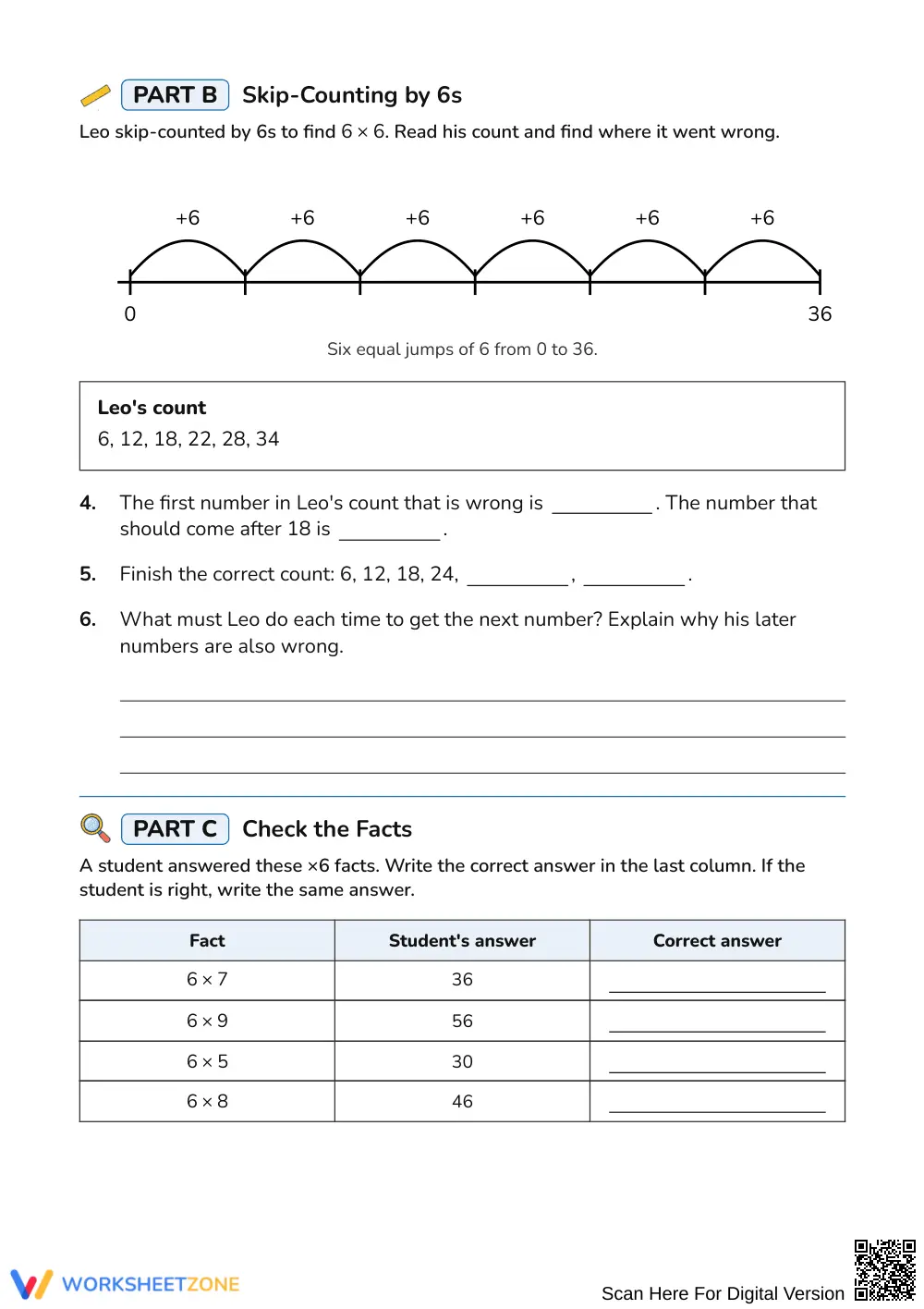
This 3-page printable resource delivers 20 targeted tasks organized across five parts: arrays, skip-counting sequences, fact checks, missing factors with fact families, and word problems. Visual models and number paths anchor early items, while structured tables guide student corrections. A complete 3-page answer key provides worked explanations for efficient grading.
Skill Progression
- Guided practice (Tasks 1–6): Students examine dot arrays and skip-counting paths to identify initial addition and counting errors using visual scaffolds.
- Supported practice (Tasks 7–14): Learners audit multiplication tables and evaluate fact-family equations, applying inverse operations and partial facts.
- Independent practice (Tasks 15–20): Students analyze word problems and solve missing-factor equations independently, writing short mathematical justifications for each correction.
This sequence follows a gradual-release model, moving learners from visual identification to independent written justification.
Standards Alignment
This resource aligns to `3.OA.C.7`: Fluently multiply and divide within 100, using properties of operations or the relationship between multiplication and division. The tasks also reinforce supporting standard `3.OA.B.5` by applying properties of operations as calculation strategies. Both standard codes can be copied directly into lesson plans, IEP goals, or district curriculum mapping tools.
How to Use It
Use this worksheet after direct instruction on the sixes facts during small-group intervention or math centers. During guided practice, observe whether students notice additive jumps in skip-counting or confuse addition with multiplication in word problems. Alternatively, assign single parts as daily warm-ups. Completion time ranges from 30 to 45 minutes.
Who It's For
This resource targets Grade 3 students building multiplication automaticity and Grade 4 learners needing targeted remediation. Visual dot arrays support English language learners and students with processing accommodations. Pair this worksheet with an interactive multiplication chart or an equal-groups anchor chart for additional visual support.
Mastering basic multiplication facts requires more than rote drill; third-grade learners must identify underlying mathematical structures and correct procedural misconceptions. This Grade 3 mathematics resource addresses standard 3.OA.C.7 through systematic multiplication by 6s error analysis, challenging students to evaluate flawed work across visual arrays, skip-counting sequences, fact families, and word problems. According to Fisher & Frey (2014), analyzing non-examples and verbalizing mathematical errors deepens cognitive processing and promotes durable retention of arithmetic concepts. By shifting focus from mechanical calculation to diagnosing flawed reasoning, the 20 structured problems guide students to recognize equal groups, apply the distributive property, and leverage inverse division relationships. This purposeful progression ensures students achieve computational fluency and conceptual understanding within 100, providing educators with formative assessment data regarding individual student operational accuracy and meaningful progress toward foundational grade-level standards.


