


























Views
Downloads




Ready Motivation & Consequence Worksheet | Grade 9 English I
Paste this activity's link or code into your existing LMS (Google Classroom, Canvas, Teams, Schoology, Moodle, etc.).
Students can open and work on the activity right away, with no student login required.
You'll still be able to track student progress and results from your teacher account.
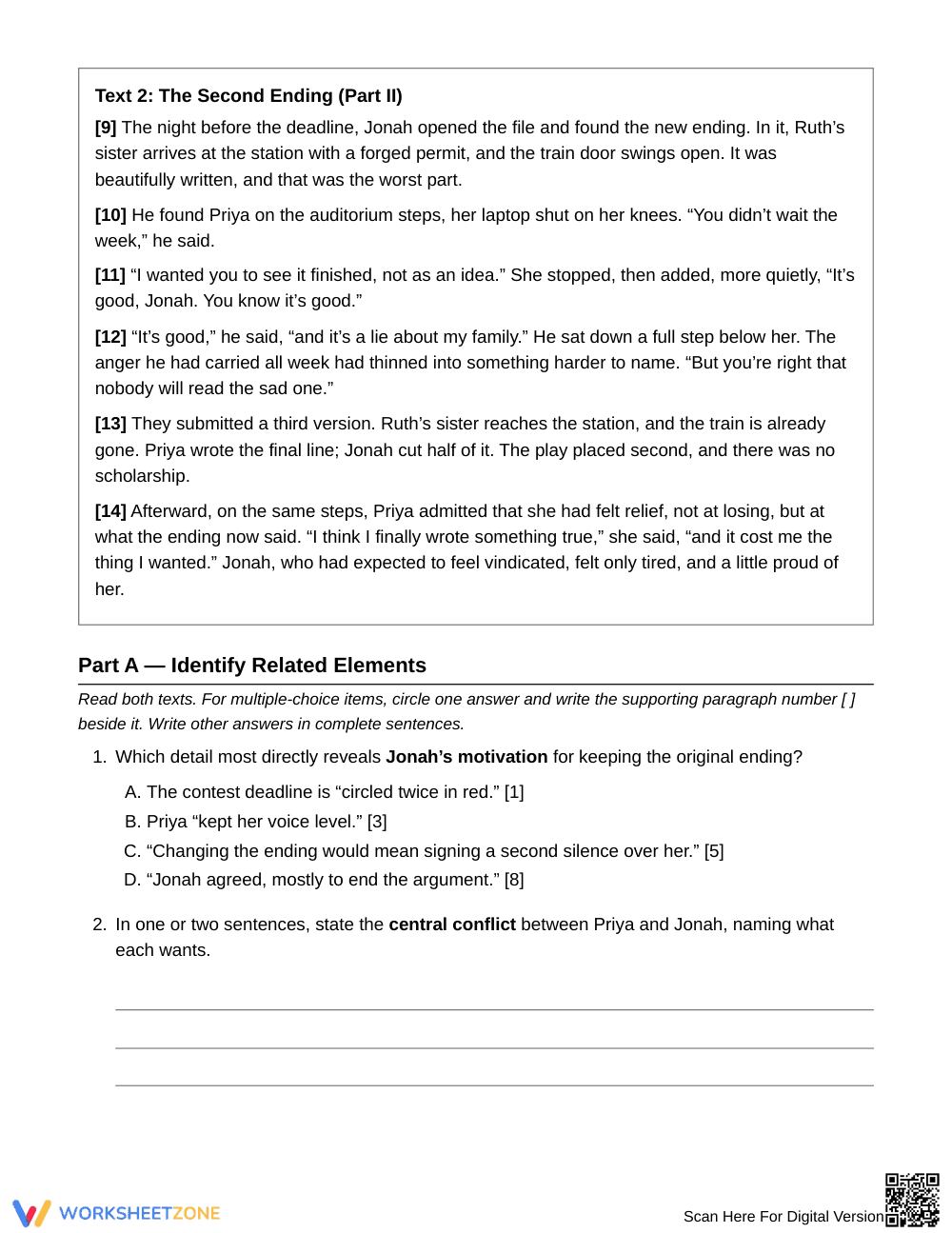
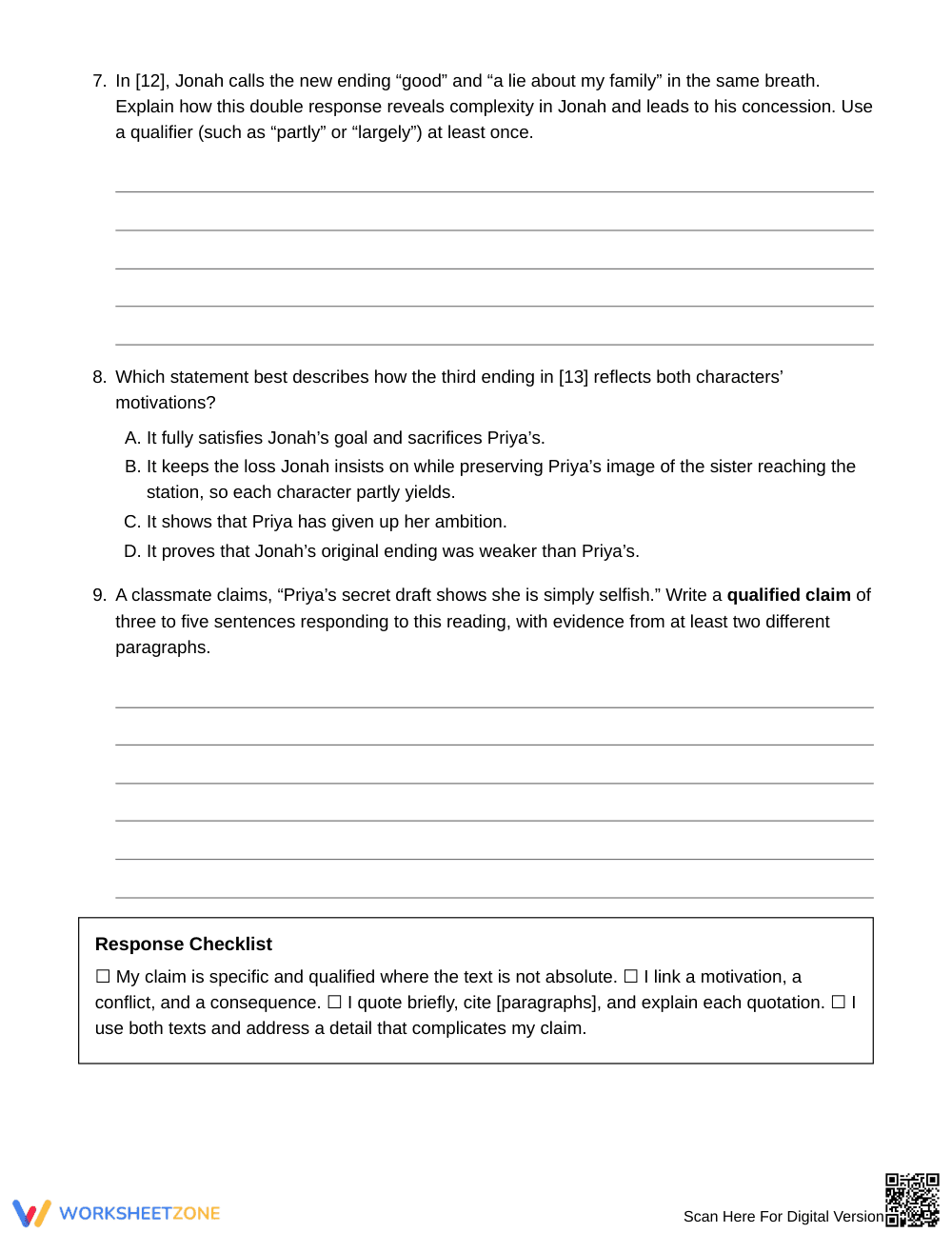
This worksheet helps Grade 9 students explain how a character's motivation produces conflict and how that conflict leads to consequences. Using a two-part short story, students practice citing paragraph evidence, writing qualified claims, and building toward whole-text arguments about theme and relationship change.
At a Glance
- Grade: 9 · Subject: English I
- Standard:
RL.9-10.3— Explain how characters' conflicting motivations drive conflict, plot, and theme.- Skill Focus: Connecting motivation, conflict, and consequence
- Format: 6 pages · 12 problems · Answer key included · PDF
- Best For: Mid-unit characterization practice and checks
- Time: 45–60 minutes
What's Inside
The worksheet opens with a short Key Ideas box and a two-part story, "The Second Ending." Students then complete multiple-choice items with paragraph citations, short written explanations, a response checklist, and extended paragraph responses. A 4-page answer key accompanies the 6-page student packet.
Skill Progression
- Guided practice: Part A, 3 items. Students identify motivation, conflict, and consequence, with options and paragraph numbers to anchor them.
- Supported practice: Part B, 6 items. Students explain how one element leads to another, using quotation and a self-check list.
- Independent practice: Part C, 3 items. Students trace a relationship, state a theme, and evaluate a claim with counterevidence.
This sequence follows the gradual-release model: I Do, We Do, You Do.
Standards Alignment
RL.9-10.3: Analyze how complex characters (e.g., those with multiple or conflicting motivations) develop over the course of a text, interact with other characters, and advance the plot or develop the theme. The standard code can be copied directly into lesson plans, IEP goals, or district curriculum mapping tools.
How to Use It
- After direct instruction: Assign Parts A and B as classwork once students have learned the three terms.
- As a unit check: Use Part C as a timed writing task near the end of the characterization unit.
While students work, watch whether they cite paragraph numbers and explain quotations rather than only copying them. Expect 45–60 minutes in total.
Who It's For
Designed for Grade 9 English I students who can read short fiction and are ready to write analytically. Part A can serve as an entry point for students who need more support, and Part C stretches stronger writers. Pair it with an anchor chart on character traits and motivation.
RL.9-10.3 asks Grade 9 and 10 students to analyze how complex characters, including those with conflicting motivations, interact with others, advance the plot, and develop a theme. This English I worksheet teaches that skill through "The Second Ending," a two-part story in which two student playwrights disagree about how to end a play. Twelve tasks move from identifying motivation and conflict to explaining consequence and defending a theme with evidence from both texts. Fisher & Frey (2014) describe gradual release of responsibility, in which teachers shift from modeling to guided work to independent performance, as a reliable structure for building complex literacy skills. The worksheet follows that sequence across three parts, with a four-page answer key supporting quick, consistent scoring. Students practice paragraph citation, short-quotation integration, and qualified claims, the habits that make literary analysis precise and persuasive.


