































Ready Momentum Variables Worksheet | Grades 8-12 Science

Paste this activity's link or code into your existing LMS (Google Classroom, Canvas, Teams, Schoology, Moodle, etc.).
Students can open and work on the activity right away, with no student login required.
You'll still be able to track student progress and results from your teacher account.
This physical science worksheet equips students in grades 8–12 to systematically dissect momentum and impulse investigations. Through authentic laboratory models involving cart collisions and force-time impulse curves, learners isolate independent and dependent variables, verify momentum conservation through structured data tables, and evaluate how contact time governs impact forces during collisions.
At a Glance
- Grade: Grades 8–12 · Subject: Science
- Standard: Scientific Inquiry — Plan investigations, identify variables, and evaluate evidence in collisions
- Skill Focus: Momentum and impulse investigation design
- Format: 4 pages · 24 problems · Answer key included · PDF
- Best For: High school physics inquiry practice
- Time: 45–60 minutes
Across 4 detailed pages, students engage with 24 scaffolded tasks organized into three distinct investigation scenarios. The packet integrates variable-identification tables, collision data records, force-time graphical analyses, and conceptual multiple-choice prompts. A complete 4-page answer key provides worked calculations, sample explanations, and expected graph interpretations.
Skill Progression
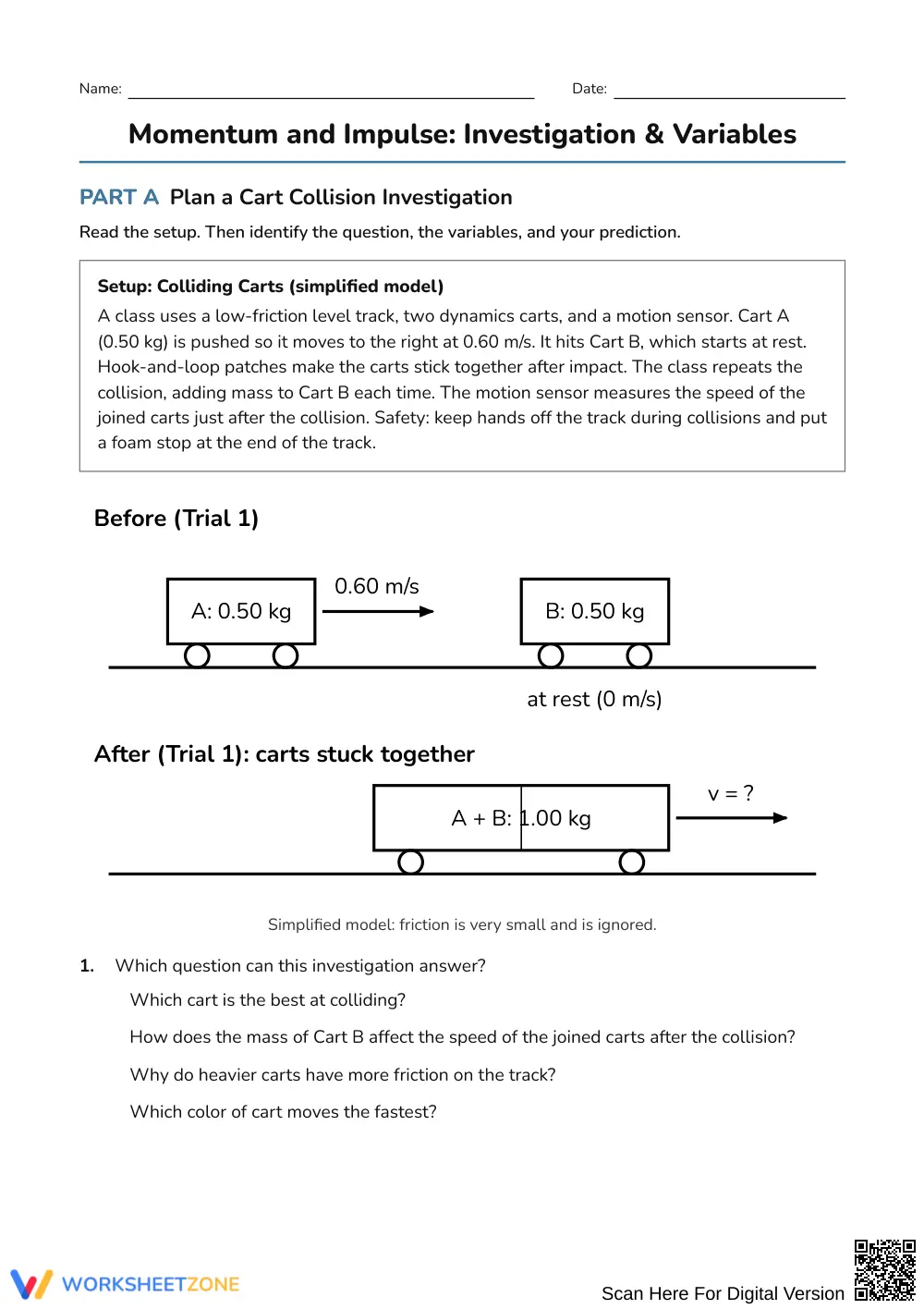
- Guided practice (Tasks 1–8): Students examine a dynamic cart collision setup, isolating testable questions, categorizing independent, dependent, and controlled variables, and formulating directional hypotheses.
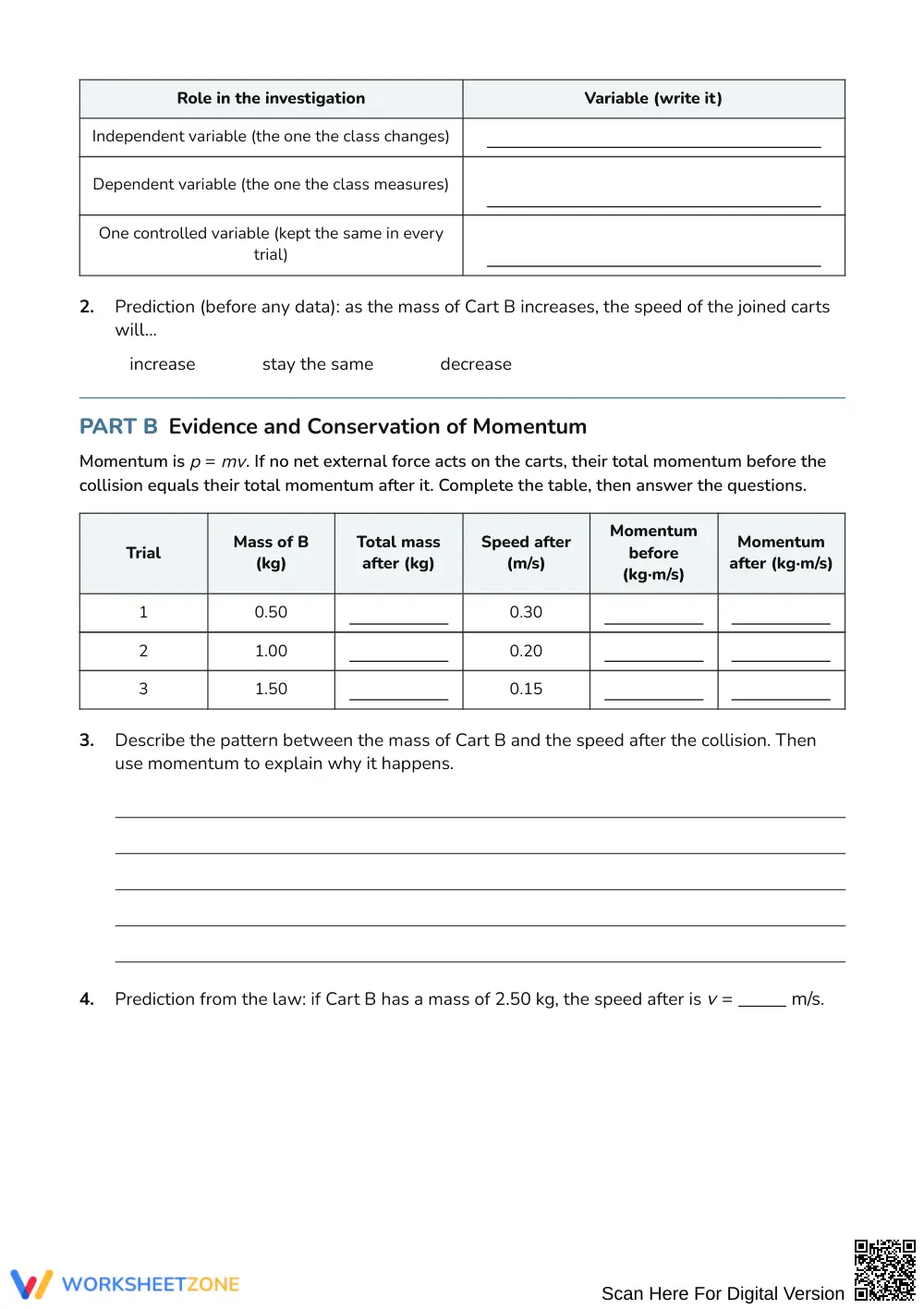
- Supported practice (Tasks 9–16): Learners complete mathematical tables calculating pre- and post-collision momentum ($p = mv$), interpreting experimental discrepancies and testing conservation principles with paired carts.
- Independent practice (Tasks 17–24): Students calculate the area under force-time graphs to determine impulse ($J = F\Delta t$), explaining how bumper material and impact duration alter peak stopping forces.
This structured progression reflects the gradual-release framework, moving students systematically from foundational variable identification to rigorous graphical and mathematical physics synthesis.
Standards Alignment
This resource aligns with high school physical science standards requiring students to plan and conduct investigations to show that the total momentum of an isolated system is conserved when external forces are absent. Additionally, it addresses learning goals where students apply mathematical concepts to demonstrate that impulse equals change in momentum. These standard descriptions can be copied directly into lesson plans, IEP goals, or district curriculum mapping tools.
How to Use It
Deploy this worksheet after direct instruction on Newton’s laws, conservation of momentum, and the impulse-momentum theorem ($J = \Delta p$). As a formative check, inspect student explanations for Task 12; verify whether learners attribute minor momentum losses to friction rather than theoretical failure. The resource functions effectively as an inquiry lab replacement or collaborative mid-unit review, requiring approximately 45 to 60 minutes.
Who It's For
This print-and-go packet serves regular, honors, and introductory Advanced Placement physics courses. For students needing math reinforcement, provide a formula card highlighting $p = mv$ and $J = F\Delta t$. Pair this activity with a dynamic cart demonstration or a digital collision simulation to ground abstract momentum values in tangible physical models.
According to Fisher & Frey (2014), purposeful skill progression from guided observation to independent data interpretation significantly improves students’ long‑term retention of physics concepts in secondary classrooms. This worksheet builds on that research by requiring learners to first isolate independent and dependent variables, then analyze multi‑trial collision data, and finally convert force‑time curves into precise impulse calculations. By engaging students in repeated cycles of prediction, measurement, and reflection, the activities reinforce the core inquiry competencies outlined in high‑school physical science curricula. The explicit focus on momentum conservation and the quantitative relationship between impact force and contact time helps learners connect abstract Newtonian principles to real‑world experimental evidence. As a result, students are better prepared to transfer these analytical skills to future laboratory investigations, project‑based assessments, and interdisciplinary STEM challenges. Integrating these tasks into a single printable packet also saves instructional planning time and supports consistent assessment across diverse classrooms.


