































Ready Molar Mass Relations Worksheet | Grades 9-12 Science

Paste this activity's link or code into your existing LMS (Google Classroom, Canvas, Teams, Schoology, Moodle, etc.).
Students can open and work on the activity right away, with no student login required.
You'll still be able to track student progress and results from your teacher account.
This molar mass worksheet builds high school science students' proficiency in classifying chemical substances, determining formula weights, and executing conversions between mass, moles, and particles. Across 35 structured items, learners connect microscopic molecular and ionic structures to macroscopic laboratory quantities, establishing foundational quantitative stoichiometry skills.
At a Glance
- Grade: Grades 9–12 · Subject: Science
- Standard: Chemistry Curriculum — Classify chemical substances, calculate molar mass, and connect macroscopic mass to particle quantities
- Skill Focus: Classification & Relationships in Molar Mass
- Format: 4 pages · 35 problems · Answer key included · PDF
- Best For: Chemistry concept reinforcement and quantitative stoichiometry practice
- Time: 45–60 minutes
What's Inside
Across 4 print-ready pages, this resource features 35 problems divided into three scaffolded parts. Students utilize an integrated atomic mass reference table to classify compounds as molecules or formula units, reference an explicit conversion pathway to calculate moles and representative particles, and interpret data tables comparing particle counts and combustion energy per gram. A complete 4-page answer key provides full mathematical solutions.
Skill Progression
- Guided practice (Part A, 10 problems): Students reference an on-page atomic mass table to classify substances as molecules or formula units and compute initial molar masses with full structural support.
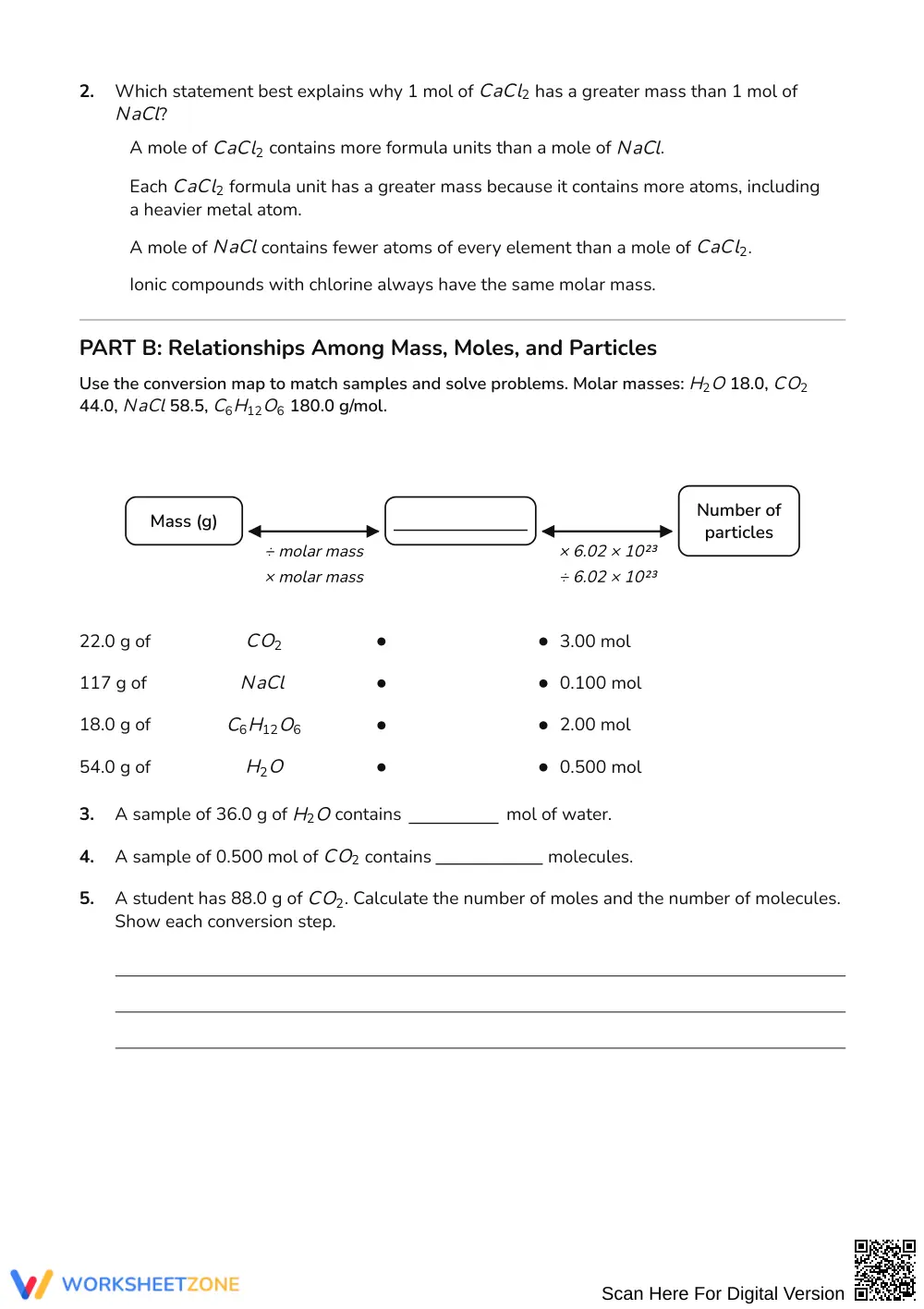
- Supported practice (Part B, 12 problems): Learners use a visual mass-to-mole-to-particle pathway to match equivalent quantities and solve multi-step dimensional conversions.
- Independent practice (Part C, 13 problems): Students analyze unprompted data tables to evaluate particle quantities in equal-mass samples and explain fuel energy differences per mole versus per gram.
This sequence follows a gradual-release instructional model, moving learners from scaffolded identification to autonomous quantitative reasoning.
Standards Alignment
This worksheet aligns with high school science standards for quantitative chemistry: Use mathematical representations to relate macroscopic mass, molar amounts, and subatomic or molecular particle counts. As a supporting foundation, it reinforces chemical bonding principles by differentiating ionic lattices from molecular compounds. Both standard codes can be copied directly into lesson plans, IEP goals, or district curriculum mapping tools.
How to Use It
Implement this resource immediately following direct instruction on Avogadro's number and molar mass calculations. Have student pairs complete Parts A and B during class workshop time, reserving Part C as a summative check for understanding. As an alternative, assign the 4 pages as an intensive pre-exam review packet. During work time, monitor how students organize conversion factors in Part B to catch inversion errors early. Expected completion time is 45 to 60 minutes.
Who It's For
This worksheet supports general chemistry and physical science students in grades 9 through 12. The built-in reference charts and conversion maps scaffold learning for students needing targeted math support, while Part C challenges advanced students to evaluate thermodynamic energy density. Pair this activity with a teacher-led mole conversion demonstration or a classroom mole map anchor chart.
High school chemistry instruction requires students to master chemical classification and quantitative relationships by connecting particle-level models to macroscopic measurements of molar mass. According to research on structured instructional delivery by Fisher & Frey (2014), student problem-solving accuracy improves significantly when complex multi-step conversions are taught using a gradual-release progression that bridges concrete reference data to abstract ratio reasoning. This 4-page, 35-task science worksheet guides learners through classifying molecules and formula units, navigating two-step mole conversions, and interpreting real-world energy density data across equal-mass fuel samples. By combining visual conversion pathways with explicit scaffolding, the resource reinforces dimensional analysis skills while preventing common student errors in chemical calculation. Science educators can implement this structured activity during stoichiometry units to verify conceptual comprehension, support struggling math learners, and provide rigorous quantitative practice aligned to secondary science curriculum standards.


