






























Ready Misleading Scale Repair Worksheet | Grade 9 English I
Paste this activity's link or code into your existing LMS (Google Classroom, Canvas, Teams, Schoology, Moodle, etc.).
Students can open and work on the activity right away, with no student login required.
You'll still be able to track student progress and results from your teacher account.
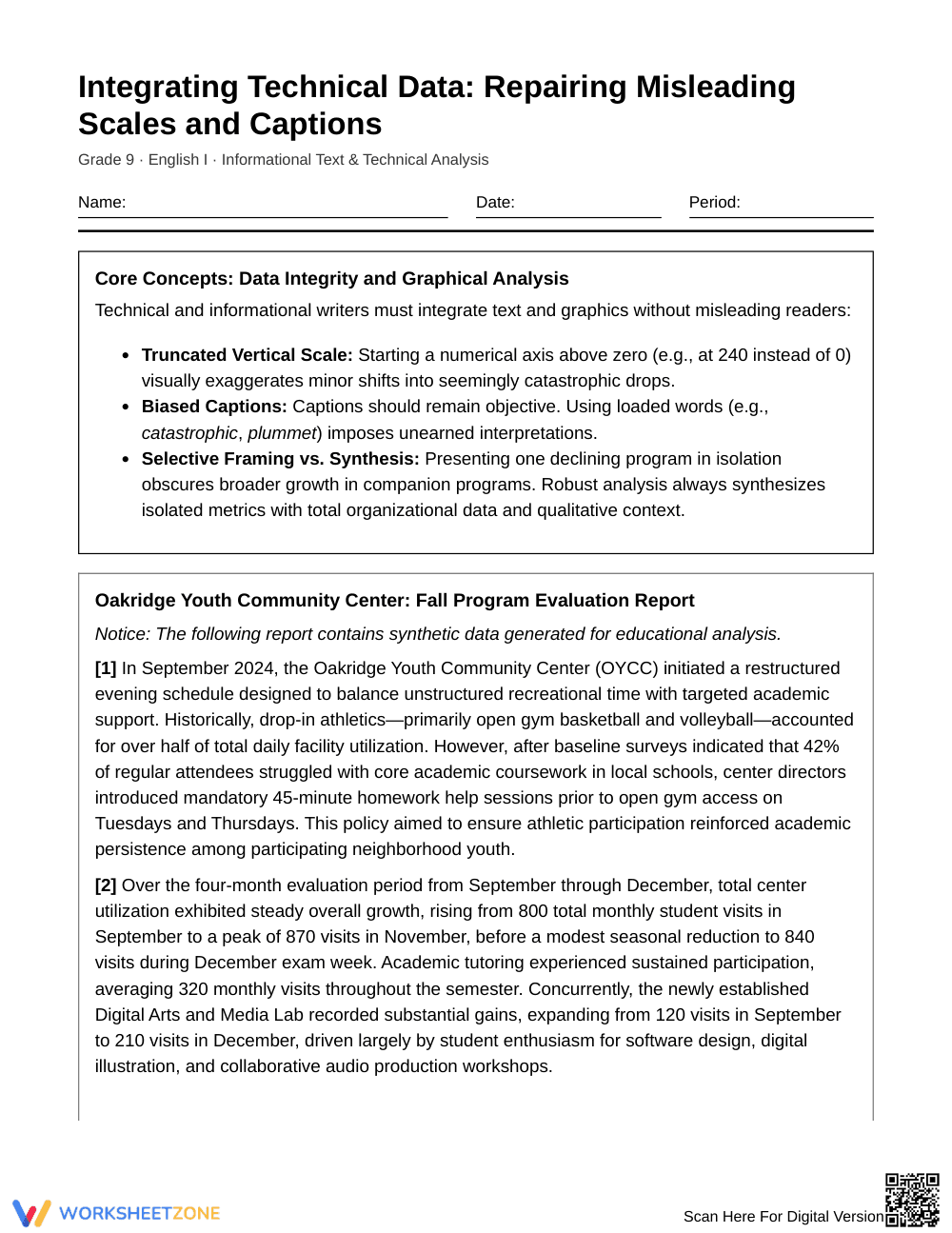
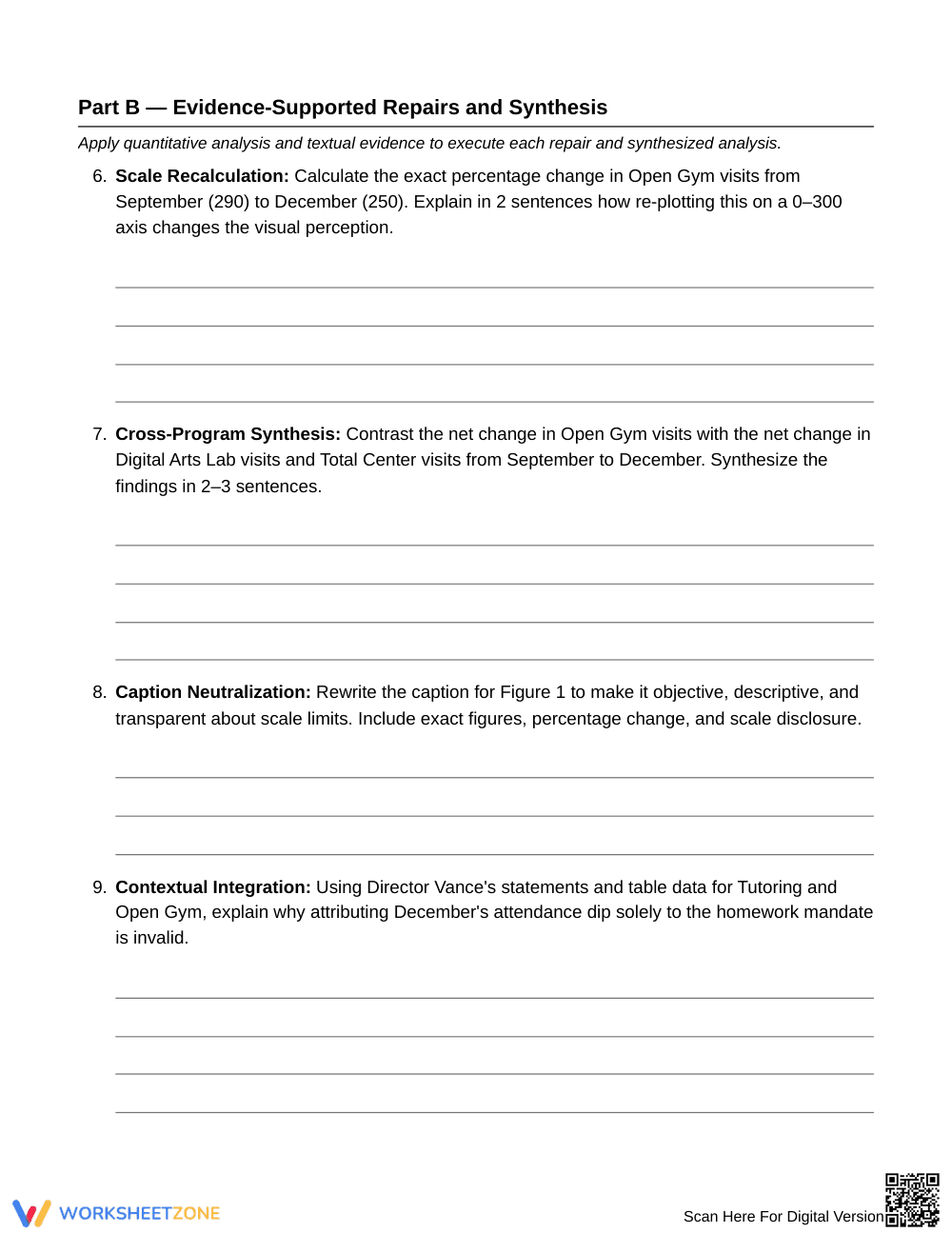
This Grade 9 technical literacy worksheet guides students to analyze and correct distorted quantitative visuals and biased captions. Using an informational evaluation report and data table, students identify truncated axes, counter flawed causal interpretations, and execute objective revisions to ensure data integrity across media.
At a Glance
- Grade: 9 · Subject: English I
- Standard:
RH.9-10.7— Integrate quantitative or technical visual data with non-fiction text- Skill Focus: Misleading scale and caption repair
- Format: 6 pages · 10 problems · Answer key included · PDF
- Best For: Informational text graphic analysis
- Time: 45–60 minutes
What's Inside
This 6-page resource provides a realistic youth center report featuring a multi-column data table and a distorted draft chart. After studying a worked exemplar, students complete 10 analytical tasks. A 3-page answer key provides complete model diagnoses, percentage calculations, objective caption revisions, and an exemplar briefing memo.
Skill Progression
- Guided practice: A worked model illustrates identifying truncated axes and reconciling chart discrepancies with tabular data.
- Supported practice: Five diagnosis tasks (Part A, Items 1–5) prompt students to detect visual scale errors, unearned causal claims, and loaded diction.
- Independent practice: Five repair tasks (Part B, Items 6–10) require calculating percentage changes, neutralizing captions, and drafting a synthesized board memo.
This progression follows the gradual release of responsibility model, transitioning students from analytical critique to technical revision.
Standards Alignment
This worksheet aligns with primary standard RH.9-10.7 by asking students to integrate visual data with text to resolve conflicting narratives. It also supports RI.9-10.7 through analyzing quantitative representations in informational print. Both standard codes can be copied directly into lesson plans, IEP goals, or district curriculum mapping tools.
How to Use It
Assign this activity during informational text analysis following direct instruction on technical writing. Have student pairs complete Part A to audit flawed claims, then assign Part B for independent synthesis. During work time, check Item 6 calculations to ensure accurate percentage change formulas. Total completion time is 45 to 60 minutes.
Who It's For
Targeted for Grade 9 English I students strengthening data literacy and informational reading skills. Differentiate by providing struggling learners with highlighted data baselines, while offering advanced students opportunities to construct alternative graphs. Pair this worksheet with a direct lesson on rhetorical appeals in technical reporting.
Mastery of informational graphic integration under standard RH.9-10.7 requires students to synthesize quantitative visual evidence with non-fiction texts while detecting manipulative presentation formats. When learners evaluate truncated graph axes and rewrite sensationalized captions, they build essential critical media literacy skills that protect against distorted data interpretations. Research by Fisher & Frey (2014) demonstrates that structured gradual-release instructional sequences—progressing from explicit error diagnosis to independent technical synthesis—significantly increase student analytical accuracy when evaluating complex informational texts. By recalculating actual percentage changes, identifying framing errors, and drafting synthesized administrative memos, high school students move beyond passive reading into active critical evaluation. This 10-task worksheet reinforces empirical reasoning, ensuring Grade 9 readers can independently verify visual claims against underlying dataset metrics and communicate objective findings effectively in formal academic and professional contexts across secondary coursework.


