


























Views
Downloads


Ready Marine Food Webs Word Search | Grades 4–5 Science
Paste this activity's link or code into your existing LMS (Google Classroom, Canvas, Teams, Schoology, Moodle, etc.).
Students can open and work on the activity right away, with no student login required.
You'll still be able to track student progress and results from your teacher account.
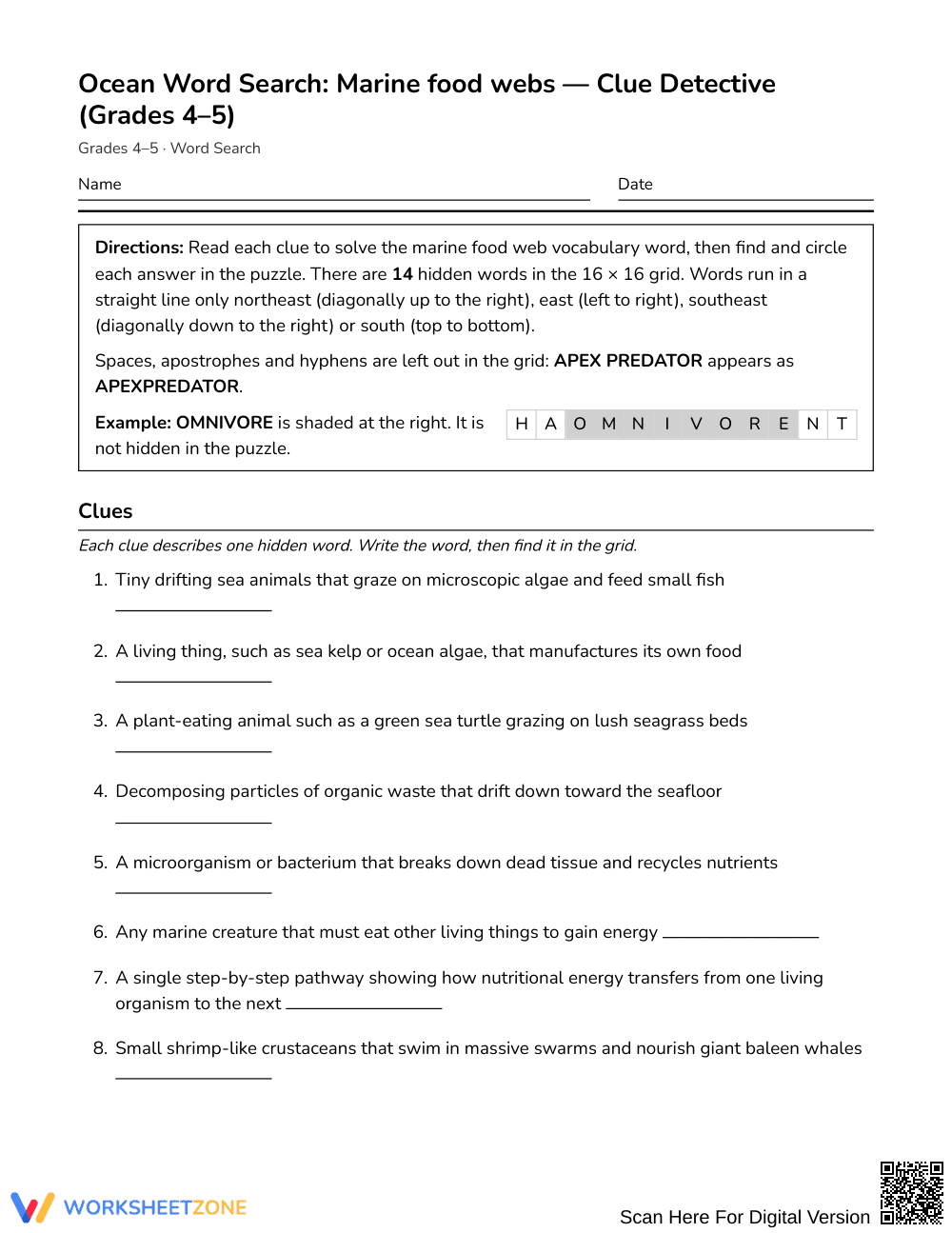
This ocean word search reinforces marine food webs vocabulary for Grades 4–5 science students. Learners identify key ocean organisms and ecological roles by decoding definitions before hunting for terms in the grid. It builds foundational ecological literacy and vocabulary retention through active, puzzle-based retrieval practice.
At a Glance
- Grade: Grades 4–5 · Subject: Science
- Standard: Not standards-assessed — vocabulary enrichment
- Skill Focus: Marine food webs
- Format: 3 pages · 14 words · Answer key included · PDF
- Best For: Science vocabulary reinforcement & review
- Time: 20–30 minutes
What's Inside
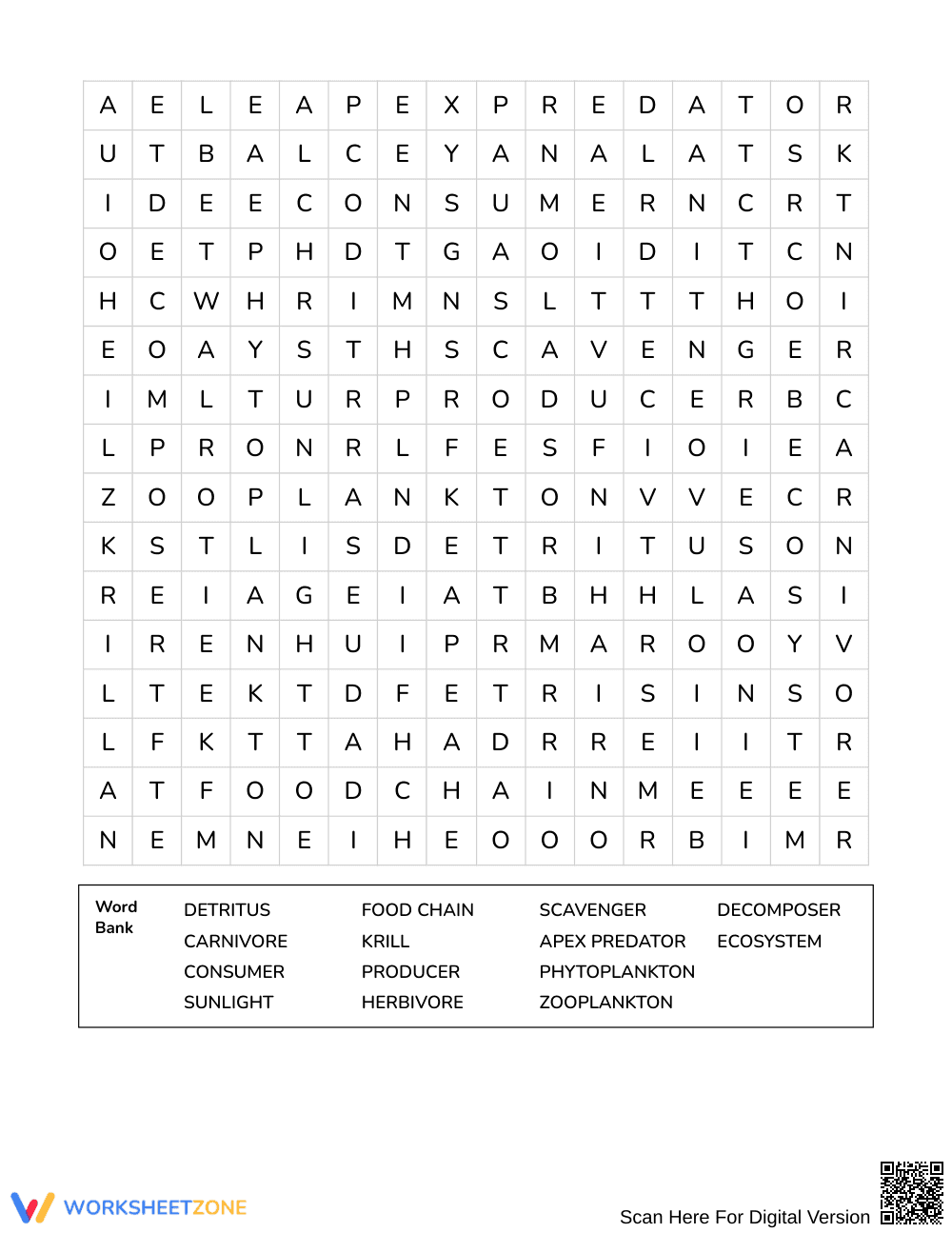
This 3-page printable science resource contains a complete clue-detective word search and a full-size answer key. Rather than scanning for a basic word list, students read 14 clue definitions describing ocean organisms and trophic levels, deduce the corresponding scientific term, and locate each vocabulary word hidden within the puzzle.
Puzzle Mechanics
The activity features a 16 × 16 letter grid designed with balanced search difficulty for upper elementary learners. Hidden terms run in four distinct directions: northeast, east, southeast, and south. Students can cross-reference the clue descriptions against a shuffled word bank to confirm spellings before tracking down target terms across the letter grid.
Standards Alignment
This activity provides targeted vocabulary enrichment and is not aligned to a formal standard. It supplements life science units on ocean ecosystems, energy transfer, and biotic interactions by reinforcing accurate scientific terminology across upper elementary science curricula.
How to Use It
Deploy this activity following direct instruction on aquatic food chains, or assign it during independent practice stations to reinforce key ecological terms. As students search for words, circulate to observe whether they can explain the ecological function of organisms like phytoplankton and krill without reading the clue prompts. Expect students to complete the 14 words in approximately 20 to 30 minutes.
Who It's For
This resource serves Grades 4–5 science classrooms, homeschool units, and environmental science clubs exploring aquatic life. For learners needing additional language support, pair this activity with an illustrated ocean food chain anchor chart or a marine organism reference glossary to assist with terminology recall.
Vocabulary enrichment activities that integrate semantic clues with retrieval practice provide measurable benefits for upper elementary science comprehension. According to Fisher & Frey (2014), content-area literacy develops most effectively when students actively interact with domain-specific terminology through multiple intentional modalities rather than relying on rote memorization or isolated definition copying. This marine food webs resource requires learners to process fourteen precise scientific definitions—including producers, consumers, detritus, and apex predators—before locating terms across a structured sixteen-by-sixteen puzzle matrix. Requiring learners to match descriptive biological clues to target vocabulary strengthens semantic memory pathways and reinforces conceptual relationships within aquatic food chains. When paired with collaborative peer discussions or visual anchor diagrams, clue-based word puzzles establish foundational science literacy that directly supports subsequent reading comprehension and inquiry-based learning across complex informational texts in Grades 4–5 life science instruction.


