




























Ready Island Freshwater Word Search | Grades 4–5 Science
Paste this activity's link or code into your existing LMS (Google Classroom, Canvas, Teams, Schoology, Moodle, etc.).
Students can open and work on the activity right away, with no student login required.
You'll still be able to track student progress and results from your teacher account.
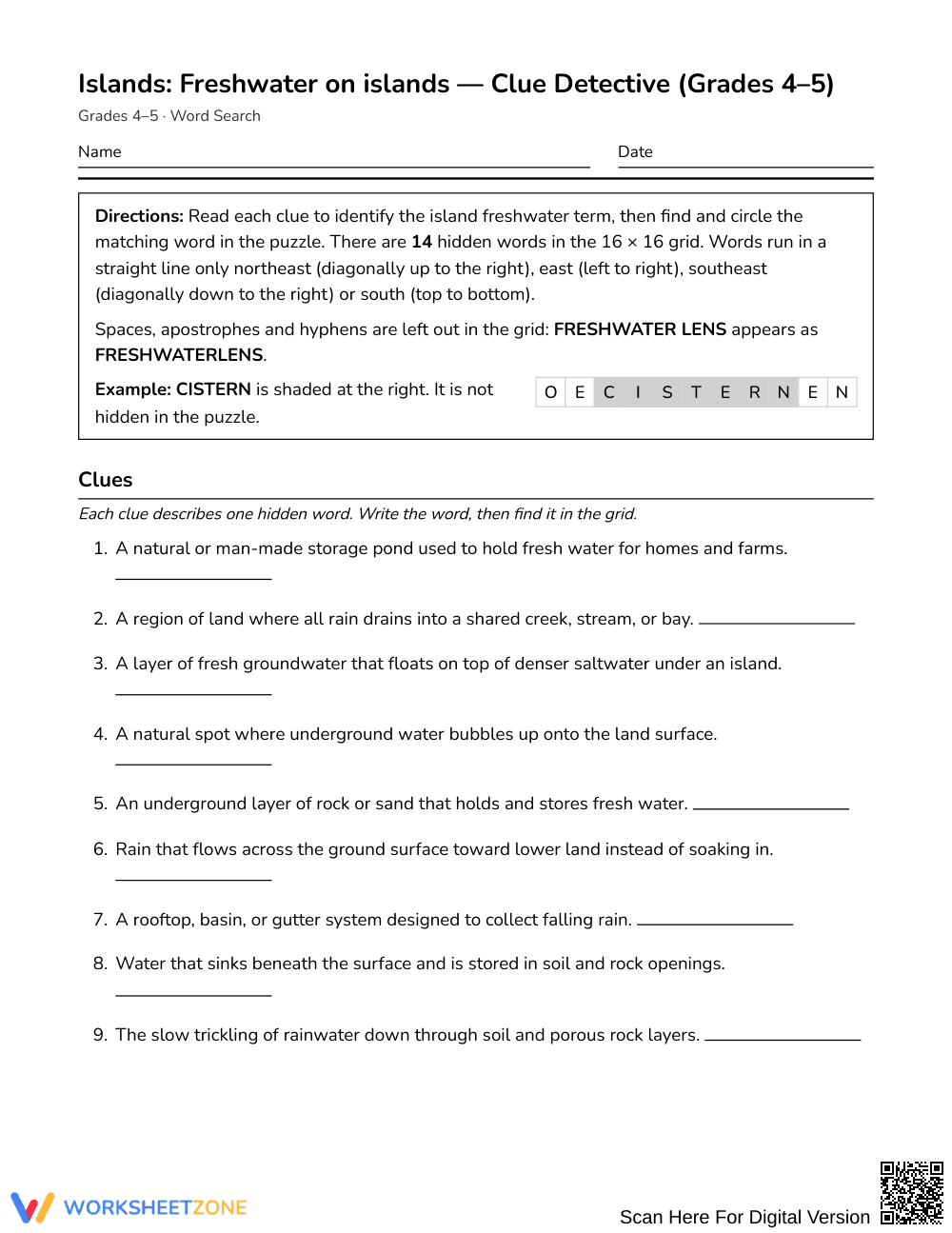
This Grades 4–5 science word search reinforces foundational earth science concepts by connecting geological terms to island hydrology. Students read informative definitions to identify 14 key vocabulary words before locating them within the grid. The activity strengthens scientific vocabulary, helps learners recognize water systems, and reinforces how freshwater behaves in isolated island environments.
At a Glance
- Grade: Grades 4–5 · Subject: Science
- Standard: Not standards-assessed — vocabulary enrichment
- Skill Focus: Freshwater on islands
- Format: 3 pages · 14 words · Answer key included · PDF
- Best For: Science vocabulary reinforcement and review
- Time: 20–30 minutes
What's Inside
This 3-page printable resource features a complete vocabulary activity designed around island water cycles and hydrology. It provides 14 rigorous science definitions that serve as clues, a shuffled word list, and an accompanying answer key. Students actively read descriptions of hydrological phenomena—including freshwater lenses, aquifers, and catchments—before searching for each targeted term.
Puzzle Mechanics
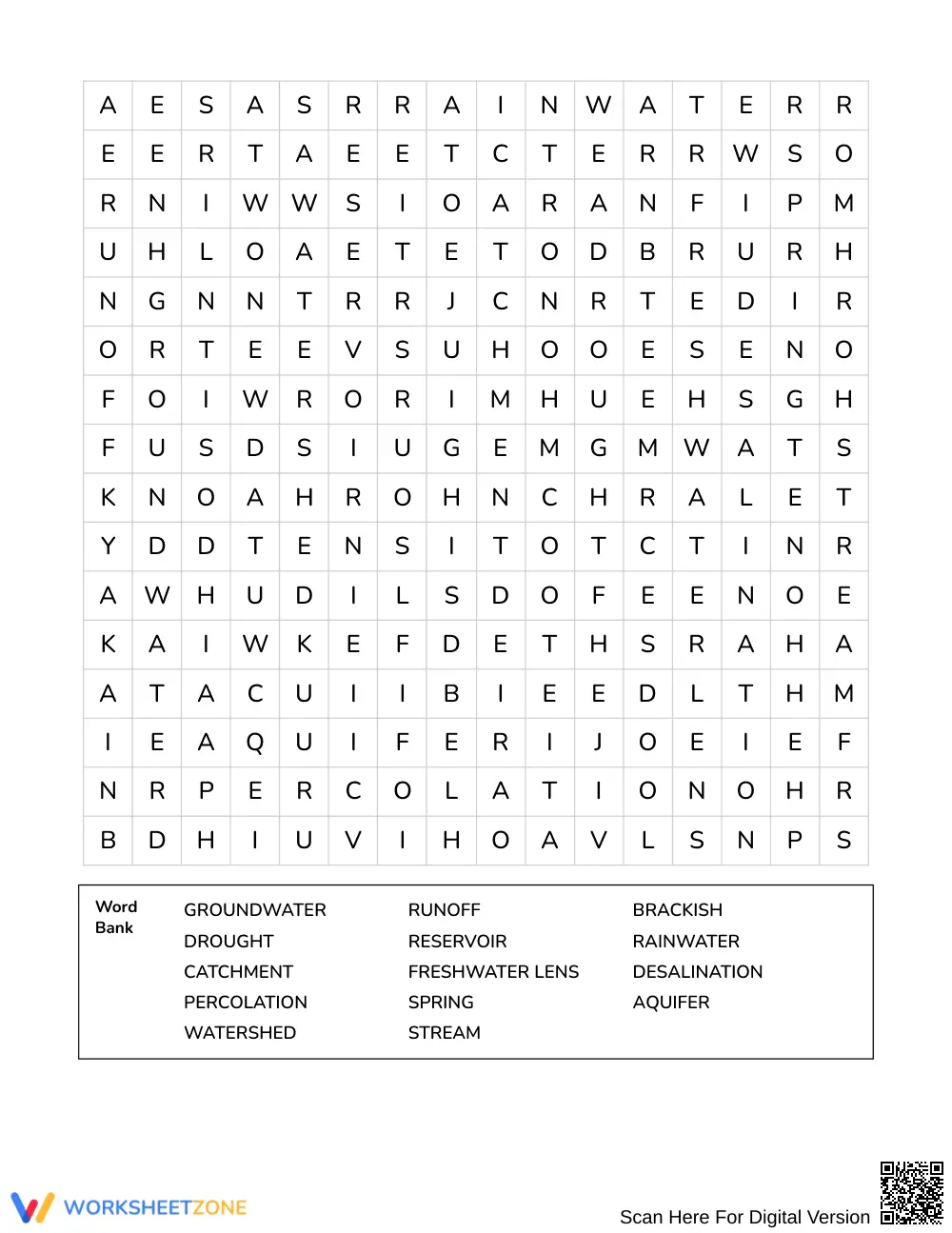
The activity centers on a 16 × 16 letter grid containing 14 hidden science terms. Hidden words run across four distinct directional paths: northeast, east, southeast, and south. Rather than relying solely on a simple search list, learners read definitions to determine target vocabulary from a shuffled word bank, requiring cognitive engagement with scientific concepts before visual scanning begins.
Standards Alignment
This activity provides targeted vocabulary enrichment rather than formal standards-based assessment. While it builds foundational background knowledge for upper elementary earth and space science units on Earth's systems, it is not aligned to a single state or national standard. Teachers can integrate the activity flexibly alongside any existing hydrology or earth systems curriculum.
How to Use It
Introduce this word search after direct instruction on the water cycle or island geography to consolidate content-specific terminology. Alternatively, assign the activity as a collaborative warm-up where student pairs read clues aloud, deduce terms, and track them across the grid. Formatively monitor whether students can accurately match definitions like percolation and catchment without consulting reference sheets. Completion typically takes 20 to 30 minutes.
Who It's For
This resource supports upper elementary learners in Grades 4–5 studying earth science, island ecosystems, and natural resource conservation. Differentiate by providing highlighted definition sheets or allowing peer partnerships for developing readers. It pairs naturally with an illustrated anchor chart detailing island aquifers, groundwater percolation, and coastal freshwater lenses.
Academic vocabulary acquisition serves as a critical prerequisite for scientific literacy and conceptual understanding in elementary earth science. While this resource is not standards-assessed, it provides targeted vocabulary enrichment focusing on freshwater on islands, helping students internalize complex terms like desalination, watershed, and brackish water. According to Fisher & Frey (2014), intentional word exposure coupled with contextual clues enables intermediate students to transition terminology from passive recognition to active domain comprehension. By requiring learners to analyze conceptual definitions prior to identifying words within a structured grid, this activity reinforces retrieval pathways and stabilizes memory traces for environmental science terminology. Integrating clue-based word puzzles during earth science units creates low-stakes opportunities for lexical retrieval, equipping diverse learners with the domain-specific vocabulary necessary to comprehend complex reading passages, participate in scientific discourse, and evaluate environmental challenges facing island ecosystems.


