
































Ready Island Adaptations Word Search | Grades 4–5 Science

Paste this activity's link or code into your existing LMS (Google Classroom, Canvas, Teams, Schoology, Moodle, etc.).
Students can open and work on the activity right away, with no student login required.
You'll still be able to track student progress and results from your teacher account.
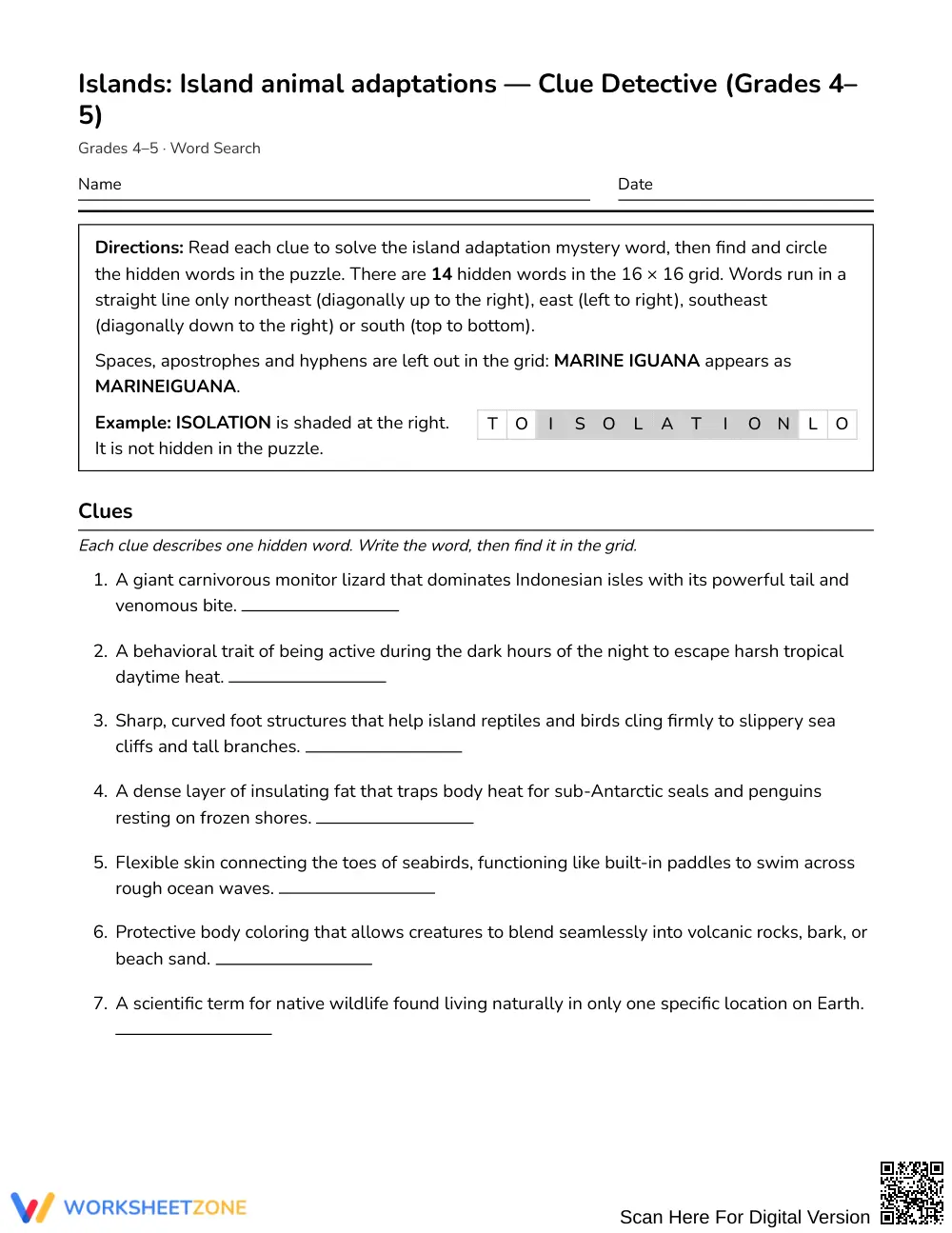
This Grades 4–5 science word search reinforces island animal adaptations through clue-based vocabulary practice. Students read context-rich definitions to identify 14 specialized biological terms before hunting for them in the puzzle grid. The activity develops scientific terminology, retention, and reading comprehension in an engaging, self-directed format.
At a Glance
- Grade: Grades 4–5 · Subject: Life Science
- Standard: Not standards-assessed — targeted vocabulary enrichment supporting animal adaptation concepts
- Skill Focus: Island animal adaptations and specialized anatomical traits
- Format: 3 pages · 14 hidden words · Full answer key included · Printable PDF
- Best For: Independent science centers, fast finishers, and emergency substitute plans
- Time: 20–30 minutes of focused student work
What's Inside
The 3-page printable activity pack features a clue detective layout focused on island ecology. Rather than an uncritical word list, the resource provides 14 descriptive clues defining phenomena like gigantism, dwarfism, camouflage, and endemism alongside species like marine iguanas and Komodo dragons. Students decipher each clue, identify the target term, and search the letter grid. A full 3-page answer key displays exact placements for rapid checking.
Puzzle Structure and Mechanics
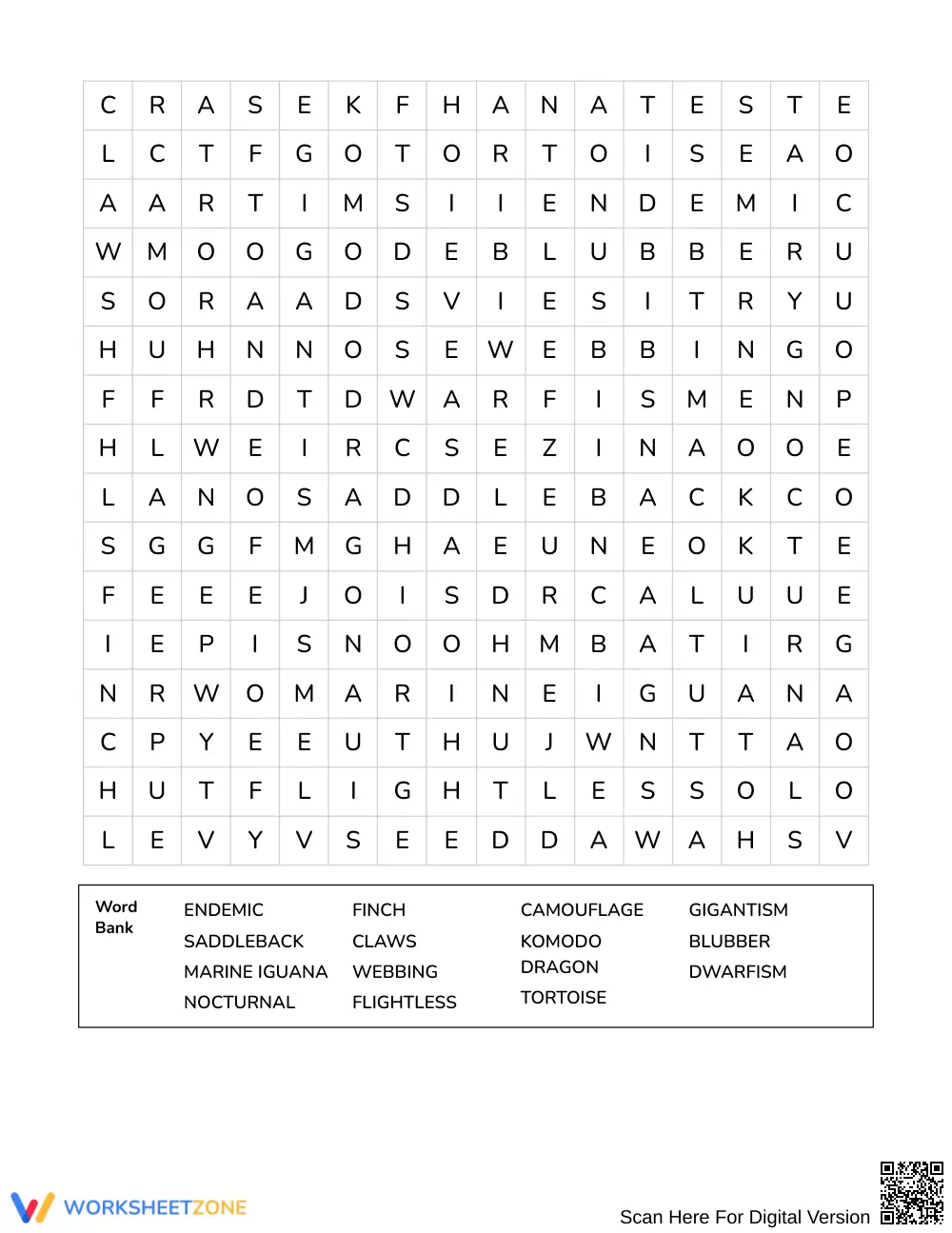
This vocabulary puzzle challenges learners through a 16 × 16 letter grid containing 14 hidden words. Words run in four orientations: northeast, east, southeast, and south. By excluding reverse directions, the puzzle remains accessible for upper elementary students while preserving visual challenge. The clues require learners to recall concepts before searching, transforming a basic word find into an active scientific retrieval exercise.
Standards Alignment
This resource serves as targeted vocabulary enrichment and is not aligned to an assessed standard code. It strengthens foundational domain knowledge of ecosystem isolation, evolutionary shifts, and physical adaptations that support fourth and fifth grade life science curricula. Teachers can introduce these terms alongside units exploring how environmental factors influence animal survival.
How to Use It
Deploy this activity during independent practice following instruction on island ecosystems, or assign it for mid-unit review. Alternatively, place copies in science centers for early finishers or substitute plans. For formative assessment, observe whether students solve terms from clues before scanning the grid, demonstrating conceptual grasp rather than passive letter hunting. Completion requires 20 to 30 minutes.
Who It's For
Designed for Grades 4–5 students studying life science, this resource accommodates diverse learners through paired clues and visual search tasks. Support developing readers by reading clues chorally or providing a glossary. Pair this puzzle with a reading passage on the Galápagos Islands or a chart comparing physical adaptations across island species.
While not tied to an assessed standard code, this vocabulary enrichment resource targets island animal adaptations to build essential scientific literacy in Grades 4–5. Integrating definitional clues with visual search tasks reinforces domain-specific terminology through dual-exposure learning. According to Fisher & Frey (2014), intentional academic vocabulary instruction that combines conceptual definitions with collaborative or independent retrieval significantly improves informational text comprehension and content mastery across elementary science settings. By prompting students to analyze descriptive traits of unique island species—such as gigantism, dwarfism, endemic populations, and specialized feeding structures—the activity bridges introductory natural selection concepts with active problem-solving. This self-contained 3-page word search provides an effective 20- to 30-minute review tool that consolidates 14 key biological terms, equipping students with the foundational academic language needed for subsequent analytical reading, class discussions, and science writing assignments.


