































Ready Intermolecular Forces Worksheet | Grades 9‑12 Science

Paste this activity's link or code into your existing LMS (Google Classroom, Canvas, Teams, Schoology, Moodle, etc.).
Students can open and work on the activity right away, with no student login required.
You'll still be able to track student progress and results from your teacher account.
Opening
Students will master interpreting graphs, tables, and energy data to explain how intermolecular forces affect boiling points and vaporization energies. By completing this worksheet, they translate evidence into scientific explanations, reinforcing the link between molecular structure and physical properties in chemistry.
At a Glance
- Grade: Grades 9‑12 · Subject: Science
- Standard: — Analyze data to explain how intermolecular forces influence physical properties
- Skill Focus: Interpreting graphs and evidence about intermolecular forces
- Format: 4 pages · 18 problems · Answer key included · PDF
- Best For: Quick classroom review, homework, or assessment preparation
- Time: 30–45 minutes
What's Inside
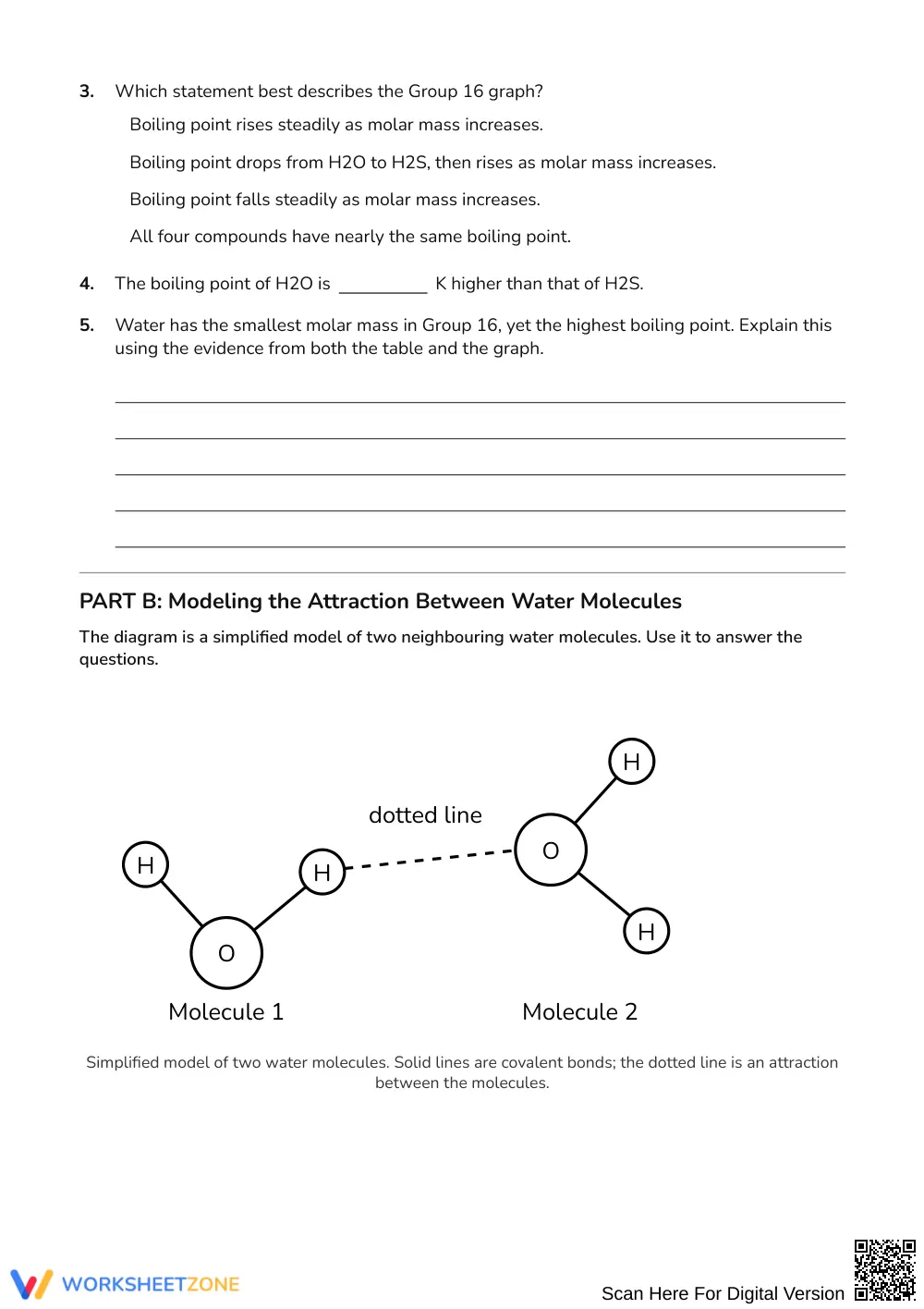
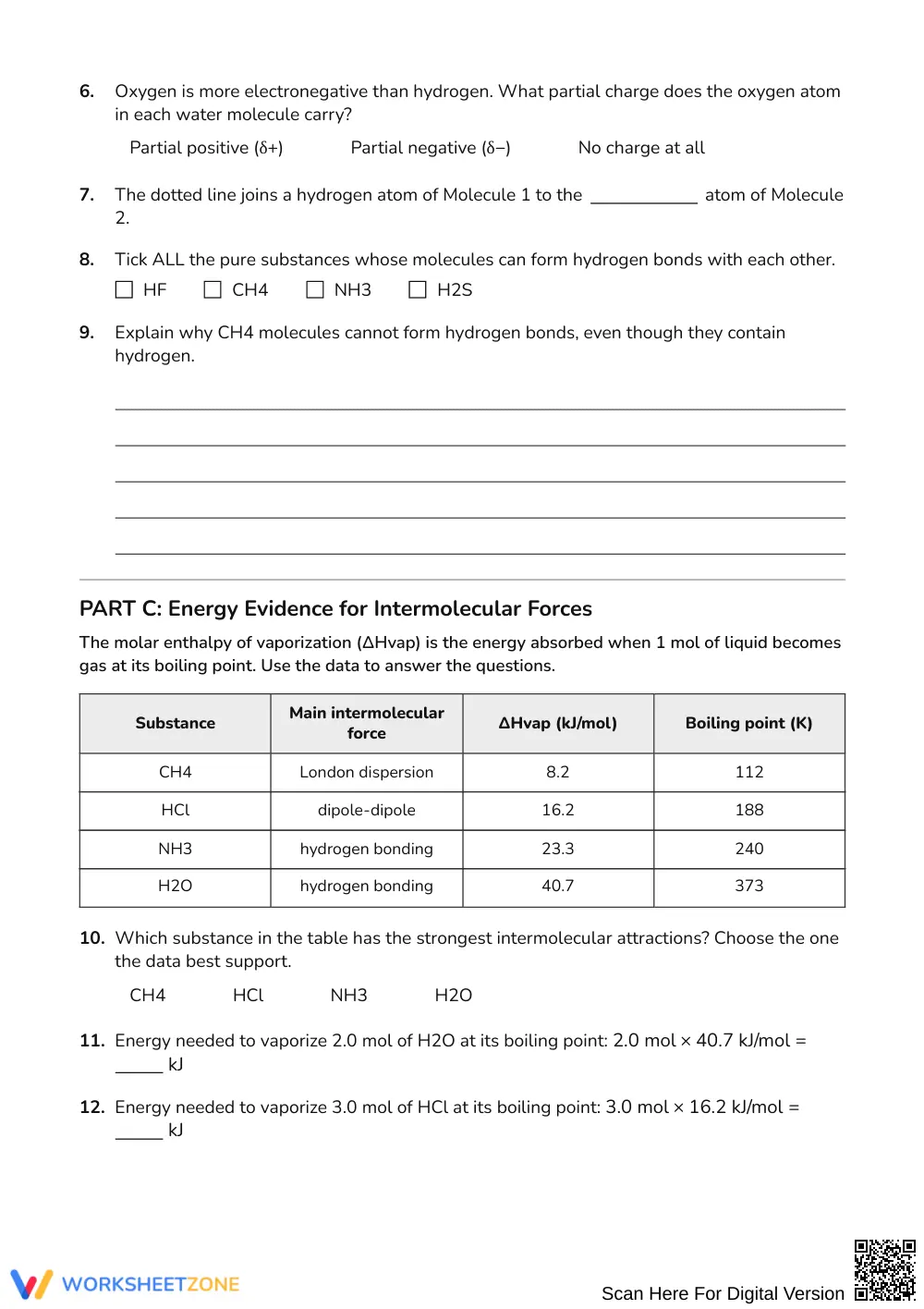
The worksheet spans four double‑sided pages and contains 18 multi‑step problems divided into three parts. Students work with tables of molar mass and boiling points, a graph of Group 16 hydrides, molecular models, and enthalpy of vaporization data. An answer key follows each page.
Skill Progression
- Guided practice (6 tasks): Students interpret a single table or graph with teacher‑led prompts and a word bank.
- Supported practice (6 tasks): Students answer mixed‑format questions that require brief written explanations.
- Independent practice (6 tasks): Students synthesize evidence from multiple data sets to construct full explanations.
These steps follow the classic I Do, We Do, You Do release model, gradually shifting responsibility to the learner.
Standards Alignment
Alignment: This activity meets high‑school science standards that require students to analyze experimental data and explain the role of intermolecular forces in determining physical properties such as boiling point and enthalpy of vaporization. It also supports cross‑cutting standards on scientific reasoning and evidence‑based argumentation. Both statements can be copied directly into lesson plans, IEP goals, or district curriculum mapping tools.
How to Use It
Use case 1: Begin a unit on chemical bonding by assigning Part A as a pre‑lab activity; observe students identify patterns before the demonstration of hydrogen bonding. Collect quick exit tickets to gauge understanding.
Use case 2: After a lecture on intermolecular forces, use Part C for guided practice during class; students work in pairs, then the teacher reviews answers, reinforcing the link between ΔHvap and boiling point. Each session takes about 30 minutes.
Who It's For
This worksheet is designed for Grades 9‑12 science students, especially those in honors or AP courses who need deeper data‑interpretation practice. The clear scaffolds support struggling learners, while the extension questions challenge advanced students. Pair it with a textbook chapter on molecular interactions or an anchor chart of intermolecular force types.
Interpreting quantitative evidence about intermolecular forces is a cornerstone of high‑school chemistry curricula. This worksheet aligns with standards that call for students to “analyze data to explain how molecular interactions influence physical properties.” Research shows that explicit data‑analysis tasks improve conceptual understanding of abstract forces (Fisher & Frey 2014). By guiding learners through tables, graphs, and energy calculations, the activities reinforce the evidence‑based reasoning emphasized in modern science education. The inclusion of both qualitative explanations and quantitative calculations mirrors best‑practice recommendations from EdReports 2024, which highlight the importance of mixed‑format assessments for deeper learning. Teachers can confidently assign this resource to develop students’ ability to connect molecular structure with observable phenomena, preparing them for college‑level chemistry and related STEM pathways. Integrating this worksheet into a unit also supports collaborative learning, as students discuss their interpretations and justify conclusions using scientific vocabulary.


