




























Views
Downloads


Ready Intermolecular Forces Worksheet | Grades 9-12 Science

Paste this activity's link or code into your existing LMS (Google Classroom, Canvas, Teams, Schoology, Moodle, etc.).
Students can open and work on the activity right away, with no student login required.
You'll still be able to track student progress and results from your teacher account.
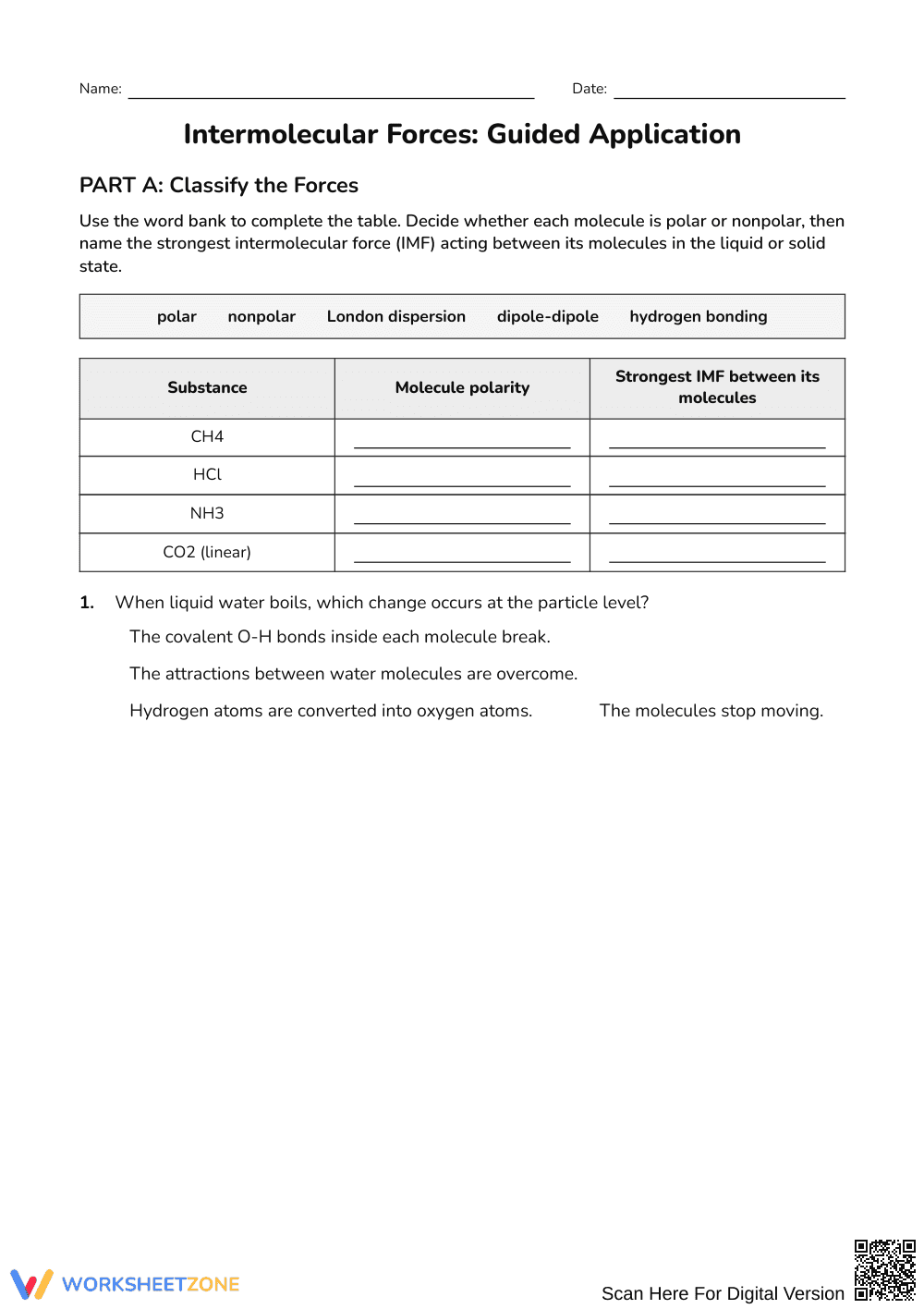
This four-page intermolecular forces worksheet helps high school chemistry students master molecular polarity, dipole attractions, and hydrogen bonding. Across 23 structured tasks, learners progress from identifying force types to analyzing thermodynamic data and predicting boiling points, translating abstract molecular behavior into concrete, observable physical properties.
At a Glance
- Grade: Grades 9–12 · Subject: Science
- Standard: Physical Science — Compare intermolecular attractions and explain macroscopic boiling and evaporation properties
- Skill Focus: Intermolecular force classification, trend prediction, and evaporation analysis
- Format: 4 pages · 23 problems · Answer key included · PDF
- Best For: High school chemistry guided practice
- Time: 45–60 minutes
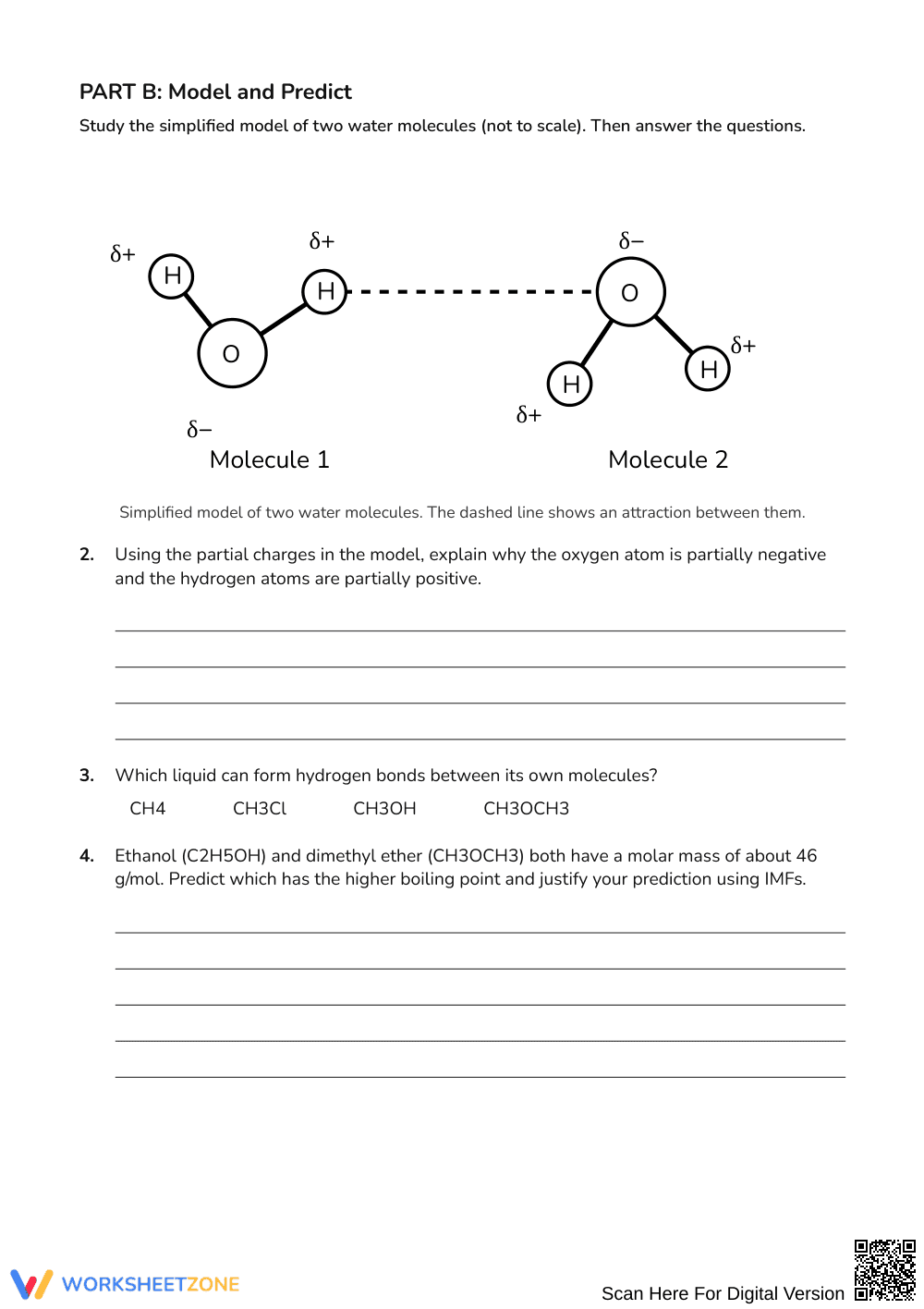
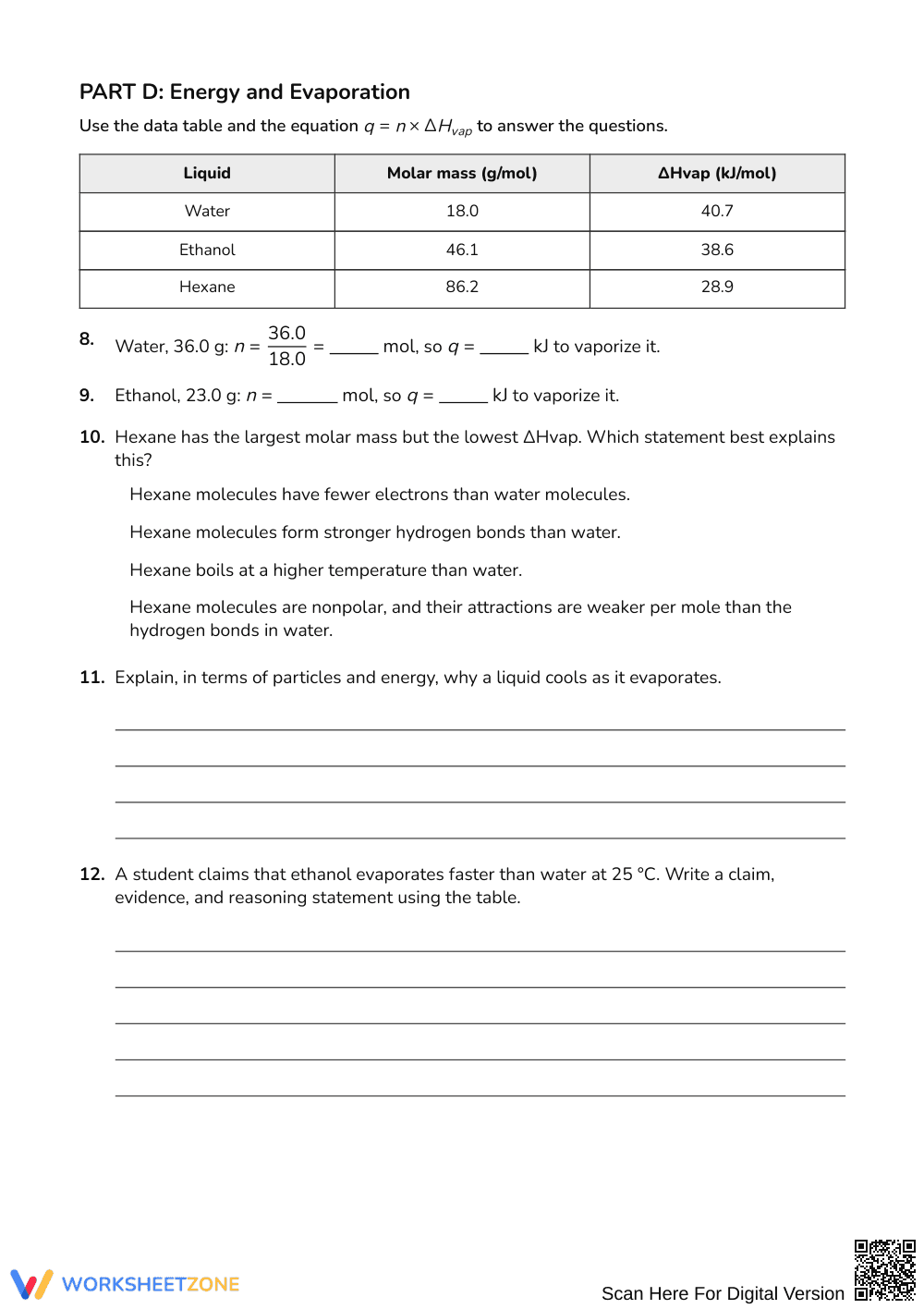
The activity features four distinct sections spanning particle diagrams, molecular comparison tables, boiling point trend graphs for Group 16 hydrides, and molar enthalpy data tables. Structural scaffolds include a targeted polarity word bank, partial charge diagrams, and worked enthalpy calculations that guide students from initial classification through quantitative claim-evidence-reasoning arguments. A comprehensive four-page answer key provides step-by-step rationales.
Skill Progression
- Guided practice: Part A supplies a word bank for classifying polar bonds and naming dominant intermolecular attractions across four common substances.
- Supported practice: Parts B and C use structural models and hydride boiling point curves to support comparative reasoning and anomalous water properties.
- Independent practice: Part D challenges students to calculate vaporization energies and write an original claim-evidence-reasoning argument on cooling rates.
This structured sequence operationalizes the gradual release of responsibility model, shifting cognitive ownership from foundational definitions to independent thermodynamic analysis.
Standards Alignment
This resource aligns with high school physical science standards addressing the structure and properties of matter, specifically how electrostatic forces between particles dictate bulk material properties. Students contrast covalent bonds with intermolecular attractions using empirical boiling and evaporation data. Both standard concepts can be copied directly into lesson plans, IEP goals, or district curriculum mapping tools.
How to Use It
Deploy this worksheet during the midpoint of an intermolecular forces unit directly after introducing dipole interactions and hydrogen bonding. As a formative check during independent work, observe whether students misattribute boiling point differences to breaking covalent bonds rather than overcoming intermolecular forces. Expected completion time is 45 to 60 minutes across one extended lab block or two standard class periods.
Who It's For
This resource serves general chemistry, honors science, and introductory AP Chemistry students seeking structured practice. Visual learners and multilingual students benefit from partial-charge diagrams and explicit math formulas, while advanced learners explore vapor enthalpy trends. Pair this assignment with an interactive molecular simulation or a water evaporation bench lab.
High school chemistry instruction requires explicit bridging between microscopic particulate interactions and macroscopic bulk phenomena. This 23-task physical science resource targets intermolecular forces, directing students through molecular polarity identification, hydrogen bonding justifications, and enthalpy-based evaporation predictions. Grounded in the gradual-release framework established by Fisher & Frey (2014), the four-part sequence shifts cognitive load from teacher-scaffolded word bank classifications to autonomous data synthesis. Students examine Group 16 hydride boiling curves and quantify vaporization enthalpy, constructing defensible scientific explanations for physical phase changes. By systematically separating intramolecular covalent bond disruption from intermolecular separation, the worksheet prevents common secondary chemistry misconceptions identified in conceptual research. Designed for 45 to 60 minutes of active inquiry across four student pages, this printable resource pairs structured practice with a complete four-page answer key, establishing measurable mastery of secondary physical science matter standards.


