




























Views
Downloads



Ready Intermolecular Forces Worksheet | Grades 9-12 Science

Paste this activity's link or code into your existing LMS (Google Classroom, Canvas, Teams, Schoology, Moodle, etc.).
Students can open and work on the activity right away, with no student login required.
You'll still be able to track student progress and results from your teacher account.
This comprehensive chemistry worksheet helps high school students distinguish intermolecular attractions from intramolecular chemical bonds. Students analyze molecular structures, interpret hydride boiling point trends, and correct common thermodynamic misconceptions through 23 scaffolded tasks. The resource establishes strong foundational understanding before students calculate heat of vaporization or examine complex organic compounds.
At a Glance
- Grade: Grades 9–12 · Subject: Science
- Standard: High School Physical Science — Relate intermolecular forces to macroscopic properties and molecular structures
- Skill Focus: Intermolecular forces, vocabulary, particle models, and phase change misconceptions
- Format: 4 pages · 23 problems · Answer key included · PDF
- Best For: First-time instruction and concept review
- Time: 45–55 minutes
What's Inside
This 4-page worksheet includes 23 structured questions organized into four clear sections: vocabulary matching with substance classification, particle model analysis, boiling point data interpretation, and a targeted misconception check. A complete 4-page answer key provides full explanations, worked thermochemical calculations, and model sentence corrections to support fast teacher evaluation.
Skill Progression
- Guided practice (Tasks 1–11): Students match foundational definitions and categorize representative substances including methane, hydrogen chloride, and ammonia using clear structural descriptors.
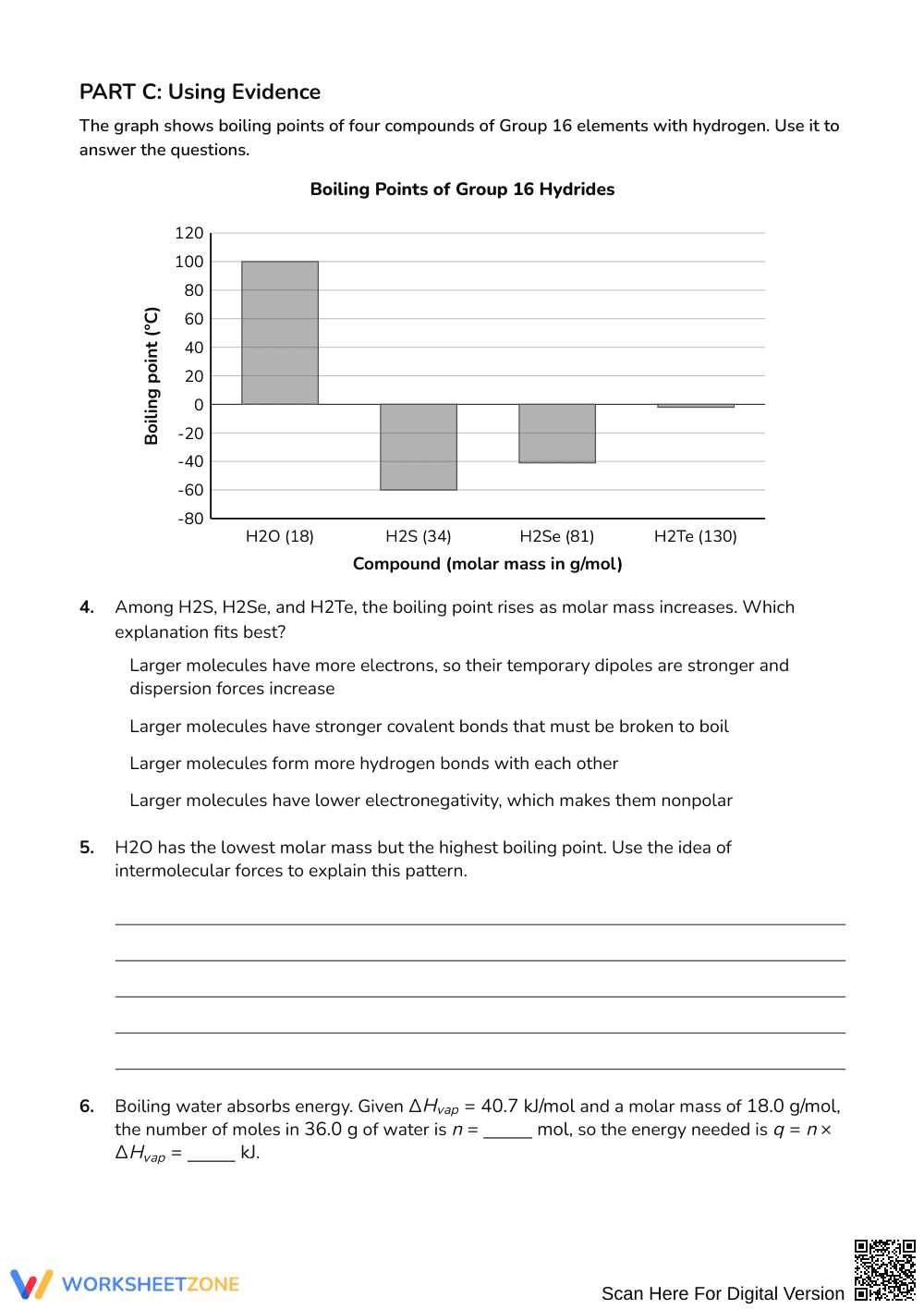
- Supported practice (Tasks 12–18): Learners inspect molecular diagrams showing delta charges, identify intra- versus intermolecular interactions, and analyze Group 16 hydride boiling curves.
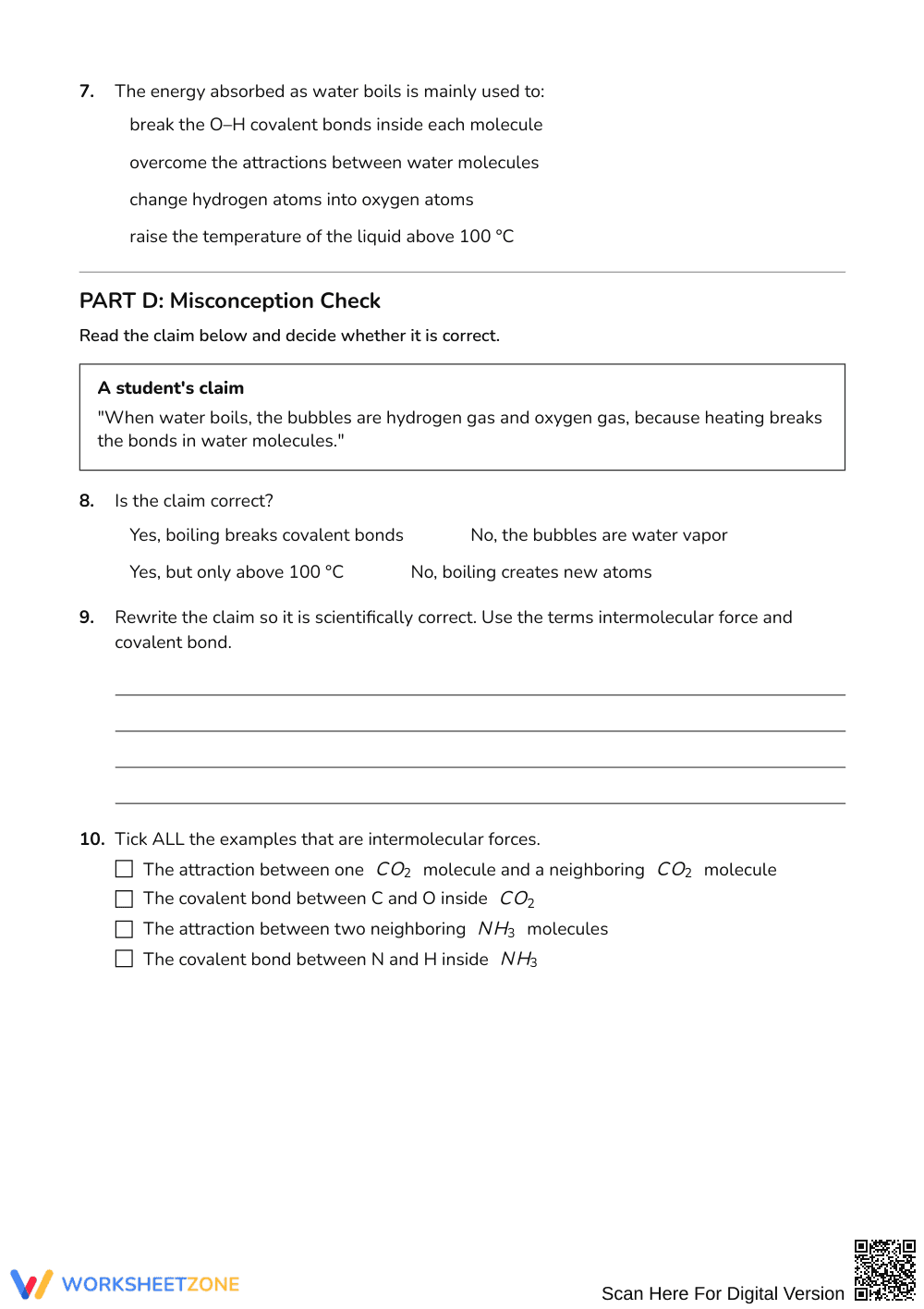
- Independent practice (Tasks 19–23): Students independently refute the misconception that boiling breaks covalent bonds, rephrase claims accurately, and classify multi-molecule interactions.
This sequence implements a gradual-release model that moves students systematically from recall to deep conceptual synthesis.
Standards Alignment
This assignment aligns with high school physical science standards requiring students to plan and conduct investigations or communicate scientific ideas about why intermolecular interactions influence bulk material properties. Students contrast dipole interactions, hydrogen bonding, and London dispersion forces against covalent bonding. Standard alignment can be copied directly into lesson plans, IEP goals, or district curriculum mapping tools.
How to Use It
Introduce this worksheet during mid-unit direct instruction after teaching Lewis structures and molecular polarity. Alternatively, assign it after lab work on evaporation rates as a quiet, formative assessment. While circulating, observe whether students mislabel the dashed line in Part B as a covalent bond. Expect students to finish the 23 items in approximately 45 to 55 minutes.
Who It's For
This activity supports general high school chemistry students, introductory physics students, and Advanced Placement Chemistry learners who need solid grounding in physical state changes. For differentiated support, pair this resource with a three-dimensional molecular model kit or a physical state anchor chart showing hydrogen bonding networks in liquid water.
According to research highlighted by Fisher & Frey (2014), student mastery of abstract scientific models accelerates when instructional tasks deliberately separate microscopic interactions from macroscopic observable phenomena. Science education research continually identifies intermolecular forces as one of the most stubborn conceptual hurdles in secondary chemistry, with over 60 percent of introductory students incorrectly assuming that boiling breaks intramolecular covalent bonds rather than intermolecular attractions. This 4-page worksheet targets that specific flaw through structured contrast drills, diagram evaluations, and explicit claim-refutation exercises. By pairing precise vocabulary definitions with visual particle representations of water and Group 16 hydride boiling data, the 23 structured items guide students through the gradual release of responsibility. As a result, learners gain the necessary reasoning skills to articulate why hydrogen bonding creates anomalous physical properties, establishing essential prerequisite knowledge for thermochemistry and molecular biology coursework.


