


























Views
Downloads



Ready Inequality Constraints Worksheet | Grade 6 Math
Paste this activity's link or code into your existing LMS (Google Classroom, Canvas, Teams, Schoology, Moodle, etc.).
Students can open and work on the activity right away, with no student login required.
You'll still be able to track student progress and results from your teacher account.
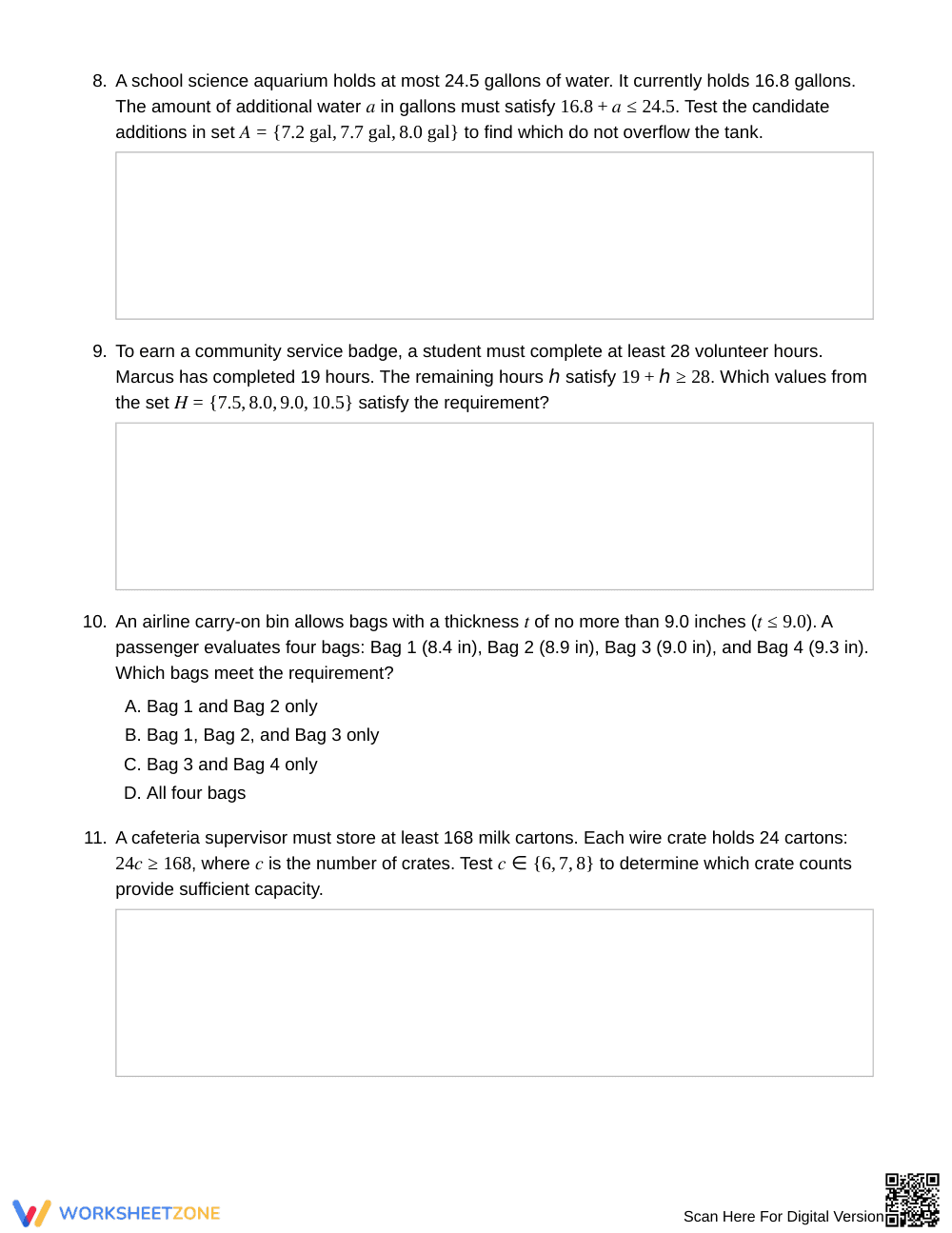
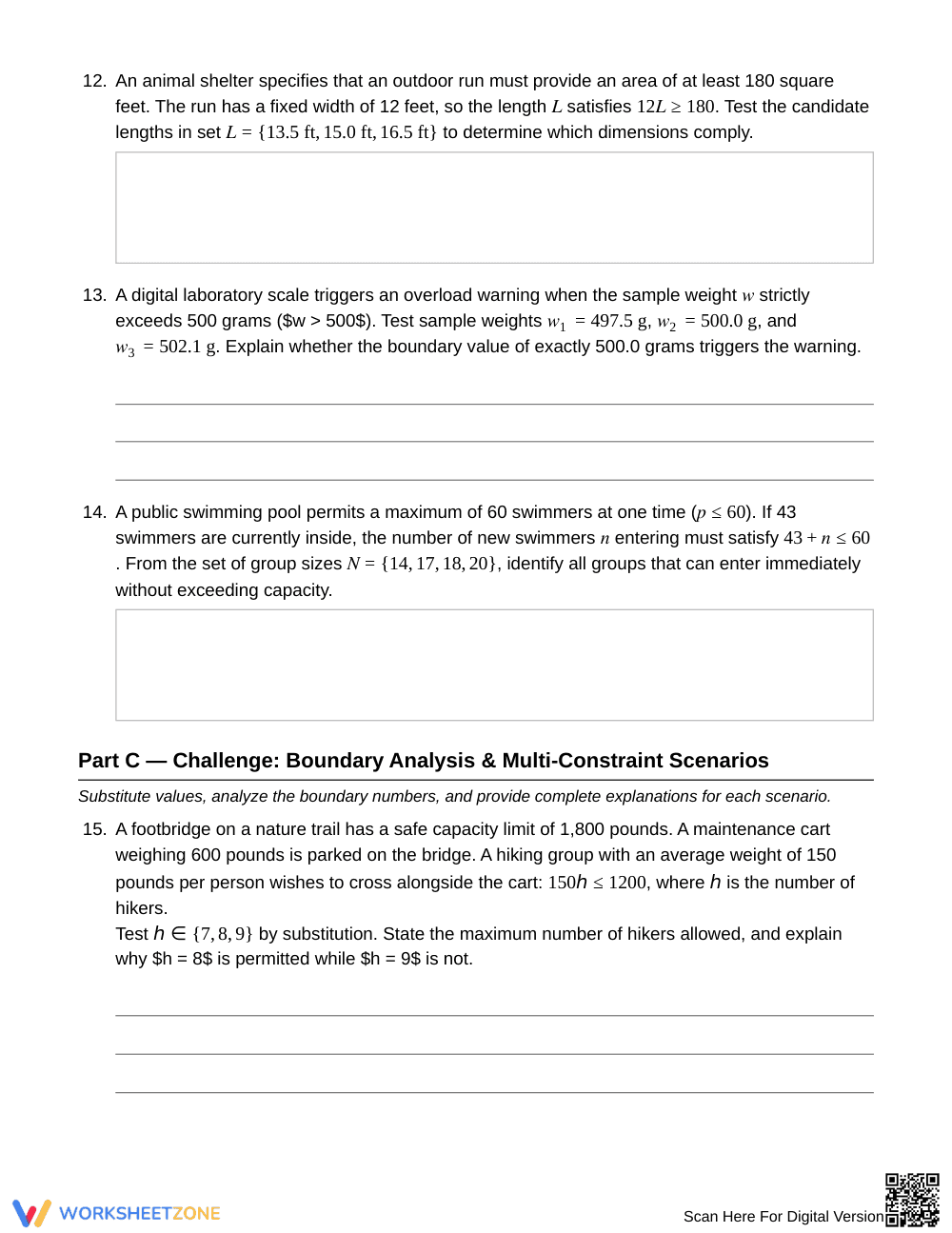
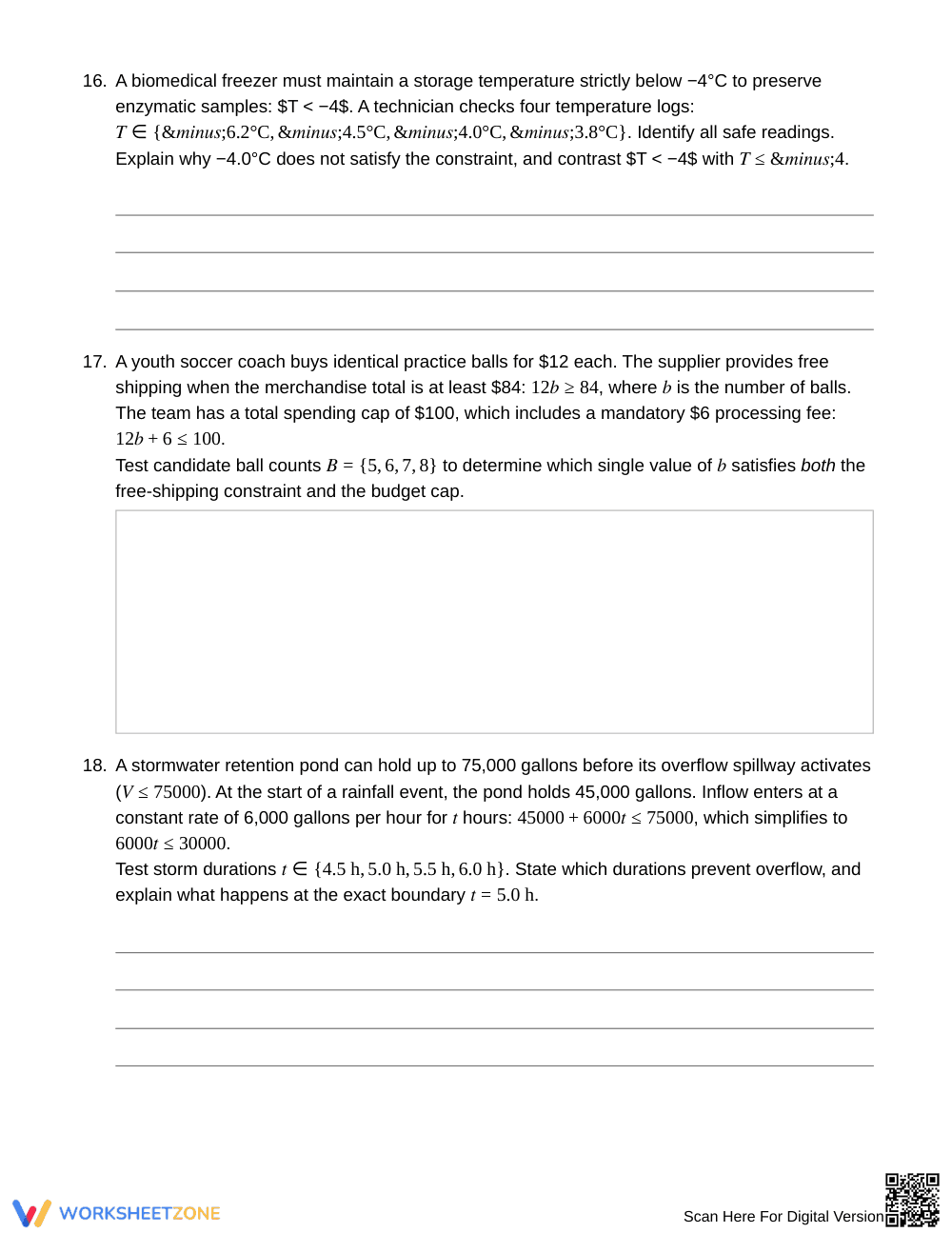
This targeted Grade 6 math worksheet guides students to test specific numbers from replacement sets to find solutions for one-step inequalities. Learners analyze real-world constraints such as capacity limits, weight thresholds, and volunteer quotas, determining whether boundary conditions satisfy strict and inclusive relations.
At a Glance
- Grade: 6 · Subject: Math
- Standard:
6.EE.B.5— Test specific values using substitution to see if they satisfy an inequality- Skill Focus: Identify Values That Satisfy a Constraint
- Format: 5 pages · 18 problems · Answer key included · PDF
- Best For: Independent practice, homework, small group review
- Time: 40–50 minutes
What's Inside
The resource features 18 structured problems organized across 5 student-facing and answer key pages. Students work through a reference box defining strict versus inclusive inequalities, discrete candidate set evaluations, multiple-choice checks, and contextual application problems. A complete 4-page answer key provides step-by-step substitution tables, truth values, and explicit boundary explanations.
Skill Progression
- Guided Practice (Part A, 4 tasks): Foundational substitution tasks where learners test candidate sets against simple linear inequalities and evaluate boundary values as true or false.
- Supported Practice (Part B, 10 tasks): Contextual word problems requiring students to evaluate multiple candidate values against real-life capacity, financial, and geometric constraints.
- Independent Practice (Part C, 4 tasks): Multi-constraint systems, rate-based equations, and critical boundary investigations where students justify why strict inequality limits fail while inclusive limits hold.
This sequence follows a gradual-release model, shifting learners from guided substitution mechanics to multi-step constraint verification.
Standards Alignment
Primary standard: 6.EE.B.5 — Understand solving an equation or inequality as a process of answering a question: which values from a specified set, if any, make the equation or inequality true? Use substitution to determine whether a given number in a specified set makes an equation or inequality true. This resource reinforces 6.EE.B.8 by connecting constraint sets to real-world boundary conditions. Both standard codes can be copied directly into lesson plans, IEP goals, or district curriculum mapping tools.
How to Use It
Deploy this practice sheet directly after introducing inequality notation and the concept of solution sets. For formative assessment, observe student reasoning on Part C boundary questions to check if they mistakenly include boundary numbers in strict inequalities ($<$ or $>$). The 18 tasks take approximately 40 to 50 minutes to complete in class or as paired homework.
Who It's For
Designed for general education Grade 6 mathematics classes, remedial math intervention, or Grade 7 review. Pair this activity with a visual number line anchor chart or guided notes on inequality vocabulary.
According to Fisher and Frey (2014), structured substitution routines enable middle school learners to bridge concrete arithmetic computation with abstract algebraic constraint reasoning. By requiring students to test discrete replacement values against linear boundaries, this targeted 18-problem worksheet reinforces foundational fluency under standard 6.EE.B.5. Learners evaluate true and false solution states across relatable real-world contexts such as elevator weight thresholds, fluid volume capacities, and school budget constraints. This systematic approach strengthens conceptual understanding of strict versus inclusive mathematical relations before students progress to graphing solution sets on open number lines. Incorporating clear boundary testing protocols helps sixth-grade students recognize why boundary endpoints satisfy inclusive inequalities while failing strict conditions. As a direct result, teachers can quickly target common misconceptions surrounding variable solution sets, ensuring students build lasting computational confidence and essential algebraic readiness across subsequent middle school grade levels.


