





























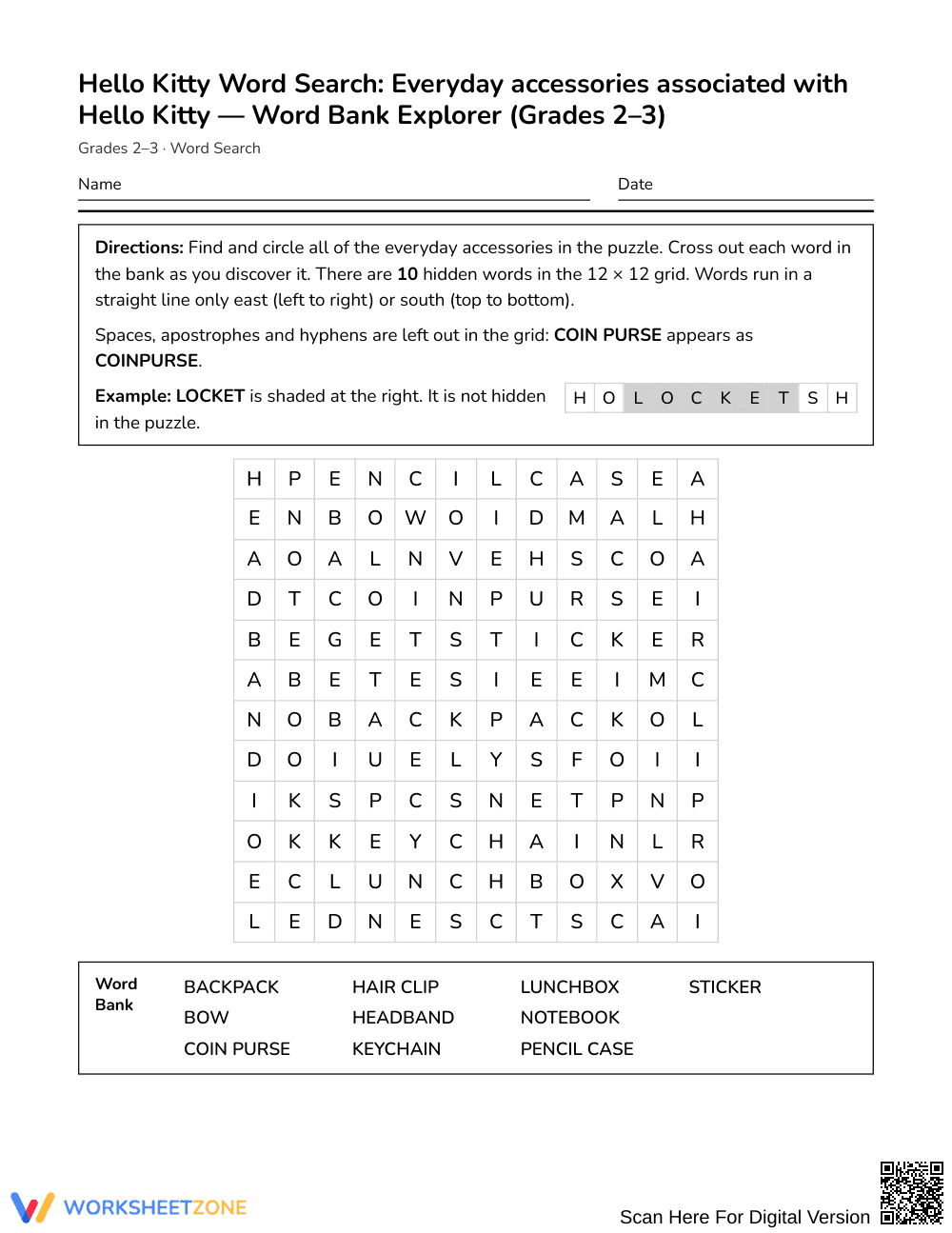


Ready Hello Kitty Accessories Word Search | Grades 2–3 ELA

Paste this activity's link or code into your existing LMS (Google Classroom, Canvas, Teams, Schoology, Moodle, etc.).
Students can open and work on the activity right away, with no student login required.
You'll still be able to track student progress and results from your teacher account.
This Grades 2–3 vocabulary word search engages young learners with themed school and personal accessories connected to Hello Kitty. Students practice visual scanning, spelling recognition, and word identification as they search for 10 everyday terms. The activity builds foundational literacy confidence through familiar, engaging themed context that motivates independent student work.
At a Glance
- Grade: Grades 2–3 · Subject: ELA
- Standard: Not standards-assessed — vocabulary enrichment
- Skill Focus: Everyday accessories associated with Hello Kitty
- Format: 1 page · 10 words · Answer key included · PDF
- Best For: Vocabulary warm-up or morning work
- Time: 10–15 minutes
This 1-page word search includes an uncluttered grid featuring 10 hidden vocabulary words alongside an organized, alphabetical word bank. Learners cross off items as they locate them, reinforcing letter patterns and word recognition. A clear 2-page answer key provides teacher and student reference with highlighted solution placements for quick visual verification.
The puzzle utilizes a clear 12 × 12 letter grid tailored specifically for early elementary learners in Grades 2–3. All 10 hidden terms run in two intuitive directions: horizontally from left to right (East) and vertically from top to bottom (South). Because words do not appear backward or diagonally, students can independently locate terms without visual frustration, using the alphabetical bank to track progress.
This activity provides targeted vocabulary enrichment and is not aligned to a specific academic standard. It focuses on functional word recognition, spelling reinforcement, and fine motor tracking rather than formal assessment benchmarks, giving teachers a flexible resource for seasonal literacy stations or informal vocabulary review.
Distribute this puzzle during morning arrival to establish a focused classroom routine, or use it after direct phonics instruction as a relaxing vocabulary station. While students work, circulate to observe visual tracking habits and letter-sequence scanning strategies. Most learners complete the 10 hidden words in 10 to 15 minutes.
This resource is designed for Grades 2–3 general education classrooms, English language learners developing everyday noun vocabulary, and students needing calming fine-motor practice. Pair this word search with an illustrated school accessories anchor chart or a descriptive writing prompt where students describe their own backpack essentials.
Themed word search activities support foundational literacy and vocabulary acquisition by reinforcing orthographic mapping, letter-pattern awareness, and focused visual scanning. As demonstrated by Fisher & Frey (2014), purposeful word exposure within low-stakes, engaging contexts helps early elementary learners solidify mental representations of written words while reducing cognitive anxiety. By presenting 10 school and everyday accessory terms in a 12 by 12 grid with strictly horizontal and vertical placements, this enrichment puzzle promotes systematic left-to-right and top-to-bottom reading pathways. Students cross off vocabulary terms from an alphabetical bank, actively pairing visual word shapes with correct spelling sequences. Because the activity serves as ungraded vocabulary enrichment rather than formal standards assessment, it provides valuable practice for emerging readers in Grades 2–3 who benefit from repeated print exposure. Incorporating structured print puzzles into independent literacy rotations fosters sustained task attention, word recognition speed, and positive associations with independent reading routines.


