




























Ready Graham's Law Evidence Worksheet | Grade 9-12 Science
Paste this activity's link or code into your existing LMS (Google Classroom, Canvas, Teams, Schoology, Moodle, etc.).
Students can open and work on the activity right away, with no student login required.
You'll still be able to track student progress and results from your teacher account.
This Graham's Law worksheet equips high school chemistry students to interpret empirical evidence and graphs showing gas diffusion and effusion rates. Learners analyze diffusion tube measurements, calculate molar mass ratios, and apply kinetic molecular theory to verify how molecular mass governs gas velocity across 18 structured questions.
At a Glance
- Grade: Grades 9–12 · Subject: Science
- Standard: Physical Science — Interpret empirical laboratory evidence and quantitative effusion rate graphs using kinetic molecular theory
- Skill Focus: Graph or Evidence Interpretation
- Format: 4 printable pages · 18 structured problems · Full answer key included · PDF
- Best For: High school chemistry gas laws practice
- Time: 40–50 minutes
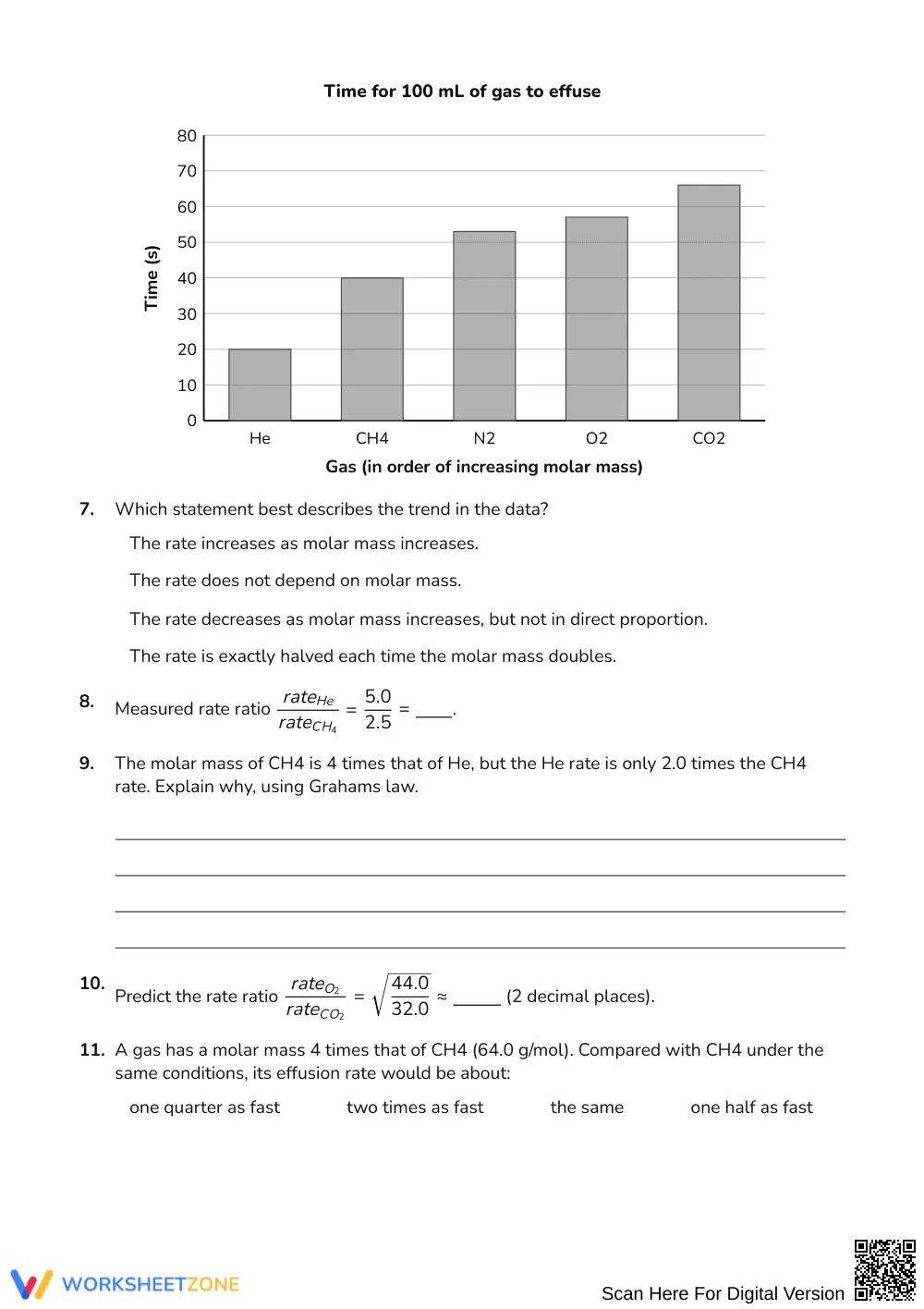
What's Inside: Across 4 pages, this resource translates gas behavior into concrete data interpretation. Part A features a diffusion tube diagram pairing ammonia and hydrochloric acid, requiring students to evaluate reaction distance ratios. Part B provides an effusion table and trend graph tracking five gases to calculate mathematical rate ratios. Part C presents particle speed models to deduce unknown gases and temperature effects. A full 4-page answer key provides complete explanations.
Skill Progression
- Guided practice (Part A, Problems 1–6): Students observe macroscopic tube evidence, calculate distance ratios with formulas, and identify collision-related experimental variations.
- Supported practice (Part B, Problems 7–12): Students analyze effusion graphs and tables, solving inverse-square-root rate relationships across five elemental and compound gases.
- Independent practice (Part C, Problems 13–18): Students interpret particle velocity vectors to identify mystery gases and predict thermal kinetic shifts without formula cues.
This sequence follows the gradual-release model, shifting learners from guided diagram analysis to independent conceptual synthesis.
Standards Alignment
This worksheet aligns with high school physical science standards for kinetic molecular theory and gas properties. Students apply the kinetic energy relationship KE = 1/2mv² to explain why molecules of unequal mass exhibit different velocities at equal temperatures. Supporting standards address quantitative mathematical modeling and evidence evaluation in science. Both standard codes can be copied directly into lesson plans, IEP goals, or district curriculum mapping tools.
How to Use It
Assign this worksheet immediately following direct instruction on Graham's law to reinforce the inverse relationship between molar mass and effusion speed. During classwork, observe whether students mistakenly double rates when mass doubles rather than applying square roots. It functions effectively as guided practice or paired lab prep, requiring 40 to 50 minutes.
Who It's For
This resource targets high school chemistry learners studying gas mechanics and kinetic molecular principles. Clear visual diagrams and structured formulas support developing students, while particle-level predictions challenge advanced learners. Pair this assignment directly with a gas simulation lab or molecular motion anchor chart.
Mastering graph and evidence interpretation in gas behavior provides essential scaffolding for high school chemistry students connecting microscopic molecular dynamics to macroscopic laboratory observations. According to Fisher & Frey (2014), structured progression from concrete physical models to abstract graphical representations significantly enhances schema development and retention in secondary science education. When students evaluate diffusion distances, compute effusion rate ratios, and interpret particle velocity models across 18 targeted tasks, they bridge computational problem solving with conceptual reasoning. Fisher & Frey (2014) demonstrate that integrating explicit visual evidence before quantitative problem solving lowers cognitive load, enabling learners to diagnose why heavier gas molecules move slower despite sharing equal average kinetic energy. This 4-page instructional resource embodies research-validated gradual release, providing high school chemistry educators with verifiable assessment evidence that confirms student mastery across foundational physical science gas law benchmarks and kinetic molecular theory concepts.


