


























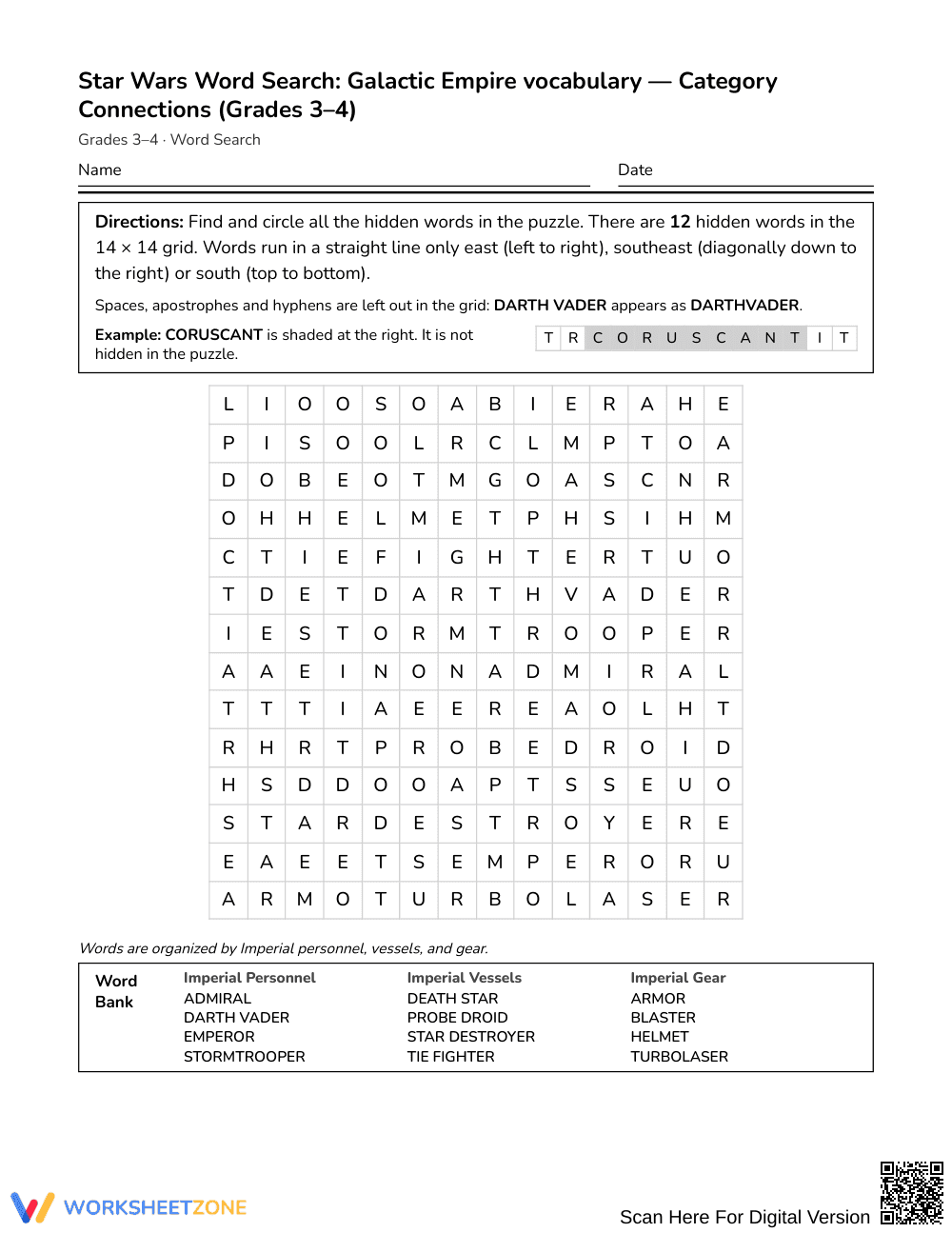

Ready Galactic Empire Word Search | Grades 3–4 ELA
Paste this activity's link or code into your existing LMS (Google Classroom, Canvas, Teams, Schoology, Moodle, etc.).
Students can open and work on the activity right away, with no student login required.
You'll still be able to track student progress and results from your teacher account.
This Grades 3–4 vocabulary word search reinforces theme-based word recognition by engaging students in locating 12 themed Galactic Empire terms. Learners identify key sci-fi nouns grouped into meaningful categories, strengthening orthographic mapping, letter pattern recognition, and thematic reading comprehension through focused, low-stress independent practice.
At a Glance
- Grade: Grades 3–4 · Subject: ELA
- Standard: Not standards-assessed — vocabulary enrichment
- Skill Focus: Galactic empire vocabulary
- Format: 1 page · 12 words · Answer key included · PDF
- Best For: Early finishers or vocabulary centers
- Time: 15–20 minutes
What's Inside
This single-page printable activity features a clean 14-by-14 letter grid containing 12 target vocabulary words. The word bank organizes terms into three conceptual categories: Imperial personnel, vessels, and gear. A comprehensive 3-page answer key provides clear visual verification of letter placements for quick grading or student self-checking.
Puzzle Structure & Mechanics
The puzzle embeds target words across a 14-by-14 letter grid using three beginner-friendly search trajectories: East (horizontal left-to-right), South (vertical downward), and Southeast (diagonal downward). Words do not run backward or upward, making the activity developmentally appropriate for elementary learners. Rather than presenting an unstructured alphabetical list, the word bank groups terms by category—personnel (such as Emperor and Admiral), vessels (such as Death Star and Tie Fighter), and gear (such as Blaster and Helmet)—to help students make semantic associations while scanning for orthographic letter sequences.
Standards Alignment
This resource serves as targeted vocabulary enrichment and is not aligned to an assessed state standard. It provides supplementary practice with domain-specific terminology, category relationships, and word recognition to enrich language acquisition and high-interest reading units.
How to Use It
Deploy this activity during independent literacy rotations or assign it to early finishers following direct vocabulary instruction. During seatwork, circulate to observe student scanning habits; learners who systematically track initial letter clusters demonstrate stronger visual search efficiency than those scanning randomly. Students typically complete the 12-word search within 15 to 20 minutes.
Who It's For
This puzzle is designed for elementary students in Grades 3–4 seeking high-interest vocabulary reinforcement. It provides accessible spelling practice for striving readers while keeping advanced learners engaged. Pair this word search with a science fiction reading passage, creative writing prompt, or space-themed anchor chart to deepen thematic context.
Structured orthographic scanning activities build foundational word familiarity by reinforcing letter-sequence recognition and category-based recall. While this vocabulary enrichment word search is not standards-assessed, systematic word play supports automatic word retrieval and print awareness among intermediate elementary readers. According to Fisher & Frey (2014), intentional exposure to domain-specific vocabulary across repeated reading contexts helps learners anchor specialized terms into long-term memory. By organizing 12 thematic terms into conceptual groups—personnel, vessels, and gear—this puzzle encourages students to connect definitions with orthographic patterns. The predictable East, South, and Southeast directional layout prevents cognitive fatigue, allowing third- and fourth-grade students to focus on visual discrimination, spelling patterns, and semantic connections. The result is an engaging, zero-prep literacy tool that reinforces language acquisition during independent centers, morning warm-ups, or extension blocks.


