































Ready Function Value vs Limit Worksheet | Grade 12 Calculus

Paste this activity's link or code into your existing LMS (Google Classroom, Canvas, Teams, Schoology, Moodle, etc.).
Students can open and work on the activity right away, with no student login required.
You'll still be able to track student progress and results from your teacher account.
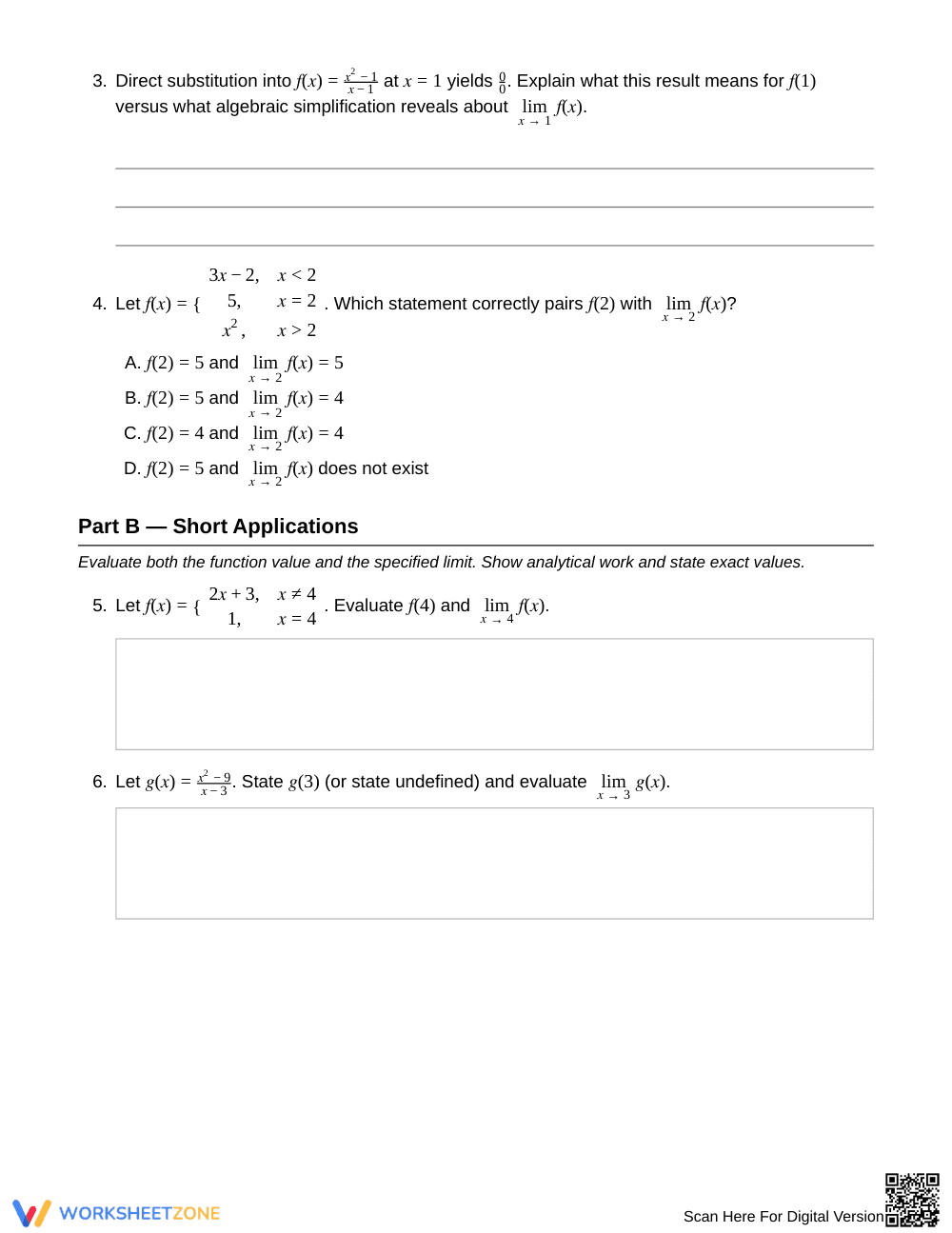
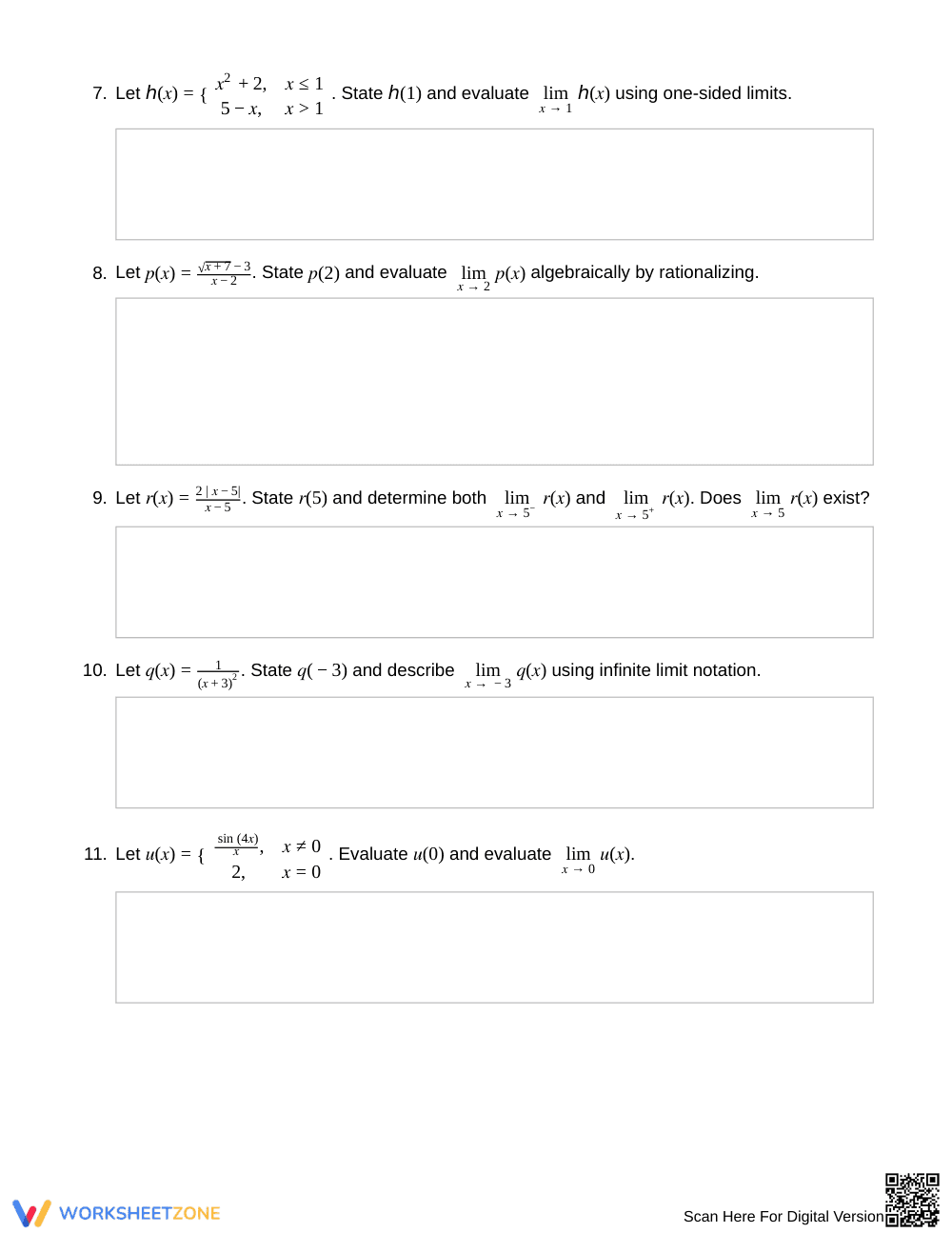
This Grade 12 Calculus worksheet builds student mastery in distinguishing function values from limits. Students analyze piecewise graphs, evaluate rational indeterminate forms, apply algebraic rationalization, and test continuity across 16 structured problems to eliminate calculus misconceptions.
At a Glance
- Grade: 12 · Subject: Calculus
- Standard: Limits & Continuity — Distinguish point evaluation from local neighborhood behavior graphically and algebraically
- Skill Focus: Function Value Versus Limit
- Format: 5 pages · 16 problems · Answer key included · PDF
- Best For: AP Calculus practice
- Time: 45–60 minutes
What's Inside
This 5-page worksheet provides 16 problems with a 3-page step-by-step answer key. It includes foundational rule boxes, graph-based questions, indeterminate algebraic evaluations, absolute value limits, trigonometric functions, and continuity proofs.
Skill Progression
- Guided Practice (Part A, Problems 1–4): Multiple-choice concept checks, graph analysis, and explaining indeterminate 0/0 behavior.
- Supported Practice (Part B, Problems 5–12): Eight algebraic evaluations using factoring, conjugate rationalization, one-sided limits, and trigonometric identities.
- Independent Practice (Part C, Problems 13–16): Four advanced tasks covering piecewise construction, error analysis, Squeeze Theorem proofs, and continuity verification.
This gradual-release structure moves students from foundational definitions to rigorous analytical proof.
Standards Alignment
This resource aligns with high school calculus standards for Limits and Continuity, requiring students to distinguish point values from limiting behavior using graphs and algebra. Standard descriptions can be copied directly into lesson plans, IEP goals, or district curriculum mapping tools.
How to Use It
Assign this worksheet after direct instruction on limits or before continuity assessments. During formative monitoring, check if students confuse 0/0 with undefined values. Completion takes approximately 45 to 60 minutes.
Who It's For
Designed for Grade 12 Calculus and AP Calculus students needing practice separating point values from limits. Differentiate by assigning Parts A and B for targeted review or Part C for extension. Pair with dynamic graphing tools.
Mastering the mathematical distinction between function values and limits is a core prerequisite for success in advanced high school calculus. According to research on scaffolded instructional design from Fisher & Frey (2014), structured progression from conceptual identification to independent analytical transfer produces significant gains in student procedural fluency and conceptual retention. In calculus, students frequently conflate the static existence of f(c) with the neighborhood convergence of limits, leading to persistent errors in continuity proofs and derivative definitions. This 16-problem resource systematically targets that cognitive obstacle through graph analysis, indeterminate algebraic evaluation, piecewise construction, and Squeeze Theorem applications across 5 pages. By pairing clear foundational reference rules with rigorous error analysis and 3 pages of step-by-step solutions, educators ensure senior mathematics students achieve measurable mastery in foundational limit analysis before entering college-level differential calculus coursework.


