































Ready Freezing and Melting Word Search | Grades 3–4 ELA

Paste this activity's link or code into your existing LMS (Google Classroom, Canvas, Teams, Schoology, Moodle, etc.).
Students can open and work on the activity right away, with no student login required.
You'll still be able to track student progress and results from your teacher account.
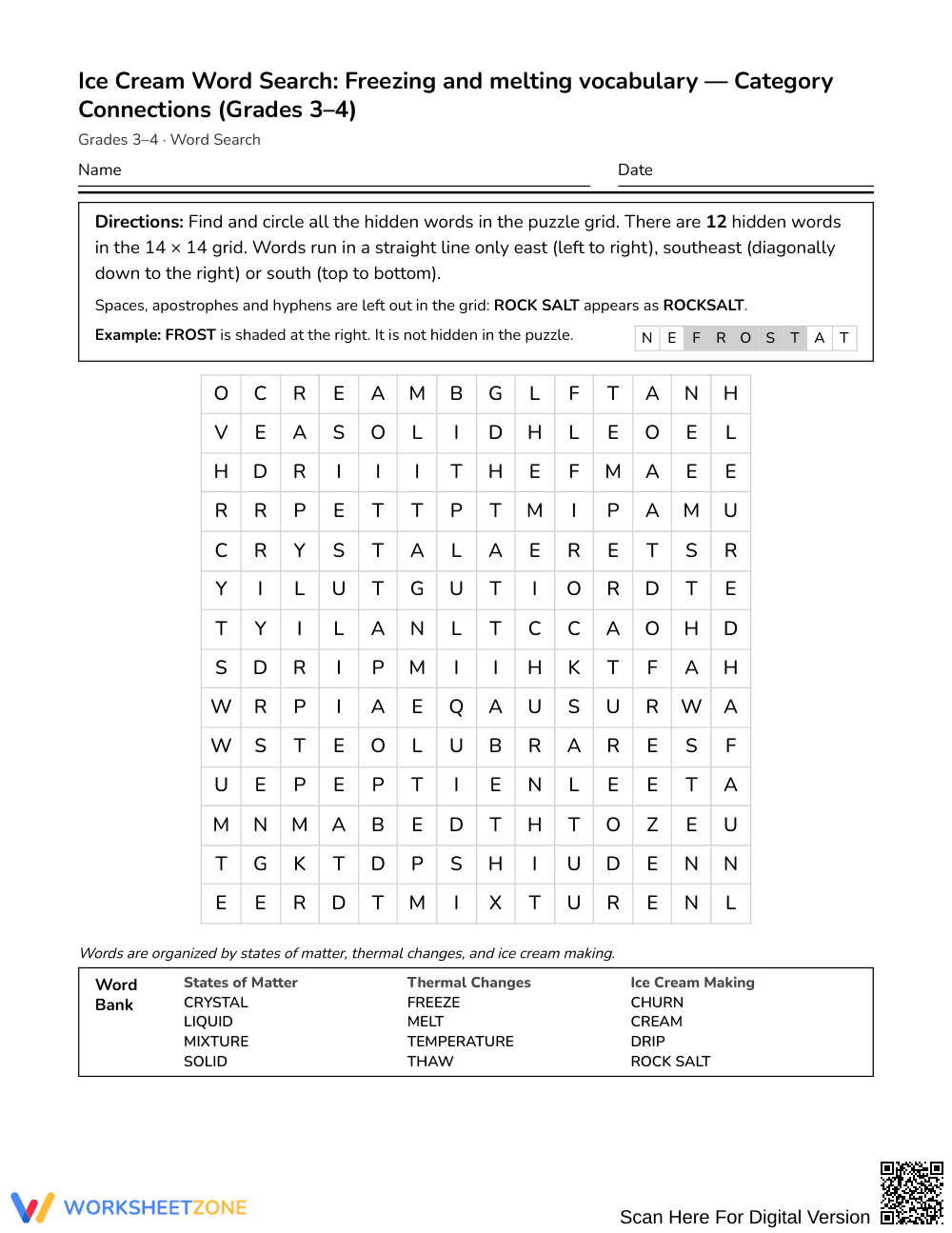
This Grades 3–4 vocabulary word search strengthens student understanding of freezing and melting concepts by challenging learners to locate 12 key science terms. Students connect thermal change vocabulary to practical physical science concepts while reinforcing word recognition, letter pattern tracking, and spelling in an engaging thematic ice cream context.
At a Glance
- Grade: Grades 3–4 · Subject: English Language Arts (ELA) Vocabulary
- Standard: Not standards-assessed — vocabulary enrichment
- Skill Focus: Freezing and melting vocabulary across thematic science categories
- Format: 1 student page · 12 words · 3-page answer key included · PDF
- Best For: Elementary science vocabulary review and early finishers
- Time: 15–25 minutes
What's Inside
This single-page word search activity presents 12 curated vocabulary words divided into three thematic categories: States of Matter, Thermal Changes, and Ice Cream Making. The activity includes concise definitions that explain each scientific term, supporting conceptual understanding alongside orthographic search. A comprehensive 3-page answer key provides clear visual solutions for rapid checking.
How the Puzzle Works
The activity is built on a 14 x 14 letter grid designed specifically for intermediate elementary learners. Words run in three accessible directions: horizontally East (left to right), vertically South (top to bottom), and diagonally Southeast (down and right). Words do not run backward, ensuring an age-appropriate challenge for Grades 3–4. Students search for 12 words grouped by category, linking terms like solid, melt, churn, and temperature to their physical properties.
Standards Alignment
This worksheet is designed strictly for vocabulary enrichment and is not aligned to a specific academic standard. It supports cross-curricular literacy by connecting elementary English Language Arts word study with foundational physical science concepts surrounding heat energy and states of matter.
How to Use It
Deploy this word search during or immediately after a science unit on heating, cooling, or mixtures. First, use it as an independent station task during literacy rotations to reinforce scientific vocabulary in an engaging format. Second, assign it as a calm warm-up or early-finisher task. During completion, observe whether students identify words using letter sequences or read definitions first to guide their search. Typical completion time spans 15 to 25 minutes.
Who It's For
This resource is tailored for Grades 3–4 students developing academic vocabulary in physical science and reading. For students needing support, pair the puzzle with a peer partner or highlight the first letter of each term. Pair this activity naturally with an informational reading passage or anchor chart detailing the melting point of ice and the freezing process of ice cream.
This non-assessed vocabulary enrichment activity reinforces freezing and melting vocabulary for Grades 3–4 learners through targeted word location and category classification. Although not aligned to a formal standard code, the word search integrates cross-curricular physical science terminology with orthographic pattern recognition. According to Fisher & Frey (2014), intentional exposure to domain-specific words within thematic clusters accelerates vocabulary acquisition and strengthens conceptual comprehension across diverse content areas. By organizing 12 essential terms into categories such as states of matter, thermal changes, and ice cream making, this activity encourages students to connect abstract scientific definitions directly to concrete physical changes. The intentional design features three directional pathways: East, Southeast, and South across a 14 by 14 grid, providing developmentally appropriate cognitive engagement without unnecessary frustration. Educators can utilize this resource for literacy centers, science warm-ups, or purposeful early-finisher review.


