


























Views
Downloads




Ready Food Web Indirect Effects Worksheet | Grade 7 Science
Paste this activity's link or code into your existing LMS (Google Classroom, Canvas, Teams, Schoology, Moodle, etc.).
Students can open and work on the activity right away, with no student login required.
You'll still be able to track student progress and results from your teacher account.
This Grade 7 science worksheet guides students to analyze competing indirect effects in aquatic food webs. Across 14 rigorous items on 5 pages, learners trace trophic cascades, interpret multi-year monitoring data, and evaluate conflicting models. Students discover how top-down predation and bottom-up nutrient forces simultaneously determine population biomass and water clarity.
At a Glance
- Grade: 7 · Subject: Science
- Standard: Ecosystem Interactions — Predict how population changes affect other species in food webs
- Skill Focus: Competing Indirect Effects in Food Webs
- Format: 5 pages · 14 problems · Answer key included · PDF
- Best For: Trophic cascade data practice
- Time: 45–60 minutes
What's Inside
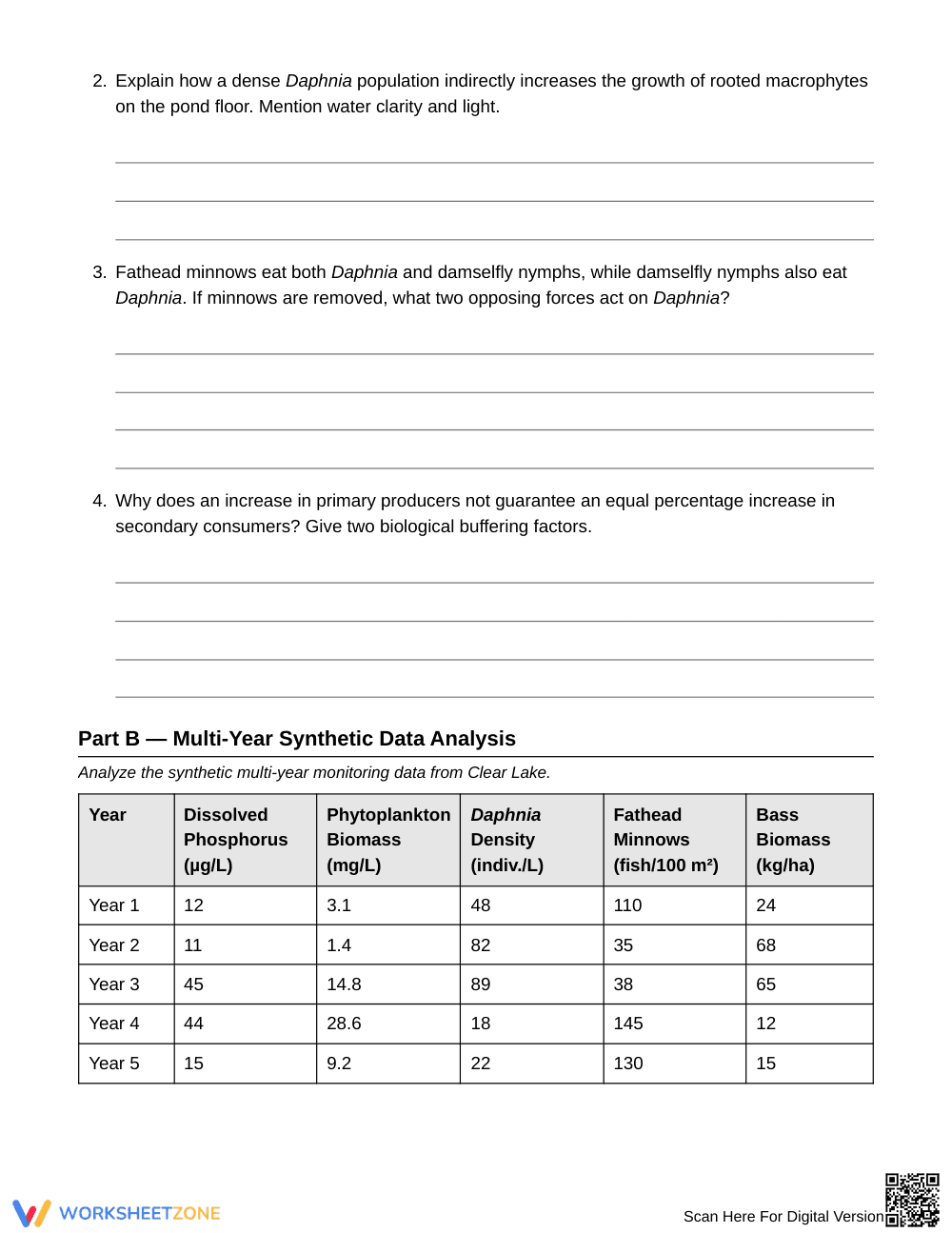
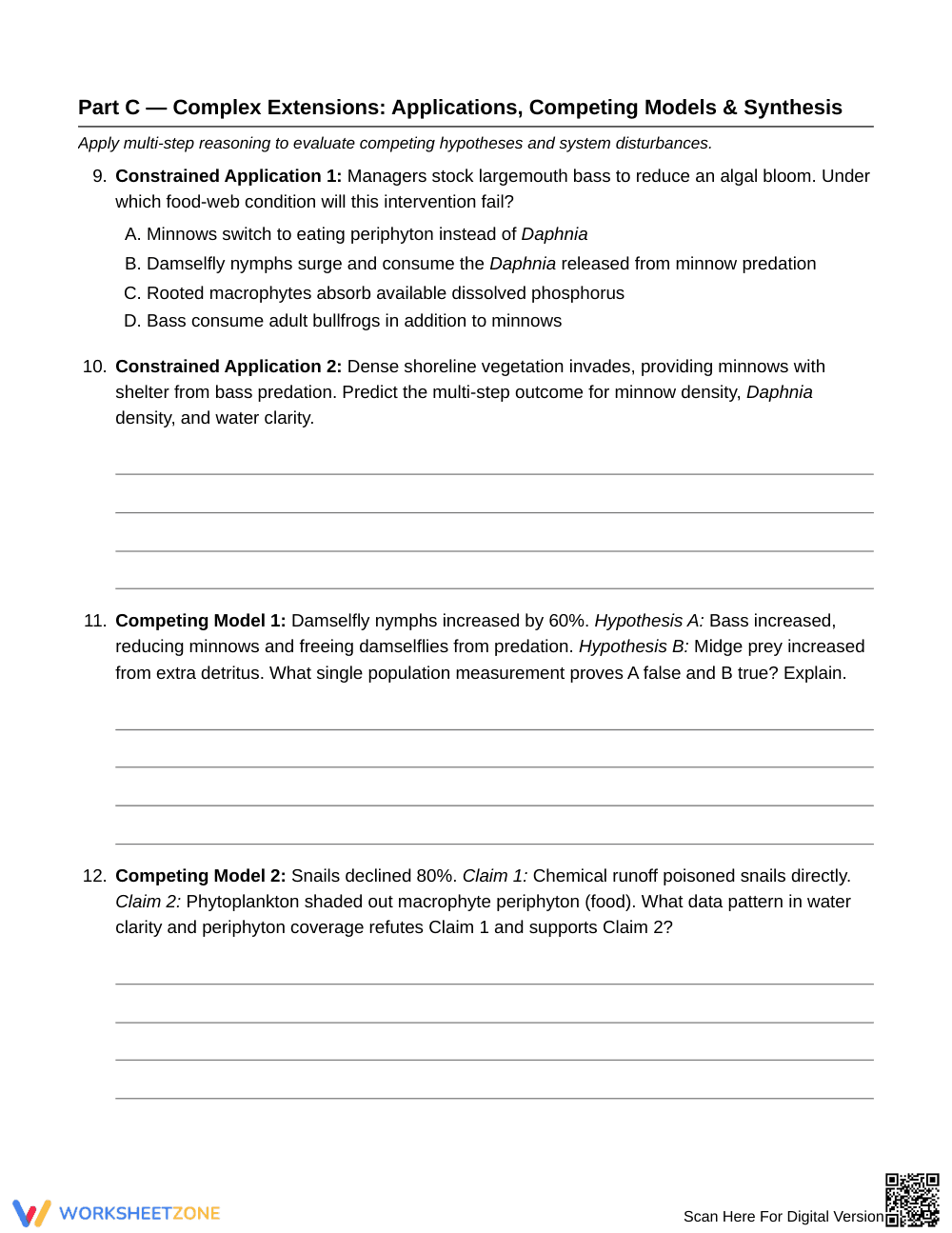
This 5-page activity outlines the Clear Lake Ecological Model, defining core feeding links alongside top-down and bottom-up pathways. Students complete 14 tasks progressing from causal chain diagrams to multi-year data interpretation and experimental design. The resource includes structured short-answer prompts, scenario evaluations, and a 2-page answer key with complete explanations.
Skill Progression
- Guided Practice (Part A, 4 tasks): Students trace direct interactions and build 4-step causal chains using directional indicators. Scaffolds guide learners to connect grazer densities to light penetration.
- Supported Practice (Part B, 4 tasks): Learners analyze a 5-year monitoring table tracking phosphorus, phytoplankton, Daphnia, minnows, and bass to identify cascade dynamics.
- Independent Practice (Part C, 6 tasks): Students evaluate competing ecological hypotheses, design controlled enclosure experiments, and defend forecasts for simultaneous disturbances.
This progression mirrors the gradual-release framework, guiding students from qualitative causal mapping to autonomous ecological data analysis.
Standards Alignment
This resource aligns with middle school life science standards on ecosystem interactions and community dynamics. Students evaluate how resource availability and competing interactions affect population stability. Both standard codes can be copied directly into lesson plans, IEP goals, or district curriculum mapping tools.
How to Use It
Use this worksheet after direct instruction on food webs to deepen systems thinking. First, assign it for collaborative partner work during a 50-minute class period where student pairs debate competing models in Part C. Second, use Parts A and B as an in-class check and Part C as homework. Formatively observe whether students trace multi-step indirect pathways or default to simple direct predation.
Who It's For
This worksheet serves Grade 7 science students mastering ecosystem interactions. Causal prompts scaffold support for struggling learners, while multi-year data analysis challenges advanced students. Pair this resource with an aquatic ecosystem food web diagram or population dynamics lesson.
According to Fisher & Frey (2014), purposeful gradual-release instruction requires moving students systematically from teacher-modeled foundational principles to complex collaborative inquiry and autonomous analytical reasoning. This Grade 7 science worksheet operationalizes that framework by guiding students through competing indirect effects within aquatic food webs across 14 rigorous items. Beginning with a detailed structural model of Clear Lake, students first trace direct feeding interactions, advance through multi-year ecological population data, and ultimately resolve competing scientific hypotheses. Research demonstrates that presenting counter-intuitive, multi-directional food web pathways prevents common student misconceptions regarding linear energy transfer and singular causality in ecosystems. By requiring middle school learners to coordinate simultaneous top-down predatory pressures with bottom-up nutrient pulses, this 5-page curriculum resource equips students to defend evidence-based claims about dynamic ecosystem stability, community resilience, and environmental interventions with confidence and scientific precision.


