




























Views
Downloads
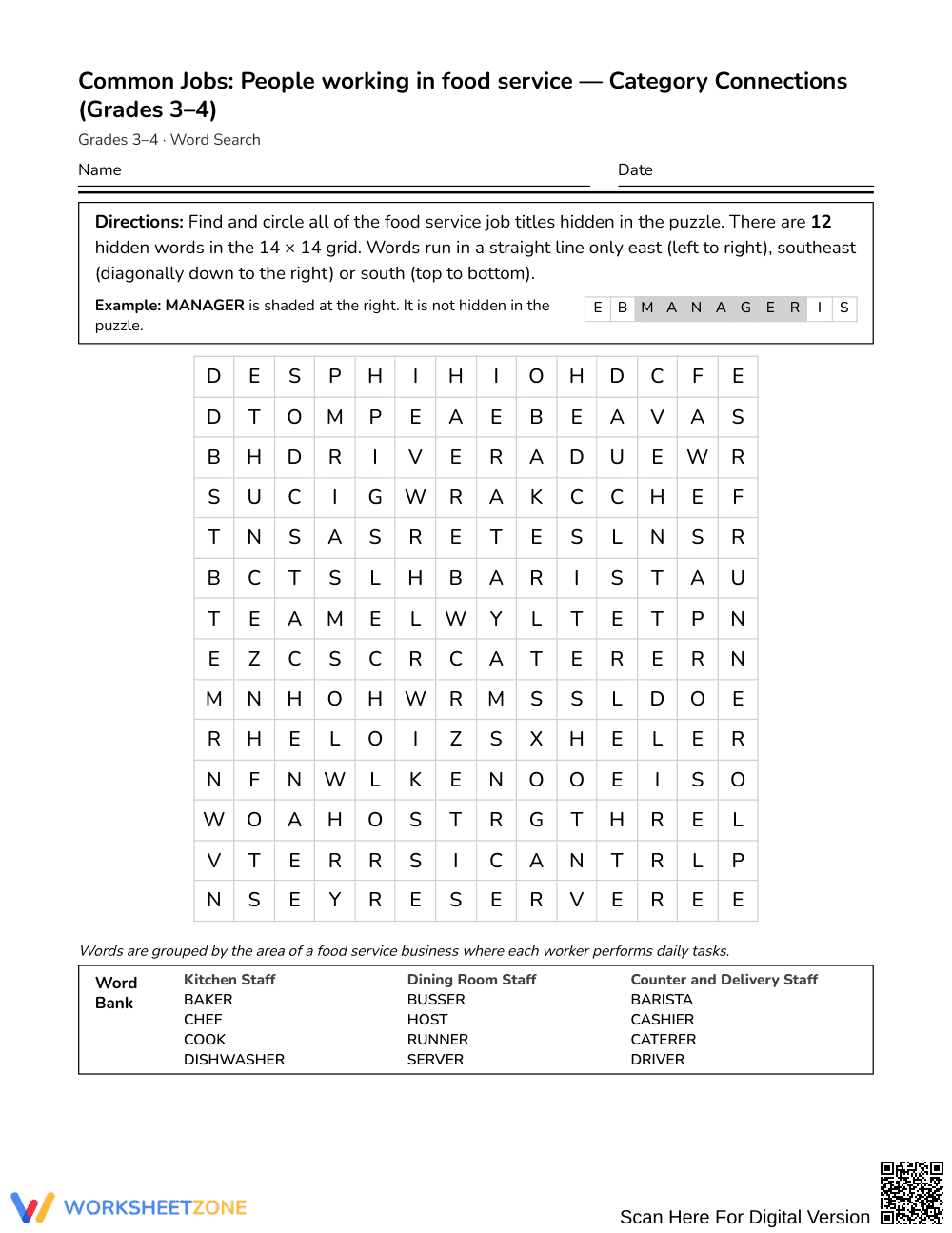

Ready Food Service Word Search | Grades 3–4 Social Studies

Paste this activity's link or code into your existing LMS (Google Classroom, Canvas, Teams, Schoology, Moodle, etc.).
Students can open and work on the activity right away, with no student login required.
You'll still be able to track student progress and results from your teacher account.
This Grades 3–4 Social Studies word search reinforces career vocabulary by challenging students to identify people working in food service across a letter grid. Learners connect twelve distinct job roles to their work settings, reinforcing spelling, reading recognition, and community roles during introductory career exploration or independent social studies centers.
At a Glance
- Grade: Grades 3–4 · Subject: Elementary Social Studies
- Standard: Not standards-assessed — vocabulary enrichment
- Skill Focus: Identifying people working in food service careers
- Format: 1 student page · 12 hidden words · 3-page answer key included · PDF
- Best For: Community helpers career vocabulary practice
- Time: 15–20 minutes of independent puzzle work
What's Inside
This resource features a single-page word search containing 12 food service terms organized into operational categories. Words are grouped into kitchen staff, dining room staff, and counter and delivery staff, helping students connect job titles to work locations. A complete 3-page answer key provides visual letter tracking for easy checking.
Puzzle Mechanics and Structure
Students search for 12 hidden words across a 14 x 14 letter grid. To keep the puzzle accessible, words run in three directions: horizontally forward from west to east (E), diagonally downward from northwest to southeast (SE), and vertically downward from north to south (S). No backwards or upward paths are used, preventing frustration while reinforcing left-to-right reading patterns. The puzzle organizes the word bank into three workplace categories—kitchen staff, dining room staff, and counter and delivery staff—paired with concise clues defining each role.
Standards Alignment
This activity serves as supplemental vocabulary enrichment and is not aligned to a formal academic content standard. It is designed to reinforce social studies terminology, occupational awareness, and domain-specific reading comprehension within an elementary Community Helpers instructional unit.
How to Use It
Introduce this word search after direct instruction on community economic roles to reinforce vocabulary. Alternatively, place the sheet in an independent social studies station or assign it to early finishers. While students search the grid, conduct quick formative observation by asking learners to describe what a busser or barista does before circling the term. Third and fourth graders typically complete the puzzle in 15 to 20 minutes.
Who It's For
This word search is tailored for students in Grades 3–4 exploring community helpers and career pathways. The directional constraints (E, SE, S) and categorized groupings support English language learners and developing readers who benefit from clear visual boundaries. Pair this puzzle with an informational read-aloud about neighborhood businesses or a community helpers anchor chart.
Vocabulary acquisition in elementary social studies relies on structured exposure to domain-specific terminology across varied print formats. According to Fisher & Frey (2014), intentional word exposure embedded within engaging thematic tasks strengthens semantic associations and improves long-term conceptual retention for developing readers. This Grades 3–4 word search reinforces 12 essential career vocabulary titles related to people working in food service, contextualizing job roles such as chefs, bussers, cashiers, and baristas within well-defined workplace environments. By restricting word placements to east, southeast, and south orientations within a 14 x 14 grid, the activity scaffolds orthographic mapping and direct visual scanning without imposing cognitive overload. Designed as a flexible enrichment resource for community helpers units, this 1-page puzzle pairs with a 3-page answer key to support independent practice, classroom language development, and foundational career literacy.


