




























Ready Flower & Pollinator Word Search | Grades 7–8 Science
Paste this activity's link or code into your existing LMS (Google Classroom, Canvas, Teams, Schoology, Moodle, etc.).
Students can open and work on the activity right away, with no student login required.
You'll still be able to track student progress and results from your teacher account.
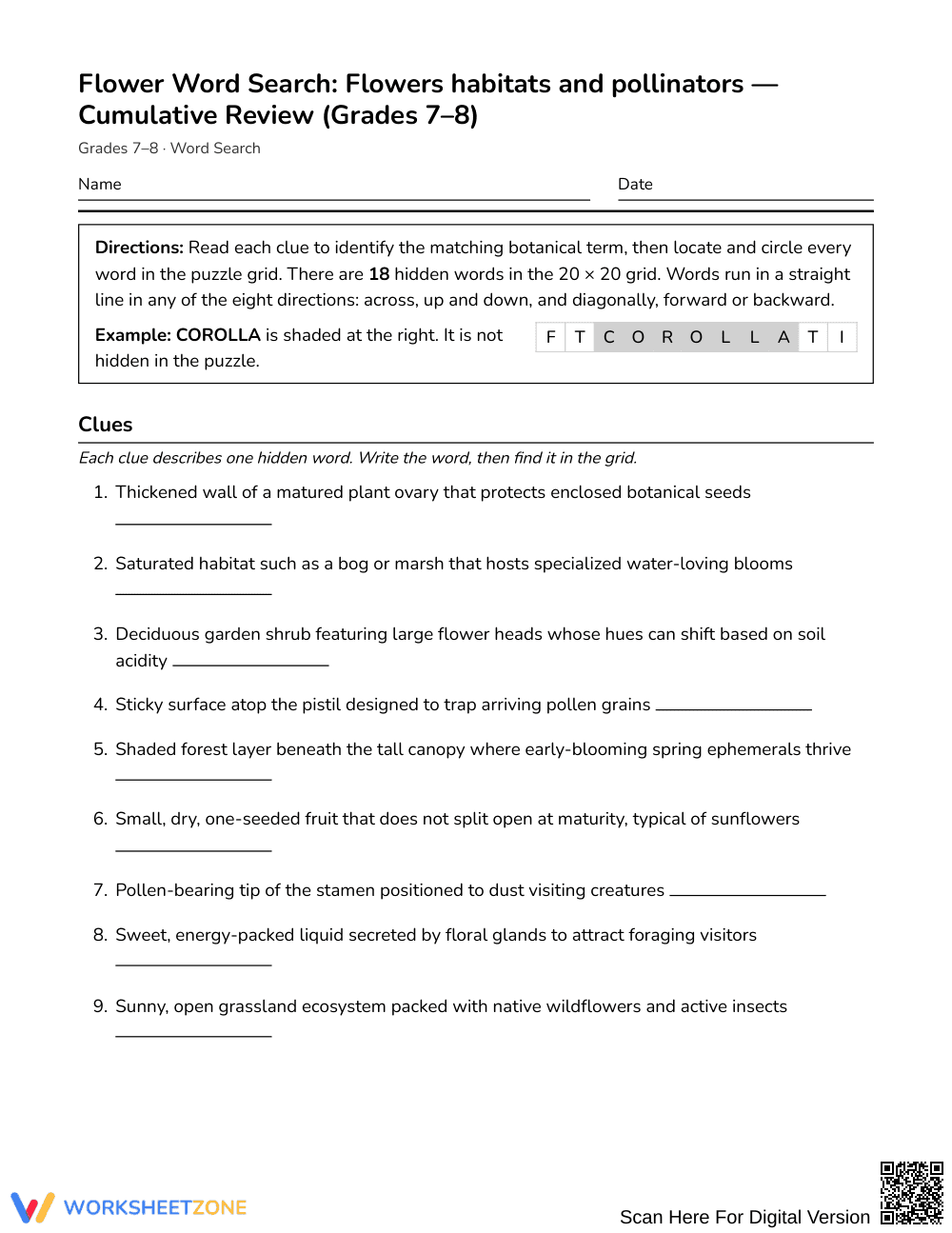
This science word search strengthens middle school biology vocabulary by challenging students to connect ecological definitions with botanical terminology. Designed for Grades 7–8, the activity reinforces key concepts surrounding flowers, habitats, and pollinators, helping learners master essential plant reproduction and ecosystem vocabulary through an engaging, clue-driven puzzle format.
At a Glance
- Grade: Grades 7–8 · Subject: Science
- Standard: Not standards-assessed — vocabulary enrichment
- Skill Focus: Flowers, habitats, and pollinators
- Format: 3 pages · 18 words · Answer key included · PDF
- Best For: Cumulative unit review and vocabulary reinforcement
- Time: 25–35 minutes
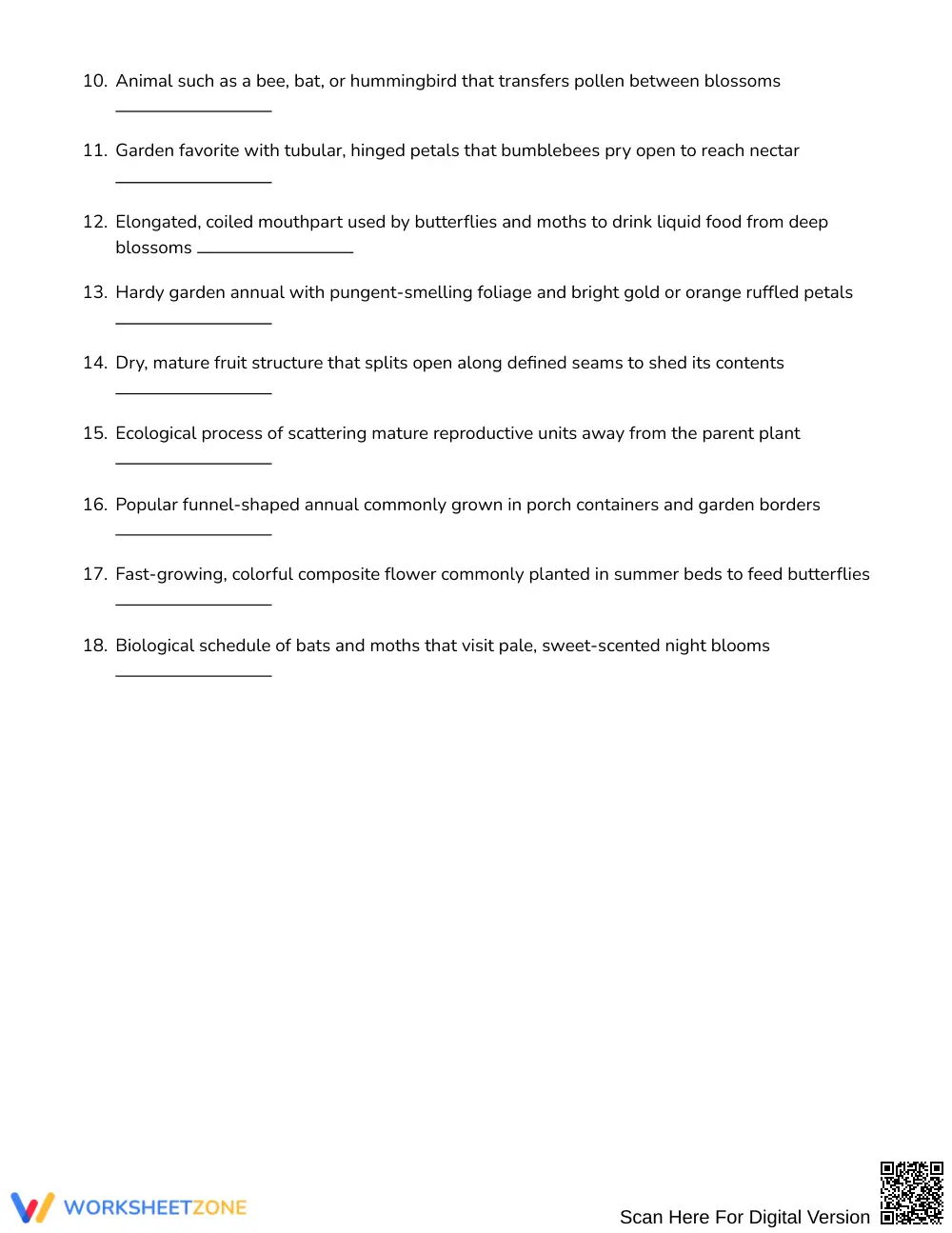
Inside this 3-page printable activity, learners discover 18 hidden vocabulary words embedded within a dense 20-by-20 letter grid. Rather than scanning for a basic word list, students read 18 botanical clues defining anatomical structures, ecosystem layers, and pollination mechanisms. A comprehensive answer key highlights every hidden term for rapid grading.
How the Puzzle Works
Students engage with this botanical search through a multi-directional puzzle architecture designed to deepen content familiarity:
- Clue Analysis: Learners read 18 descriptive science clues defining plant anatomy, specialized pollinator adaptations, and habitat zones to determine the target vocabulary terms.
- Grid Search: Identified terms are hidden across a substantial 20-by-20 grid, requiring focused visual scanning and spatial tracking.
- Multi-Directional Orientation: Words run in all 8 compass directions—North, Northeast, East, Southeast, South, Southwest, West, and Northwest—including reverse and diagonal orientations.
Standards Alignment
This resource serves as supplemental vocabulary enrichment and is not formally aligned to an assessed state or national science standard. Instead, it provides targeted content reinforcement for middle school life science units covering plant biology, angiosperm reproduction, and ecosystem interactions.
How to Use It
Deploy this word search after direct instruction on plant reproduction and pollination as an engaging cumulative review. Alternatively, assign it as a collaborative partner challenge during station rotations to reinforce ecological terminology before an exam. During the activity, circulate to observe whether students can deduce words directly from the clues or if they require reference materials for terms like pericarp and achene. Students typically finish the puzzle in 25 to 35 minutes.
Who It's For
This puzzle is structured for Grades 7–8 science students reviewing life science and botany curricula. It supports independent learners, early finishers, and students needing low-stress vocabulary exposure. Teachers can differentiate by providing a glossary for emerging bilingual students or challenging advanced learners to use three discovered terms in a written explanation of plant fertilization. Pair this search with a hands-on flower dissection lab or an illustrated botanical diagram.
Middle school science achievement relies heavily on specialized vocabulary acquisition, as academic terminology provides the conceptual foundation for understanding complex biological systems. This botanical word search reinforces essential vocabulary covering flowers, habitats, and pollinators through contextual clues and active spatial retrieval. According to Fisher & Frey (2014), intentional vocabulary instruction integrated with guided retrieval and definitional clues significantly accelerates domain-specific language comprehension in adolescent learners. By requiring students to interpret scientific definitions before scanning an 18-word puzzle matrix across multiple orientations, this activity transforms passive word finding into active semantic processing. Students solidify key conceptual links between anatomical floral structures, specialized pollinator behaviors, and reproductive seed dispersal mechanisms. This structured engagement promotes long-term botanical terminology retention, equipping middle school students with the precise scientific literacy needed for advanced life science coursework, ecosystem analysis, and collaborative scientific discourse.


