
































Ready Europe Review Word Search | Grades 7–8 Social Studies

Paste this activity's link or code into your existing LMS (Google Classroom, Canvas, Teams, Schoology, Moodle, etc.).
Students can open and work on the activity right away, with no student login required.
You'll still be able to track student progress and results from your teacher account.
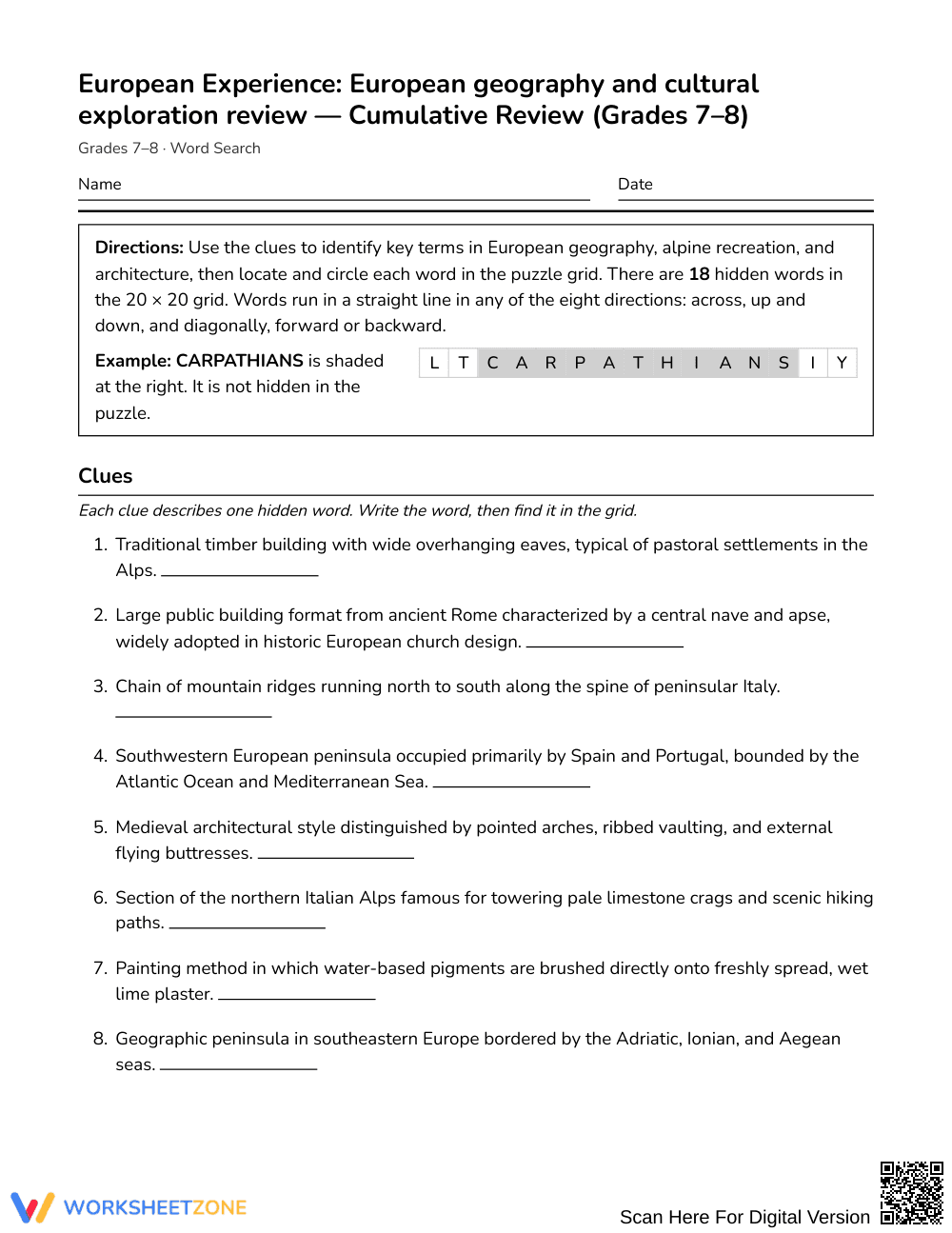
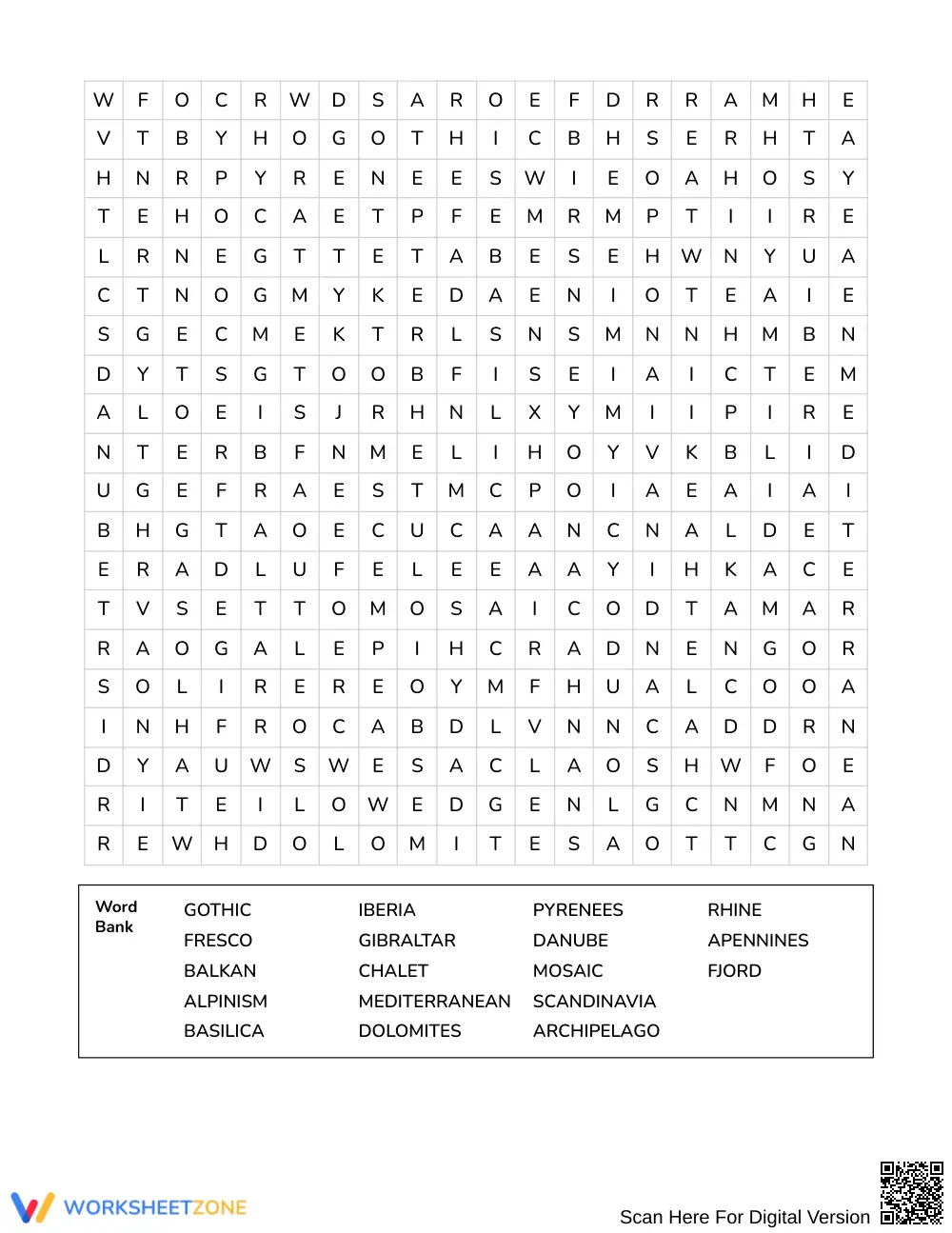
This European geography word search reinforces core physical, cultural, and architectural vocabulary for middle school social studies students. Learners review 18 essential terms spanning major river systems, alpine landforms, and historic art traditions, applying contextual clues to identify each concept before searching across the puzzle grid.
At a Glance
- Grade: Grades 7–8 · Subject: Social Studies
- Standard: Not standards-assessed — vocabulary enrichment
- Skill Focus: European geography and cultural exploration review
- Format: 3 pages · 18 words · Answer key included · PDF
- Best For: Cumulative review and geography vocabulary reinforcement
- Time: 25–35 minutes
What's Inside
The 3-page printable PDF features an 18-word search puzzle accompanied by rigorous, content-rich definitions. Instead of simple rote scanning, students read descriptive clues detailing geographic features like the Danube and Iberian Peninsula, alpine phenomena, and structural styles such as Gothic and fresco. The packet includes a complete 4-page answer key showing exact letter coordinates and highlighted paths for rapid evaluation.
How the Puzzle Works
The activity is built on a 20 by 20 grid containing 18 hidden terms positioned along eight directional paths: north, northeast, east, southeast, south, southwest, west, and northwest. Students consult a shuffled word bank alongside substantive clue statements. Learners read each factual description to recall the corresponding geographic or architectural term, then locate the target word across the dense letter layout.
Standards Alignment
This activity serves as dedicated vocabulary enrichment rather than a formal standards-assessed task. While not pegged to a specific state or national code, it directly strengthens domain-specific geographical terminology and spatial literacy essential for secondary social studies proficiency.
How to Use It
Deploy this word search during a cumulative review block after completing direct instruction on European physical geography and regional cultures. Alternatively, assign it as an independent station task or emergency sub plan. Formative assessment tip: observe whether students read the clue descriptions first to recall terminology or rely solely on scanning the word bank. Plan for 25 to 35 minutes of engaged learning time.
Who It's For
Designed for Grades 7–8 Social Studies learners, this puzzle offers engaging vocabulary reinforcement for whole-class practice, early finishers, or review centers. Support emerging bilingual students by encouraging partner work with an atlas or physical classroom wall map to connect terms with visual locations.
Active retrieval of domain-specific academic vocabulary directly enhances reading comprehension and long-term retention in secondary content areas. According to Fisher & Frey (2014), structured vocabulary learning that combines definitional context with focused orthographic recognition solidifies conceptual understanding across content-area literacy tasks. This word search engages Grades 7–8 learners in multi-directional spatial analysis across a 20 by 20 grid while reviewing 18 distinct European geography, alpine recreation, and historic architectural terms. By requiring students to connect rigorous descriptions—such as glacial fjords, the Iberian landmass, and medieval Gothic construction—to corresponding vocabulary, the resource provides an engaging review mechanism that bridges factual knowledge and spatial problem-solving. Educators can integrate this activity as a low-stakes formative checkpoint, reinforcing complex geographical terminology without requiring extensive teacher preparation. Consequently, middle school classrooms gain a practical vocabulary resource that promotes student autonomy and academic retention.


