


























Views
Downloads


Ready Electromagnet Strength Worksheet | Grade 12 Physics
Paste this activity's link or code into your existing LMS (Google Classroom, Canvas, Teams, Schoology, Moodle, etc.).
Students can open and work on the activity right away, with no student login required.
You'll still be able to track student progress and results from your teacher account.
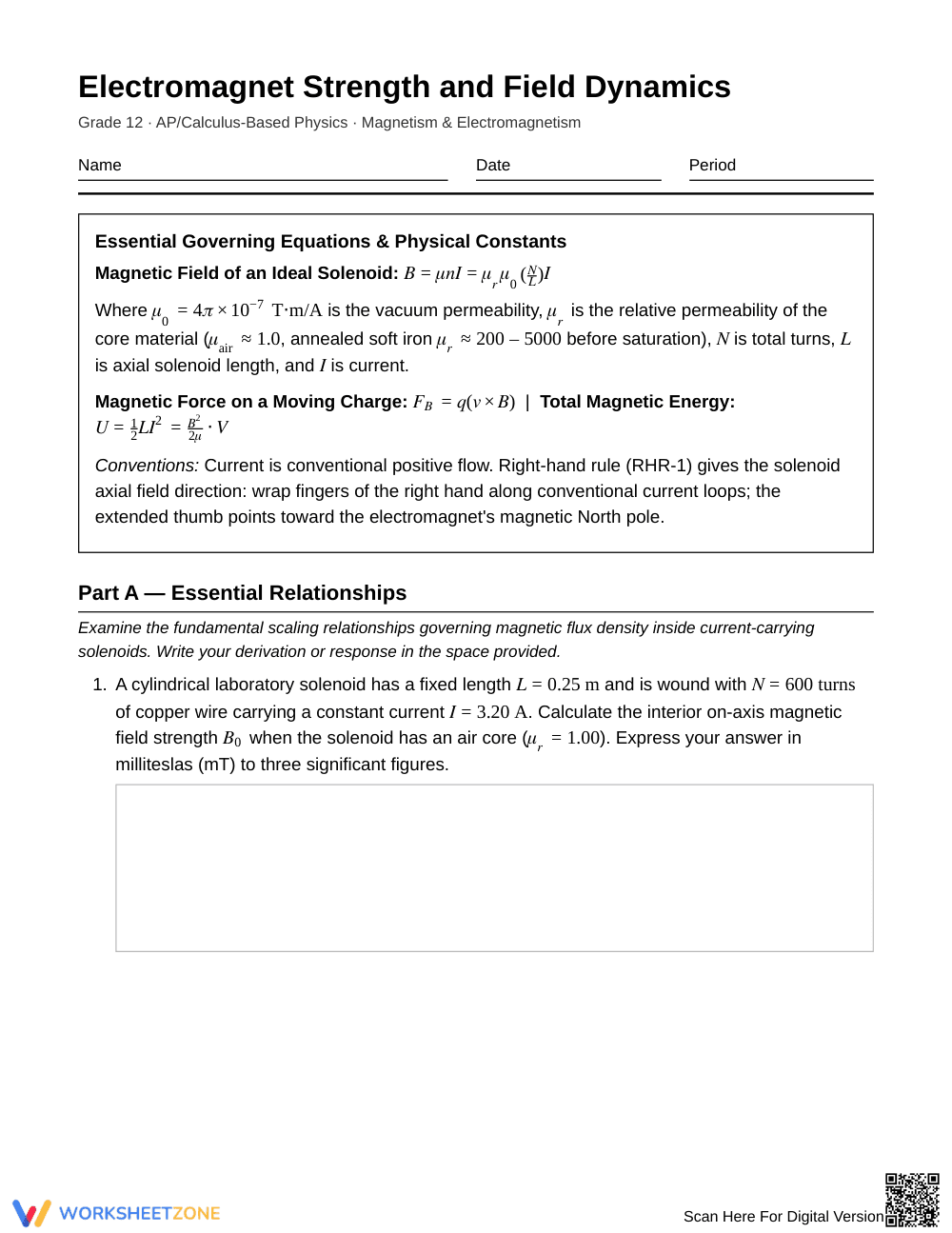
Mastering the factors that govern solenoid field strength requires synthesizing mathematical formulas with microscopic physical models. This comprehensive physics worksheet guides Grade 12 students through evaluating turn density, relative permeability, core saturation, and thermal resistance to explain electromagnet strength changes under diverse operational conditions.
At a Glance
- Grade: 12 · Subject: Physics
- Standard: Electromagnetism — Calculate and explain factors altering solenoid magnetic flux density
- Skill Focus: Explain Electromagnet Strength Changes
- Format: 5 pages · 12 problems · Answer key included · PDF
- Best For: AP Physics advanced problem-solving practice
- Time: 45–60 minutes
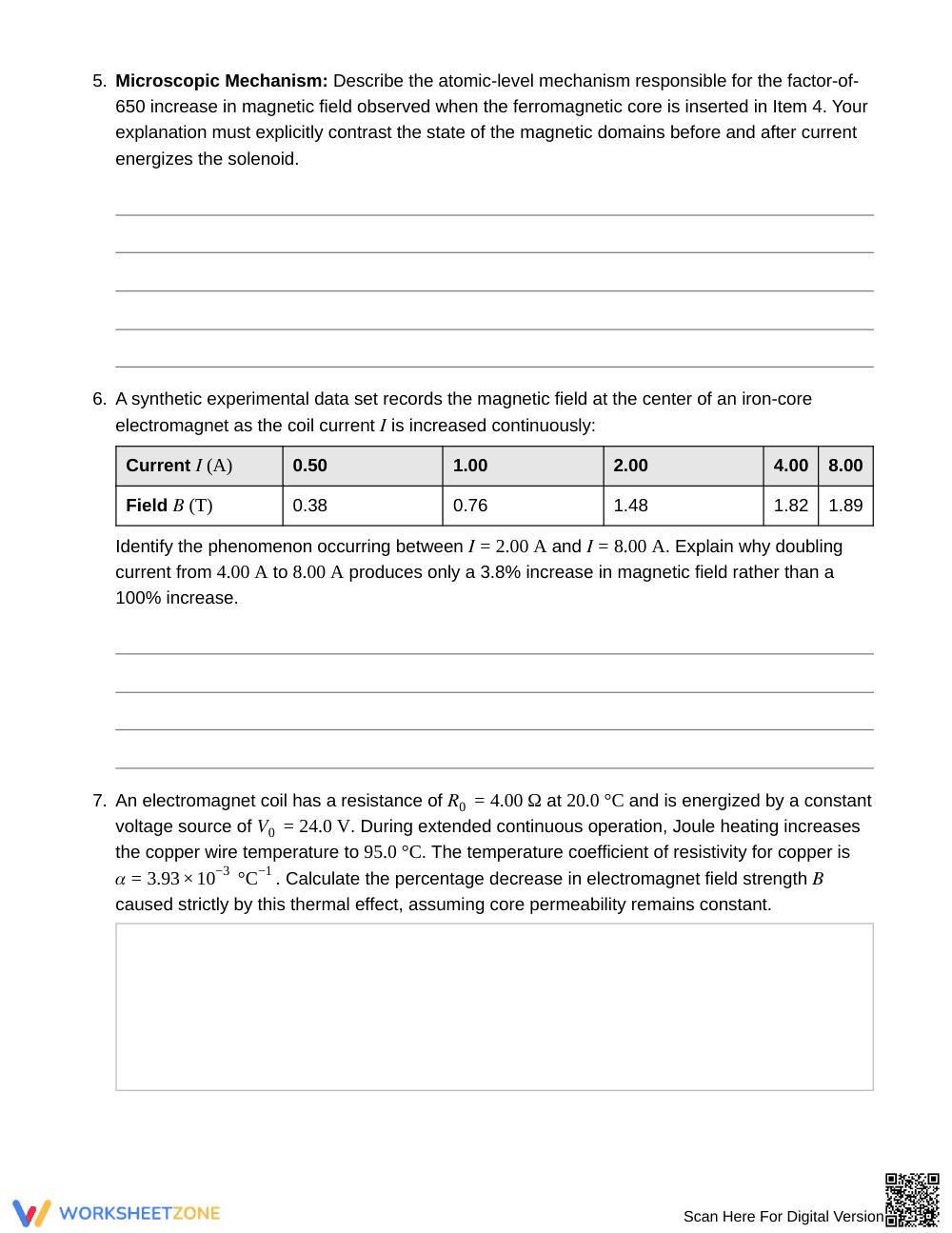
This 5-page instructional resource contains 12 rigorous physics tasks designed to probe conceptual and quantitative electromagnetism. It opens with an essential governing equations and constants reference block, moves through algebraic scaling relations, examines empirical saturation data and Joule heating effects, and concludes with dynamic predictive modeling. A comprehensive 4-page answer key provides step-by-step mathematical solutions and explicit microscopic explanations.
Skill Progression
- Guided practice (Part A — 3 problems): Students apply solenoid field equations and algebraic scaling to compute on-axis flux density, assess geometric adjustments, and evaluate structural voltage limits with constant reference support.
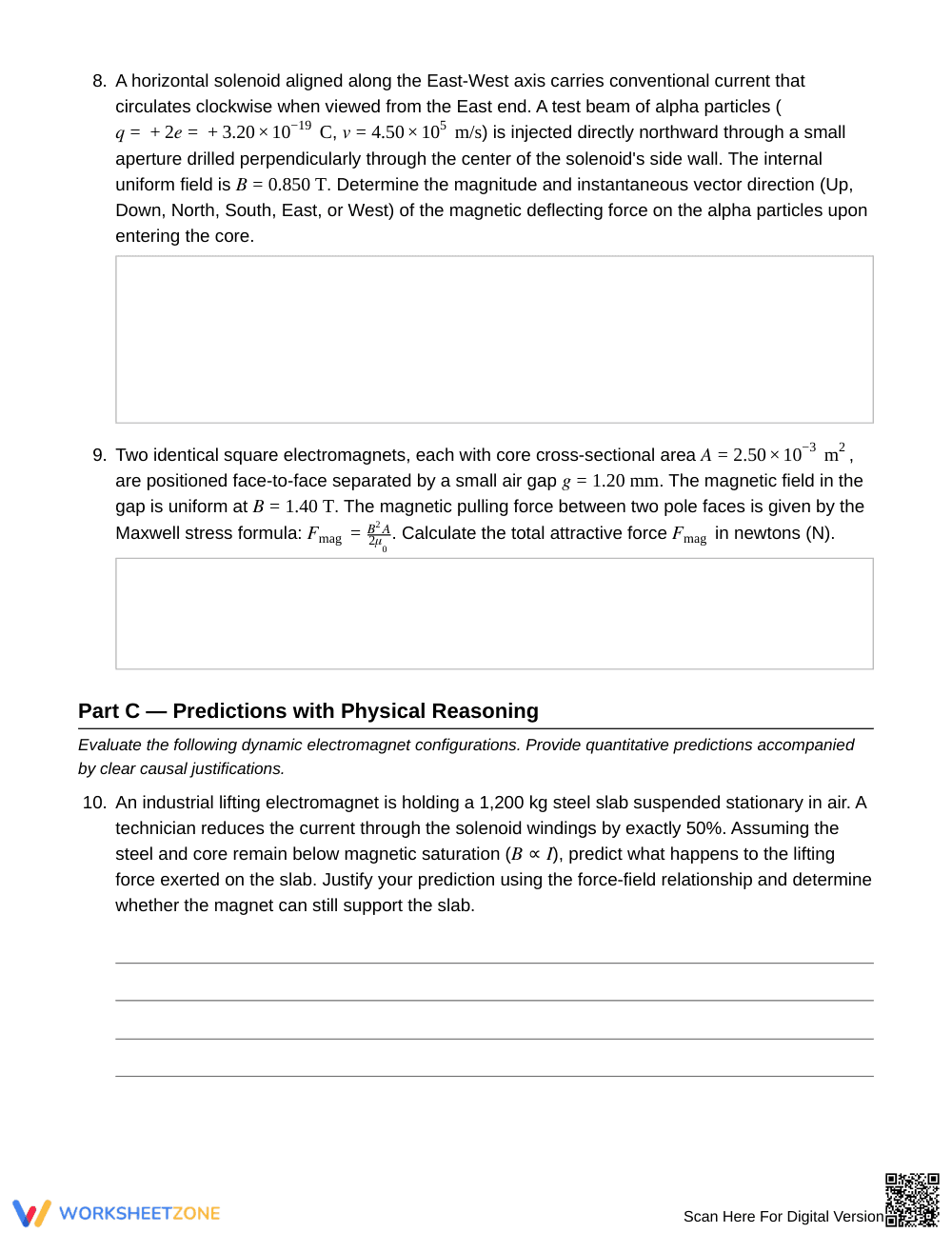
- Supported practice (Part B — 6 problems): Students evaluate multi-step scenarios including ferromagnetic core insertion, microscopic domain alignment, empirical magnetic saturation graphs, thermal resistivity shifts, and Lorentz force vectors.
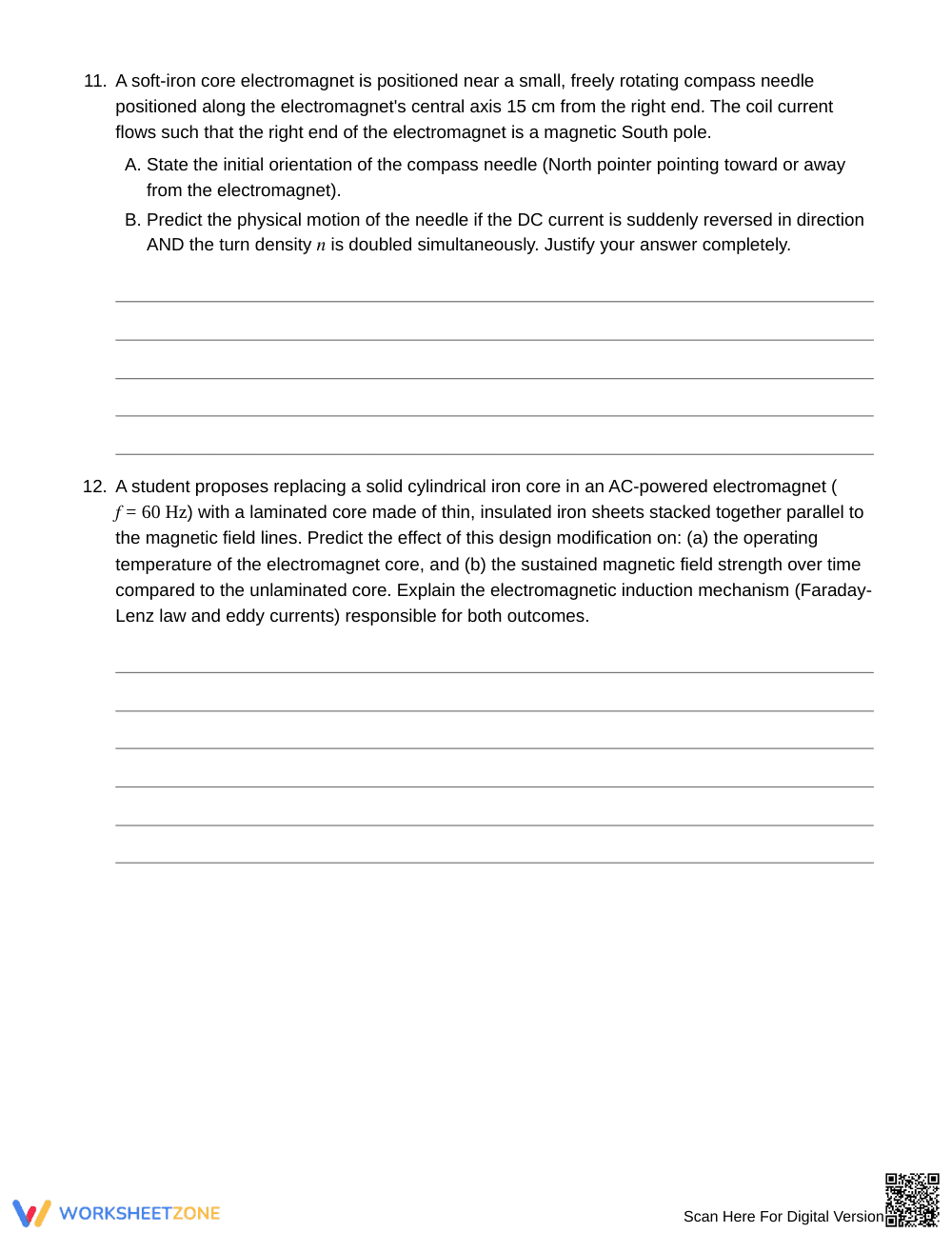
- Independent practice (Part C — 3 problems): Students generate high-level physical justifications for industrial lifting thresholds, compass needle reversals, and AC laminated core eddy-current mitigation.
This sequence follows a gradual-release instructional model that transitions learners from direct formula substitution to nuanced physical justification.
Standards Alignment
This worksheet aligns directly with high school and AP-level physics standards on Magnetism and Electromagnetism. Students analyze the quantitative relationship between electric currents and magnetic fields, model magnetic domains within ferromagnetic materials, and apply energy conservation principles to induction and resistance. These alignment details can be copied directly into lesson plans, IEP goals, or district curriculum mapping tools.
How to Use It
Deploy this worksheet after direct instruction on Ampère's Law and solenoid dynamics as an intensive in-class problem-solving workshop or as an AP exam review assignment. During work time, formatively assess whether students mistakenly treat magnetic saturation as a linear response or neglect Joule heating when calculating current changes under constant voltage. Anticipate an expected completion time of 45 to 60 minutes.
Who It's For
This activity is tailored for Grade 12 AP Physics C, AP Physics 2, or honors physics students preparing for rigorous college-level mechanics and electromagnetism assessments. For students needing support, pair this resource with a hands-on solenoid laboratory demonstration or an interactive magnetic domain visualization tool.
Developing a robust conceptual understanding of electromagnetism requires high school students to coordinate macroscopic circuit variables with microscopic magnetic domain behaviors. According to findings from Fisher & Frey (2014), structured problem sets that systematically sequence algebraic derivations, empirical data interpretation, and qualitative explanations foster deeper cognitive transfer than isolated calculation drills. This Grade 12 physics resource targets the core skill of explaining electromagnet strength changes across 12 multifaceted analytical problems. Learners calculate interior magnetic field strengths, interpret non-linear magnetic saturation curves, quantify thermal resistance losses from Joule heating, and predict mechanical force outputs in dynamic electromechanical systems. By prompting students to evaluate both the underlying atomic alignment mechanisms and explicit scaling equations governing magnetic flux density, this practice module reinforces rigorous problem-solving habits and prepares advanced students for collegiate science assessments.


