































Ready Day of the Dead Symbols Word Search | Grades 6–7 ELA

Paste this activity's link or code into your existing LMS (Google Classroom, Canvas, Teams, Schoology, Moodle, etc.).
Students can open and work on the activity right away, with no student login required.
You'll still be able to track student progress and results from your teacher account.
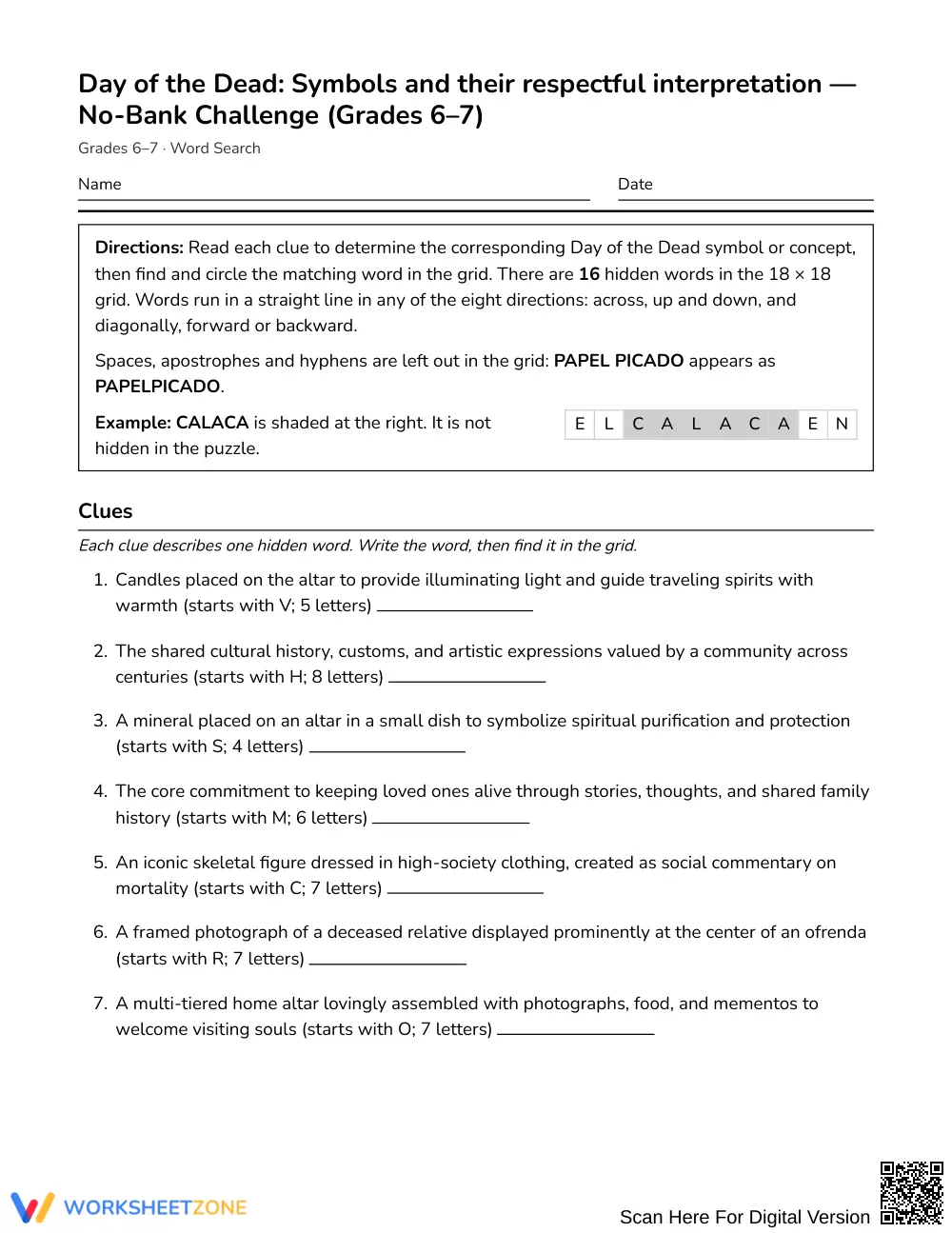
This Day of the Dead word search builds cultural vocabulary and respectful interpretation of traditions across Grades 6–7. Students analyze detailed definitions to identify 16 authentic cultural concepts before locating them within the puzzle grid. The activity reinforces background knowledge and vocabulary acquisition without relying on a simple word bank.
At a Glance
- Grade: Grades 6–7 · Subject: English Language Arts (ELA)
- Standard: Not standards-assessed — vocabulary enrichment
- Skill Focus: Day of the Dead symbols and their respectful interpretation
- Format: 3 printable student pages · 16 words · Full answer key included · PDF
- Best For: Cultural vocabulary enrichment and background knowledge
- Time: 25–35 active classroom minutes
This 3-page printable resource delivers an engaging clue-driven puzzle challenge paired with a comprehensive 4-page answer key. Rather than scanning a pre-printed list, students read 16 rigorous cultural clues to identify key terms like ofrenda, cempasuchil, and papel picado before searching. The full solution key provides clear letter-by-letter grid overlays to make grading or student self-checking effortless.
Puzzle Mechanics
This challenge is built upon a dense 18 x 18 letter grid containing 16 hidden vocabulary terms. Words run in all 8 possible directions: north, northeast, east, southeast, south, southwest, west, and northwest. Because no word bank is supplied on the student pages, learners must rely entirely on the provided informational clues to deduce each target term before locating it in the puzzle.
Standards Alignment
This activity serves strictly as vocabulary enrichment and cultural exploration rather than targeted alignment to a specific state or national standard. It strengthens domain-specific academic vocabulary and deepens reading comprehension by connecting cultural traditions with precise terminology during thematic units.
How to Use It
Deploy this word search during an introductory lesson on Latin American traditions to activate prior knowledge, or assign it after reading informational texts as an engaging vocabulary review. During independent or partner work, circulate to observe which clues prompt quick identification and which cultural concepts require additional teacher explanation. Most middle school learners will complete the clue decoding and word search within 25 to 35 minutes.
Who It's For
This resource is designed for Grades 6–7 English Language Arts or social studies classes studying cultural traditions and symbolism. Teachers can differentiate by providing a glossary for emerging bilingual students or having advanced learners write original descriptive sentences for each term. Pair this puzzle with an informational reading passage on Day of the Dead altars or a shared cultural anchor chart.
Academic vocabulary acquisition requires intentional engagement with context and meaning rather than passive memorization. As demonstrated by Fisher & Frey (2014), intentional word-learning experiences that combine definitional clues with active processing strengthen student retention and conceptual understanding across content areas. This Grades 6–7 Day of the Dead vocabulary resource embodies these principles by eliminating standard word banks and requiring middle school students to synthesize descriptive cultural definitions before searching the 18 x 18 letter grid. As an unaligned vocabulary enrichment tool, it emphasizes respectful interpretation of cultural symbols such as ofrendas, cempasuchil, and calaveras within authentic contexts. Teachers using this 16-word activity provide students with purposeful practice in deciphering domain-specific terminology, promoting deeper cultural literacy and collaborative academic discussion. The resource equips educators with a structured, rigorous mechanism for reinforcing essential cultural concepts through thoughtful, text-grounded vocabulary inquiry.


