































Ready Daily Hygiene Actions Word Search | Grades 6–7 ELA

Paste this activity's link or code into your existing LMS (Google Classroom, Canvas, Teams, Schoology, Moodle, etc.).
Students can open and work on the activity right away, with no student login required.
You'll still be able to track student progress and results from your teacher account.
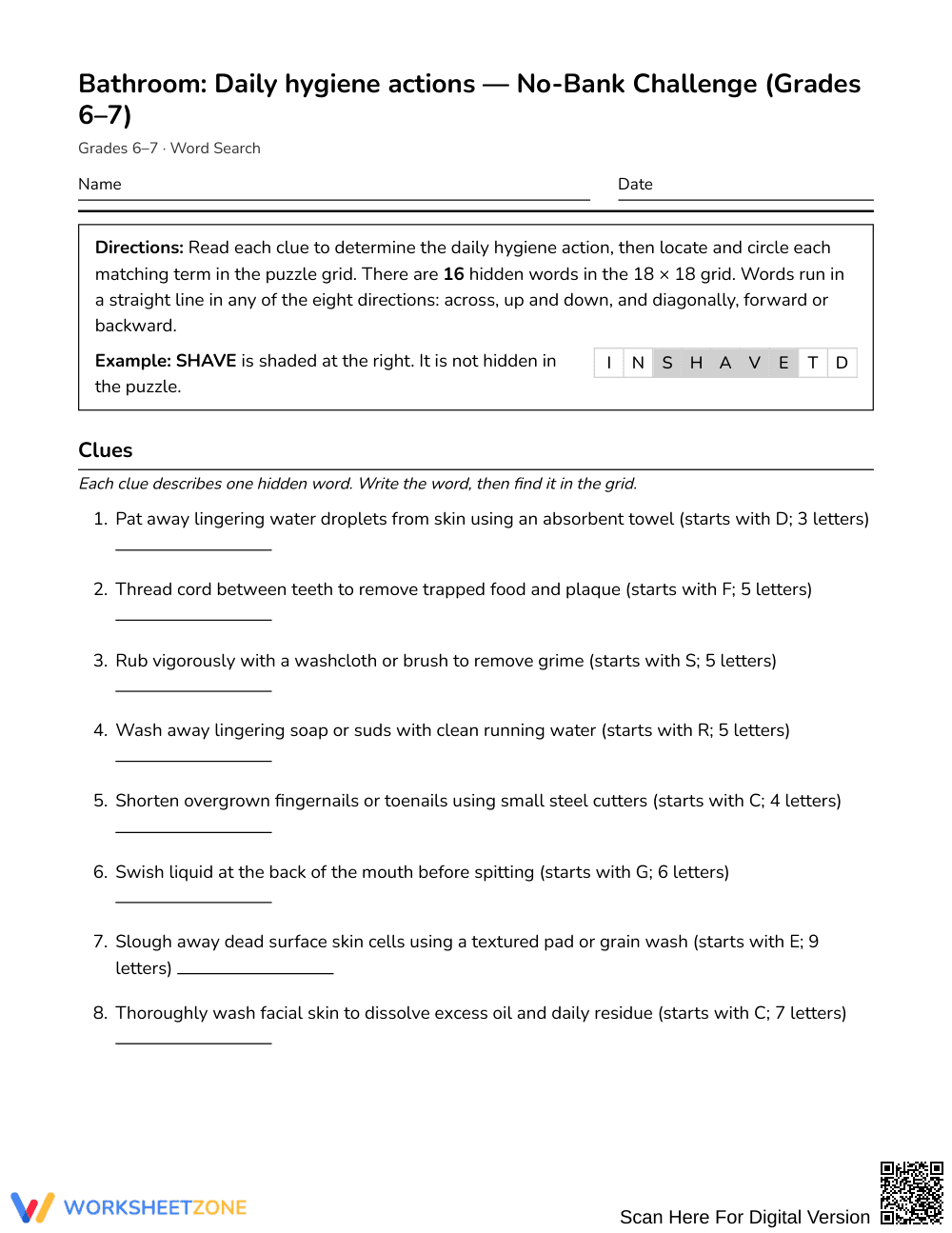
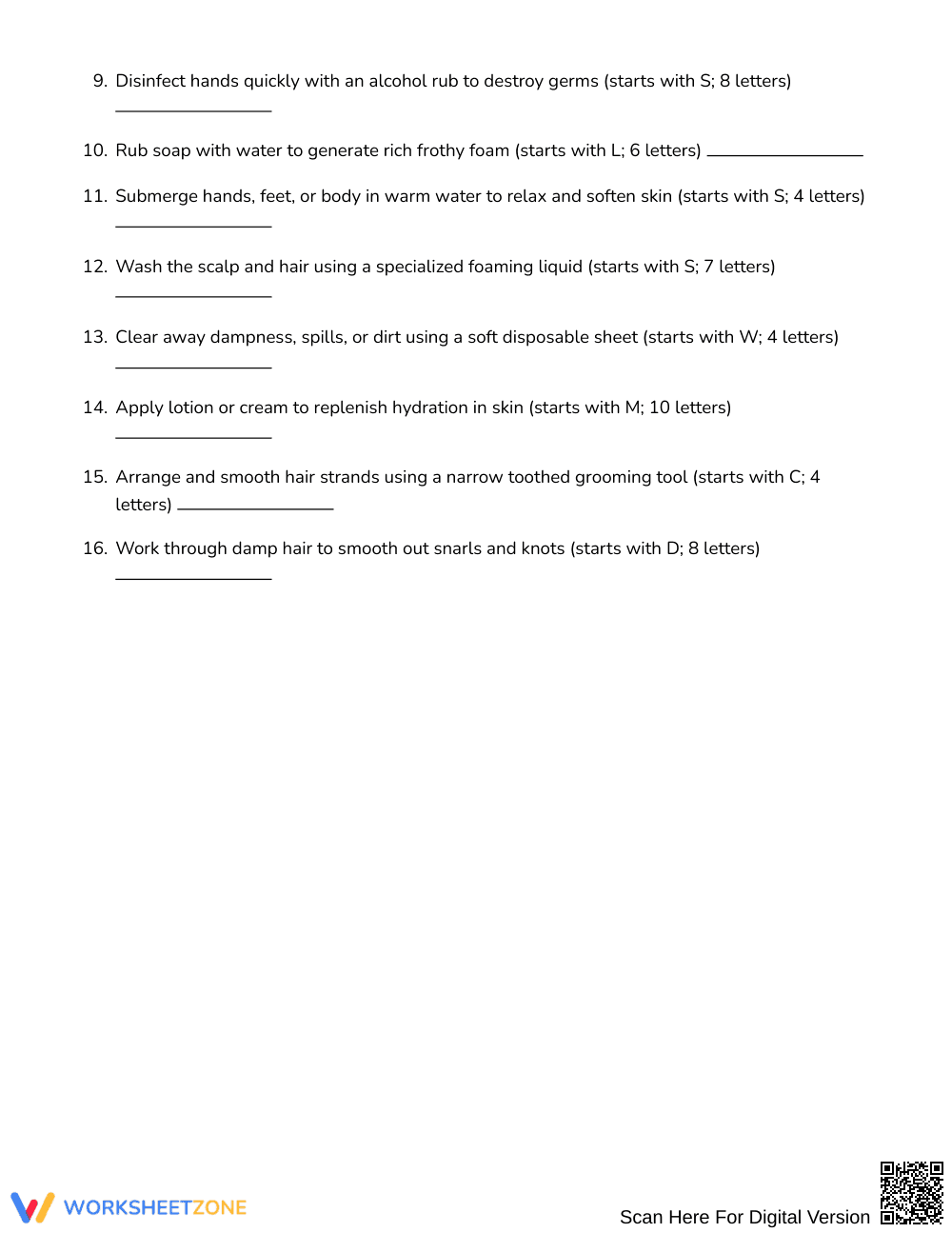
This Grades 6–7 daily hygiene actions word search reinforces essential personal care vocabulary through an engaging no-bank puzzle format. Students decode 16 functional self-care verbs by reading precise contextual clues before searching for each hidden term across the puzzle grid, strengthening word recognition, spelling precision, and reading comprehension.
At a Glance
- Grade: Grades 6–7 · Subject: English Language Arts (ELA)
- Standard: Not standards-assessed — vocabulary enrichment
- Skill Focus: Daily hygiene actions
- Format: 3 pages · 16 words · Answer key included · PDF
- Best For: Vocabulary enrichment and life skills
- Time: 20–30 minutes
What's inside: This 3-page printable activity challenges students to identify 16 targeted vocabulary terms related to daily routines. Instead of relying on a standard word bank, the resource provides 16 text-based definition clues that learners must interpret to identify words such as cleanse, exfoliate, detangle, and sanitize. A complete 3-page solution key shows the exact letter coordinates and paths for fast teacher verification.
Puzzle Mechanics and Structure
This puzzle is structured as a challenging no-bank vocabulary search designed to prompt critical thinking:
- Grid Dimensions: An 18 x 18 letter matrix provides an expansive search field that encourages systematic scanning techniques.
- Search Trajectories: Words run in all 8 directions—horizontally, vertically, and diagonally (N, NE, E, SE, S, SW, W, NW)—including reverse orientations.
- Clue-Based Retrieval: Without a pre-printed word bank, students must read each functional definition to deduce the target verb before locating it.
Standards Alignment
This activity serves as dedicated vocabulary enrichment and life skills practice and is not aligned to an academic content standard. It focuses on expanding tier-two domain vocabulary and practical self-care terminology, giving middle school students meaningful practice connecting precise definitions to functional daily habits.
How to Use It
Use this word search as an engaging bell-ringer during health or life skills units, or introduce it after direct vocabulary instruction to reinforce personal care terminology. During independent work time, observe whether learners correctly define each clue before hunting in the grid to check reading comprehension. Typical completion time spans 20 to 30 minutes.
Who It's For
This resource is crafted for Grades 6–7 learners in general ELA classes, English language development groups, and special education life skills programs. For students needing extra support, teachers can highlight initial letters or provide a separate reference list. Pair this activity with an anchor chart on personal grooming routines or procedural writing prompts.
Vocabulary enrichment activities that require learners to retrieve words from context clues rather than simple copying foster deeper orthographic and semantic mapping. According to research by Fisher & Frey (2014), intentional word exposure coupled with definition-matching tasks significantly improves adolescent comprehension, word retrieval, and long-term retention of functional vocabulary. This Grades 6–7 word search targets daily hygiene actions through an 18 x 18 grid containing 16 hidden vocabulary words running in eight distinct compass directions. Because the resource operates as a no-bank challenge, students must actively process definitions for terms like exfoliate, sanitize, and cleanse before finding them in the puzzle. While designated as non-standards-assessed vocabulary enrichment rather than linked to an academic standard code, this print-ready resource directly supports morphological awareness, reading fluency, and practical life skills routines across middle school English language arts and advisory classrooms.


