































Ready Cooking & Cooling Word Search | Grades 4–5 ELA

Paste this activity's link or code into your existing LMS (Google Classroom, Canvas, Teams, Schoology, Moodle, etc.).
Students can open and work on the activity right away, with no student login required.
You'll still be able to track student progress and results from your teacher account.
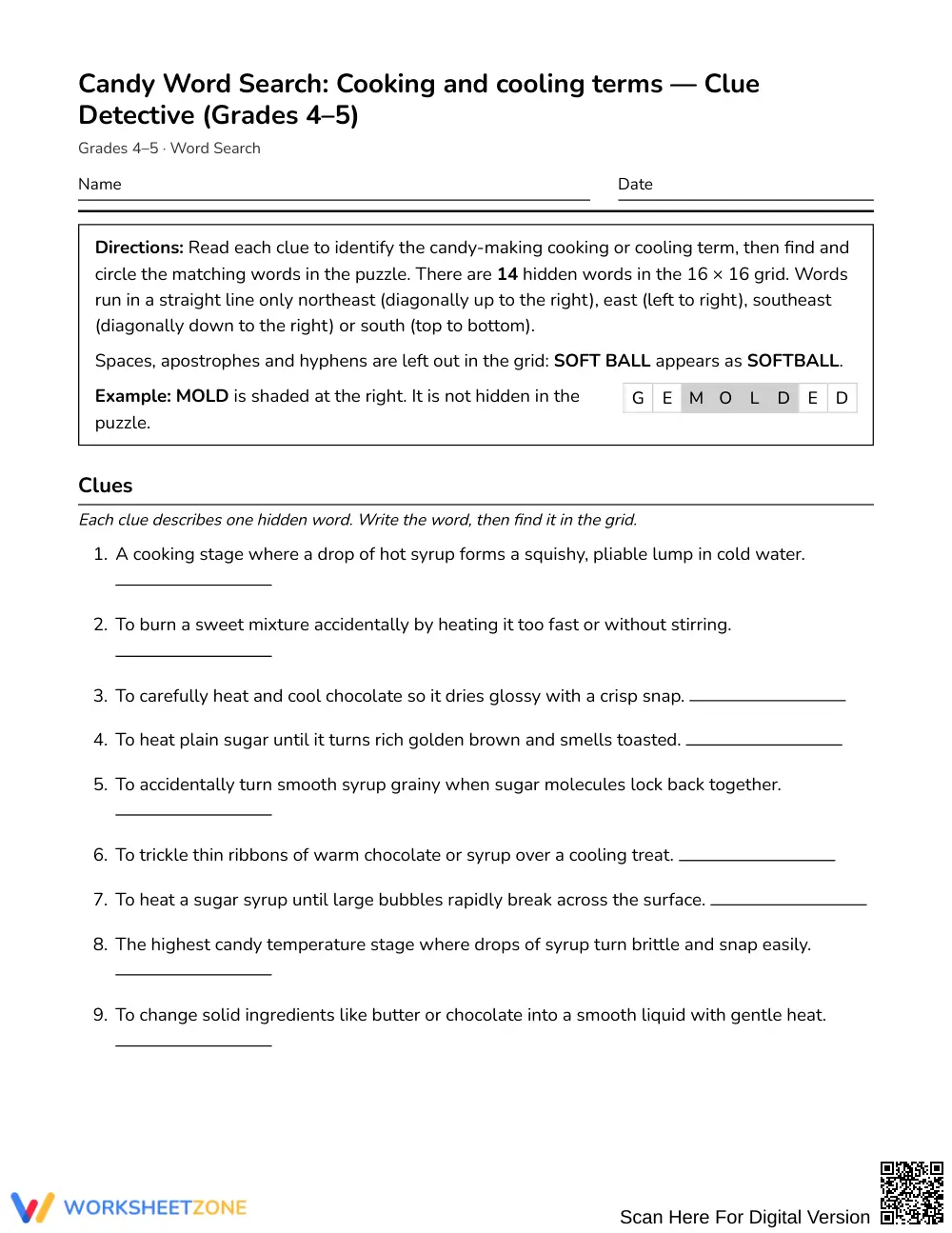
This Grades 4–5 candy-themed word search reinforces culinary vocabulary through an active clue-solving format. Students read descriptive definitions of 14 essential cooking and cooling terms, determine each target word, and locate it within the letter grid. The activity strengthens domain-specific reading comprehension and word recognition through engaging, hands-on practice.
At a Glance
- Grade: Grades 4–5 · Subject: English Language Arts
- Standard: Not standards-assessed — vocabulary enrichment
- Skill Focus: Cooking and cooling terms
- Format: 3 pages · 14 words · Answer key included · PDF
- Best For: Vocabulary centers and fast finishers
- Time: 20–30 minutes
This 3-page printable activity pack presents 14 candy-making vocabulary words paired with descriptive, context-rich clues. Instead of merely hunting for items from an exposed list, learners act as clue detectives by reading definitions for terms like caramelize, temper, and crystallize before tracking them down. The resource includes a shuffled word bank to support emerging decoders, followed by a full 3-page answer key that highlights exact letter coordinates and word paths for swift grading.
The puzzle is built around a dense 16 × 16 letter grid engineered to challenge intermediate elementary solvers. Hidden vocabulary terms run across four distinct orientations: northeast (NE), east (E), southeast (SE), and south (S). Students review the provided definition clues to deduce each cooking or cooling term, check their spelling against the shuffled word bank, and scan the grid along diagonal, horizontal, and downward paths to locate all 14 entries.
This activity provides targeted vocabulary enrichment and is not aligned to a specific grade-level academic standard. While unaligned to formal assessment codes, the puzzle directly develops domain-specific terminology that supports upper-elementary informational reading, cross-curricular science connections to thermal energy, and procedural writing comprehension.
Deploy this word search during independent literacy stations or as a post-lesson enrichment task after a shared reading on procedural culinary texts. For an effective formative observation, circulate while students read the clues to observe whether they infer the correct vocabulary term independently or require scaffolding from the shuffled bank before searching the grid. Most students will finish the puzzle in 20 to 30 minutes.
This resource is designed for Grades 4–5 students developing tier-three vocabulary in English Language Arts. It serves as an accessible entry point for English language learners and striving readers who benefit from context clues paired with spelling patterns. Pair this puzzle with an informational passage on candy-making chemistry or an anchor chart displaying states of matter and temperature changes.
According to Fisher & Frey (2014), intentional exposure to domain-specific vocabulary across interactive learning formats significantly deepens conceptual comprehension and retention for upper-elementary students. Rather than relying on rote memorization, embedding definitions within puzzle-based tasks requires students to retrieve semantic meaning while attending carefully to orthographic letter patterns. This Grades 4–5 vocabulary enrichment activity reinforces 14 cooking and cooling terms through clue-driven discovery, bridging reading comprehension with specialized culinary science concepts. Research indicates that when learners actively connect definitional cues to spelling configurations, their lexical acquisition shifts from passive exposure to durable long-term storage. By engaging students in purposeful word analysis across a structured 16 by 16 letter matrix, this educational resource strengthens content-area reading foundations and equips students with the specialized language necessary for analyzing procedural and scientific texts across diverse classroom environments.


