

































Ready Concession & Rebuttal Worksheet | Grade 12 English IV

Paste this activity's link or code into your existing LMS (Google Classroom, Canvas, Teams, Schoology, Moodle, etc.).
Students can open and work on the activity right away, with no student login required.
You'll still be able to track student progress and results from your teacher account.
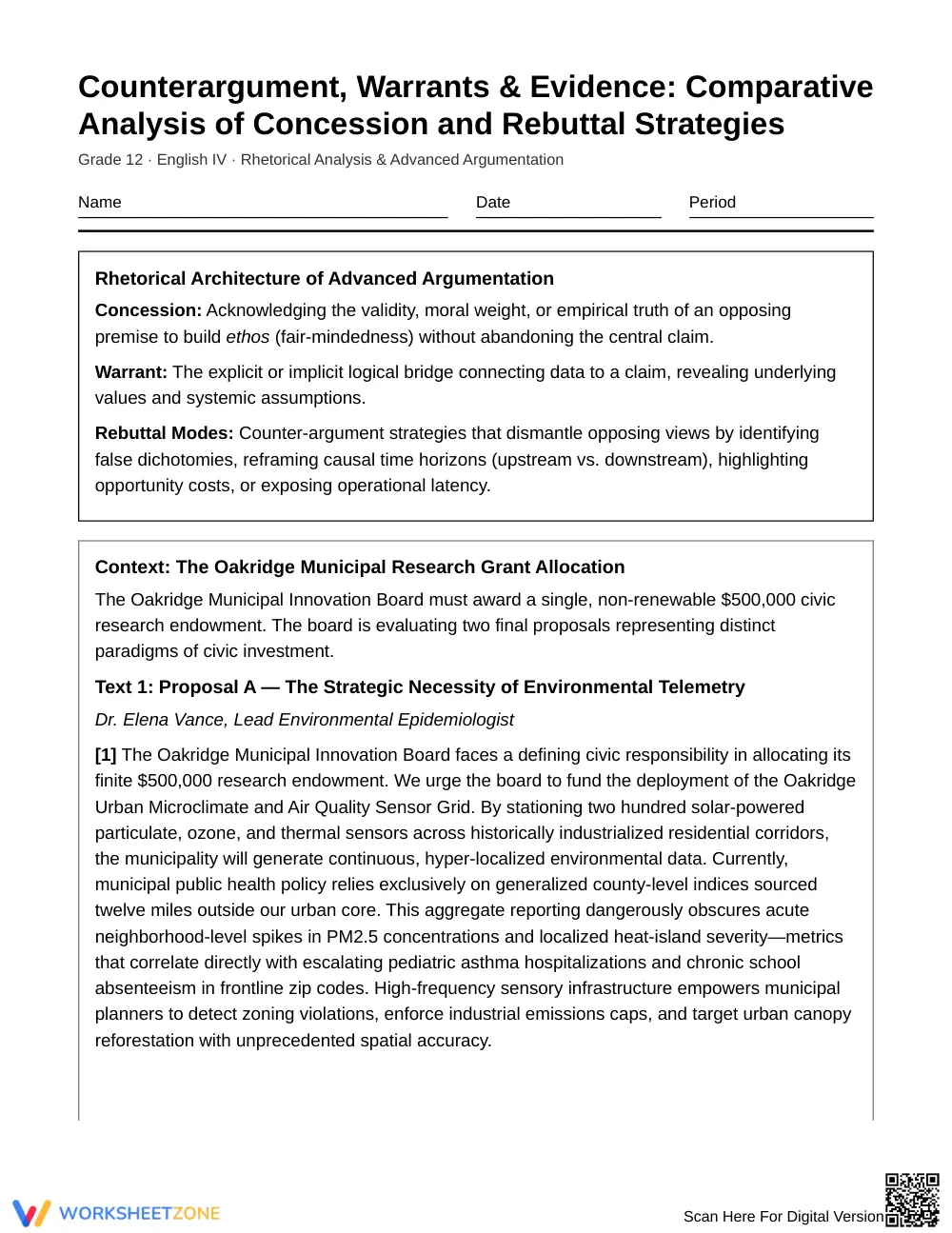
This Grade 12 rhetoric worksheet trains students to compare concession and rebuttal strategies across competing policy texts. Students examine two conflicting civic grant proposals to evaluate how writers validate counterarguments, reveal underlying warrants, and pivot to defend alternative priorities. The structured progression equips high school seniors to deconstruct nuanced rhetorical architecture and craft bounded synthesis arguments.
At a Glance
- Grade: 12 · Subject: English IV
- Standard: Advanced Argumentation — Evaluate rhetorical strategies, warrants, and counterarguments across complex civic texts
- Skill Focus: Compare Concession and Rebuttal Strategies
- Format: 6 pages · 10 problems · Answer key included · PDF
- Best For: Advanced rhetorical analysis and comparative synthesis
- Time: 60–90 minutes
What's Inside
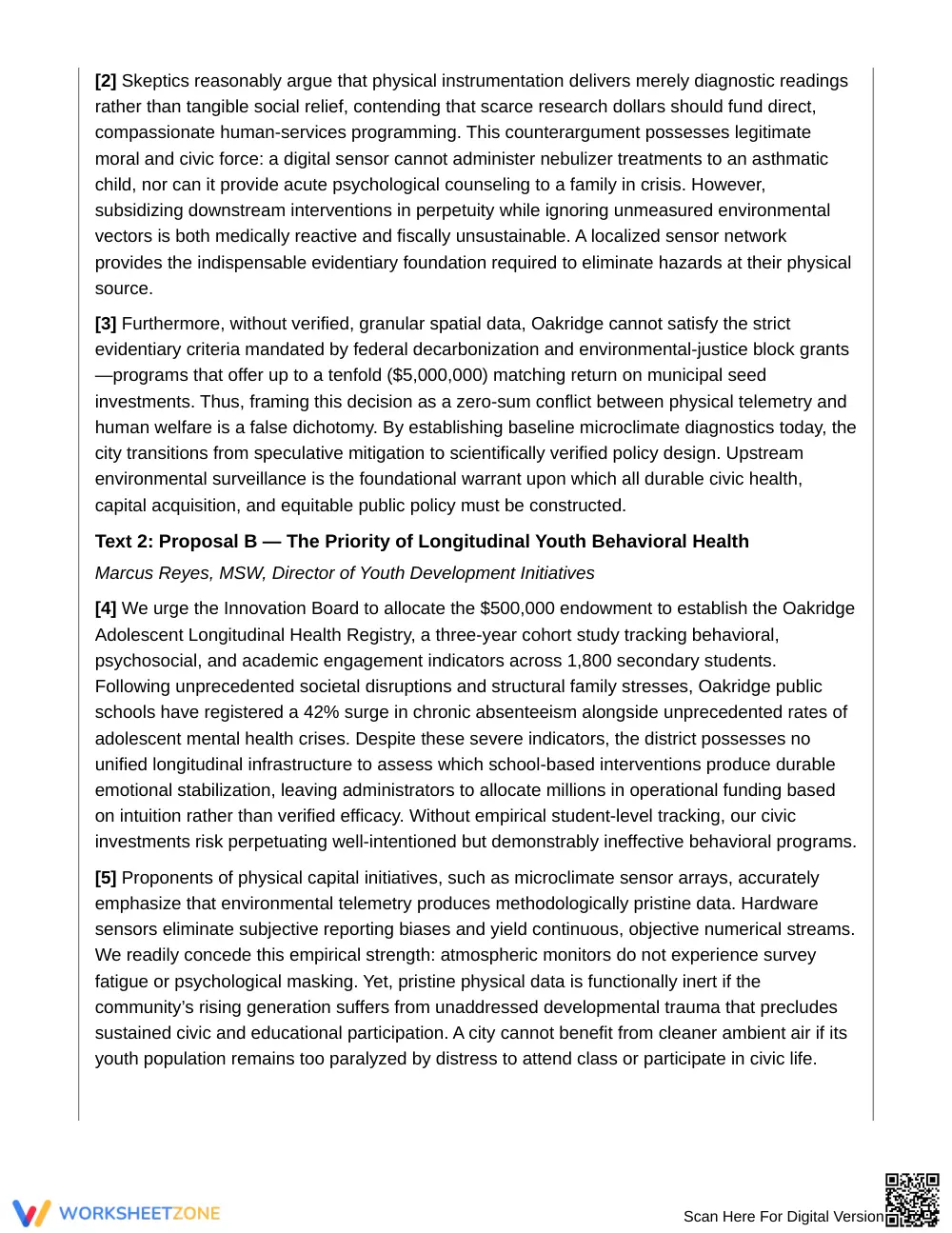
The 6-page student packet features an architectural reference box defining concessions, warrants, and rebuttal modes, followed by two rigorous paired texts modeling competing municipal investments. Across 10 analytical prompts, students conduct close-reading investigations of textual warrants, syntactic pivots, and evidential force. A comprehensive 4-page answer key provides complete model analyses, warrant explanations, and sample synthesis paragraphs.
Skill Progression
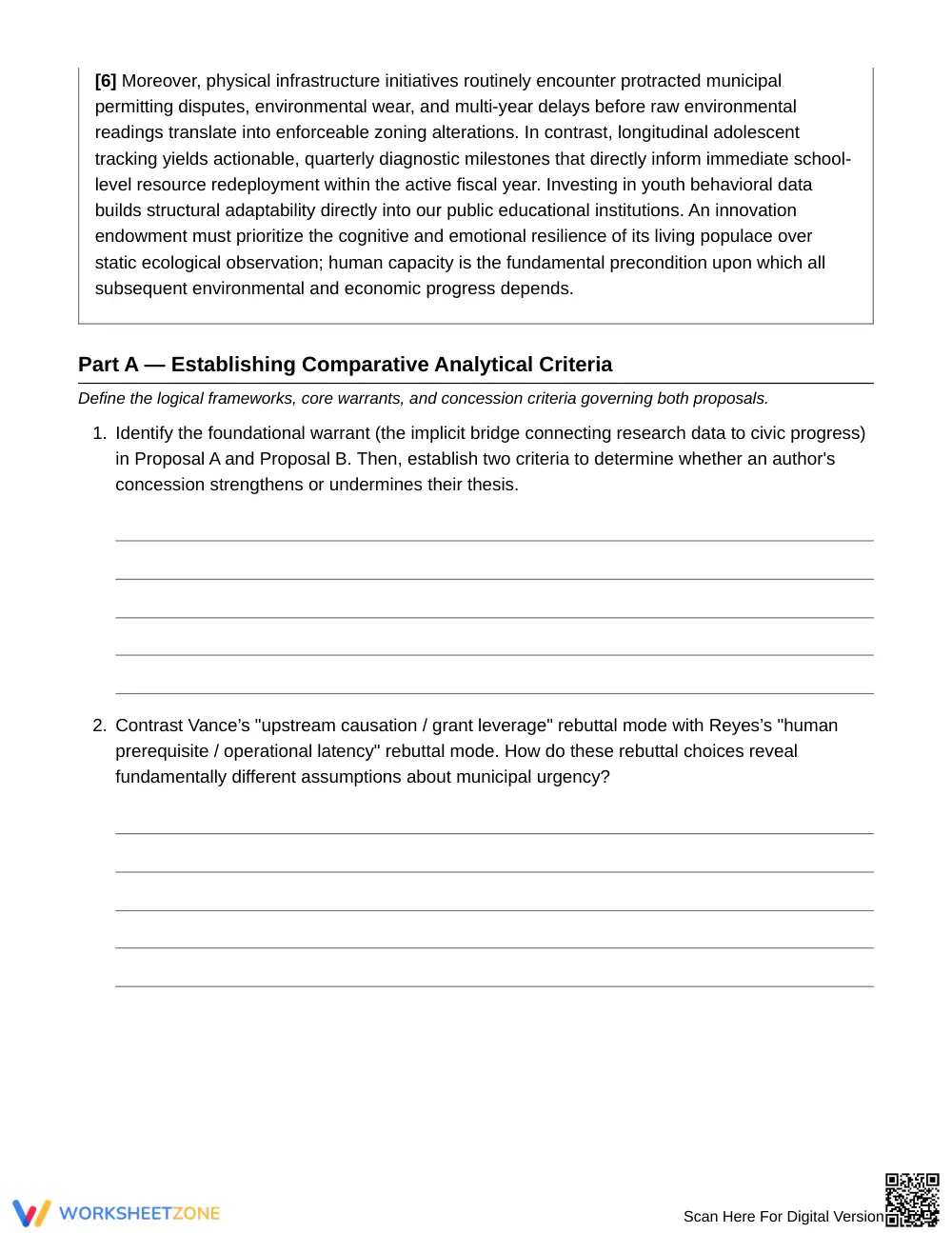
- Guided Practice (Part A, Tasks 1–2): Students analyze foundational architectural frameworks, defining implicit warrants and establishing evaluative criteria to judge whether concessions bolster or compromise thesis integrity.
- Supported Practice (Part B, Tasks 3–8): Paired-text prompts guide learners through text-dependent investigations of syntactic pivots, operational latency rebuttals, empirical metrics, and audience resistance management.
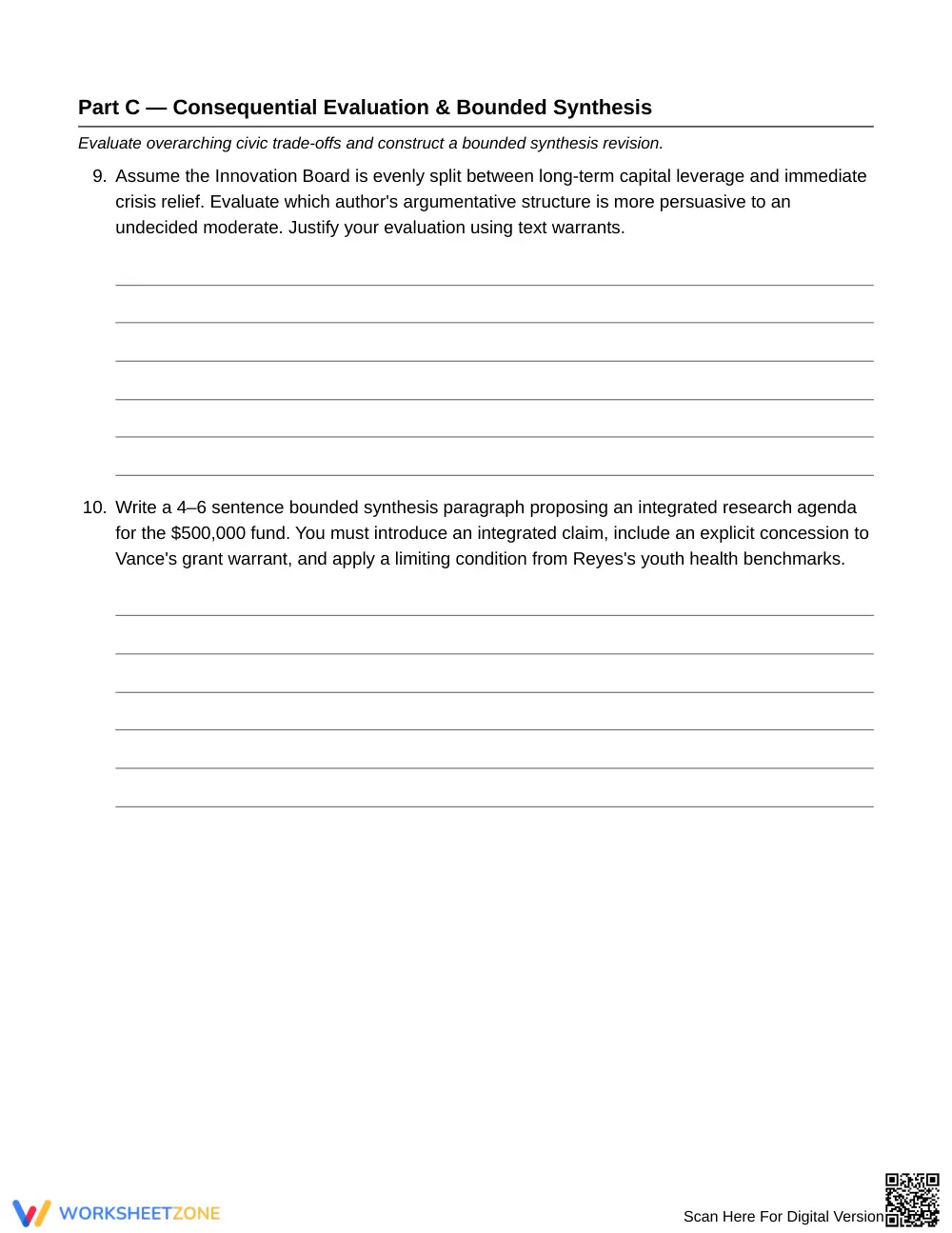
- Independent Practice (Part C, Tasks 9–10): Students synthesize findings independently by judging holistic persuasiveness for moderate stakeholders and drafting a four-to-six sentence bounded synthesis paragraph.
This sequence mirrors the gradual-release framework, guiding students from structural recognition to autonomous rhetorical evaluation and bounded synthesis.
Standards Alignment
This resource aligns with Grade 12 English Language Arts standards for advanced argumentation, evaluating how authors structure concessions and rebuttals to address audience resistance. It also supports standards requiring students to assess premises, warrants, and evidence in competing texts. Both standard codes can be copied directly into lesson plans, IEP goals, or district curriculum mapping tools.
How to Use It
Deploy this worksheet after direct instruction on Toulmin argumentation. During a 60-to-90-minute block, assign Parts A and B for collaborative dissection, reserving Part C for summative synthesis. For formative assessment, check Task 8 responses to verify whether students identify how contrasting conjunctions regulate rhetorical force. Expected completion time is 60 to 90 minutes.
Who It's For
Designed for Grade 12 English IV and AP Language students, this activity prepares seniors for collegiate writing. For emerging writers, provide sentence frames for the Part C synthesis prompt. Pair this packet directly with an instructional unit on Toulmin argument structure or policy rhetoric.
According to Fisher & Frey (2014), analytical reading demands explicit instruction in identifying structural concessions, unstated warrants, and syntactic rebuttal pivots before students can generate nuanced written arguments. In Grade 12 English IV, comparing concession and rebuttal strategies ensures learners do not merely summarize competing perspectives, but actively deconstruct how authors negotiate audience resistance and frame civic trade-offs. This 6-page worksheet addresses advanced argumentation by moving students through 10 calibrated tasks: from categorizing implicit warrants in authentic municipal proposals, to dissecting syntactic transitions, to composing bounded synthesis claims. The 4-page answer key supplies thorough benchmark rationales, supporting objective formative evaluation. Grounding high school seniors in systematic rhetorical deconstruction reinforces critical thinking, equipping students to evaluate complex societal discourse, resolve conflicting public priorities, and sustain rigorous academic discourse across collegiate and civic environments.


