





























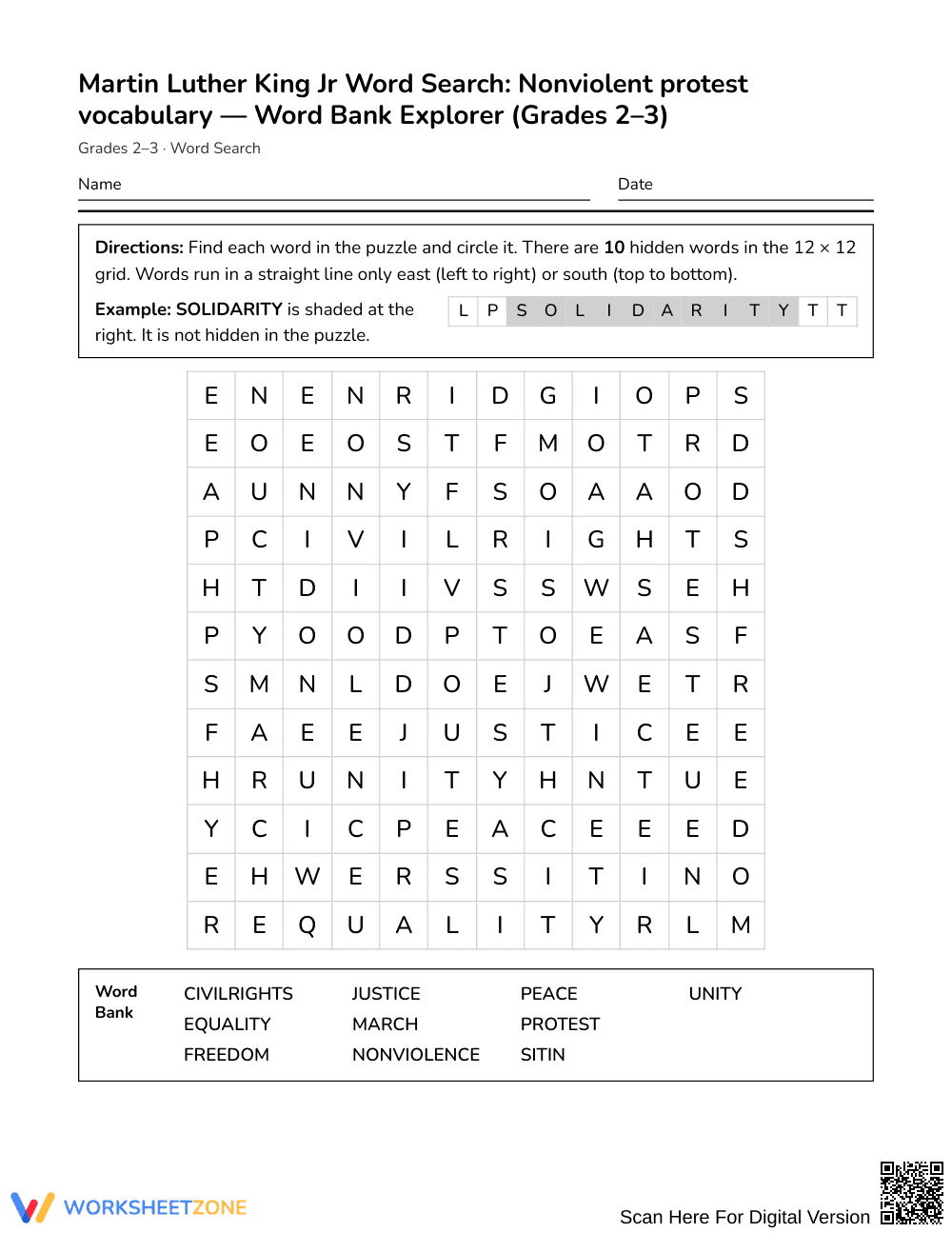


Ready Civil Rights Word Search | Grades 2–3 Social Studies

Paste this activity's link or code into your existing LMS (Google Classroom, Canvas, Teams, Schoology, Moodle, etc.).
Students can open and work on the activity right away, with no student login required.
You'll still be able to track student progress and results from your teacher account.
This Grades 2–3 social studies word search introduces young learners to essential nonviolent protest vocabulary connected to Dr. Martin Luther King Jr. and the American Civil Rights Movement. Students locate 10 foundational historical terms within a structured grid, strengthening word recognition, spelling accuracy, and thematic vocabulary comprehension during elementary social studies instruction.
At a Glance
- Grade: Grades 2–3 elementary · Subject: Social Studies and History
- Standard: Not standards-assessed — supplementary historical vocabulary enrichment
- Skill Focus: Nonviolent protest vocabulary and historical concepts
- Format: 1 page puzzle · 10 hidden words · Full answer key included · PDF
- Best For: Civil Rights unit introductory vocabulary review
- Time: 15–20 minutes of seatwork
What's Inside
The activity provides a clean, single-page word search featuring 10 essential vocabulary terms tied to peaceful activism and the Civil Rights Movement. An alphabetical word bank anchors the bottom of the page, allowing emerging readers to track terms systematically as they scan the puzzle. A comprehensive two-page answer key clearly marks the precise coordinates and placement of each term, enabling rapid self-checking or immediate teacher evaluation without extra grading friction.
Puzzle Structure and Mechanics
Built specifically for primary-grade accessibility, the puzzle utilizes a compact 12-by-12 letter grid tailored to second- and third-grade visual tracking skills. Target words run exclusively in two accessible directions: East (horizontal, left to right) and South (vertical, top to bottom). By completely eliminating backward and diagonal orientations, the puzzle avoids developmental frustration while reinforcing standard English reading directionality. Students refer to the alphabetized word bank to identify and cross off key vocabulary including equality, freedom, justice, and nonviolence.
Standards Alignment
This learning activity is designed specifically for vocabulary enrichment and historical concept exposure rather than formal standards-based testing. It does not align to an assessed state standard, functioning instead as high-interest supplemental practice during thematic units on civic engagement, peaceful change, and American leaders.
How to Use It
Deploy this word search during direct instruction as an engaging launchpad before reading a text about Dr. Martin Luther King Jr., prompting students to preview essential concepts. Alternatively, assign it after an interactive history lesson as a quiet independent consolidation task. For formative assessment, circulate as students work and ask them to define terms like protest or sitin in their own words. Most students complete the activity within 15 to 20 minutes.
Who It's For
This resource serves Grades 2–3 elementary students beginning their study of historical changemakers and peaceful advocacy. Its clear layout and forward-facing word paths offer accessible differentiation for English language learners and developing readers needing low-stress vocabulary practice. For maximum instructional impact, pair this puzzle with a picture-book biography of Martin Luther King Jr. or an introductory anchor chart defining peaceful community action.
According to Fisher & Frey (2014), intentional exposure to domain-specific vocabulary before and during content-area reading establishes critical conceptual anchors for primary-grade learners. This Grades 2–3 social studies resource provides non-standards-assessed vocabulary enrichment centered on nonviolent protest and civil rights history. By searching for 10 foundational words across a 12-by-12 grid with strictly left-to-right and top-to-bottom letter paths, emerging readers practice orthographic pattern recognition without visual overload. Fisher & Frey demonstrate that pairing targeted word-level exploration with thematic discussion significantly improves word retention and conceptual understanding in early elementary social studies units. This activity gives educators a reliable, zero-prep tool that reinforces vital historical language—including terms like equality, justice, and peace—while supporting independent orthographic discovery. It bridges fundamental literacy decoding with meaningful civic knowledge, ensuring developing readers gain confidence with the foundational language of nonviolent activism.


