

































Ready Character Claim Repair Worksheet | Grade 9 English I

Paste this activity's link or code into your existing LMS (Google Classroom, Canvas, Teams, Schoology, Moodle, etc.).
Students can open and work on the activity right away, with no student login required.
You'll still be able to track student progress and results from your teacher account.
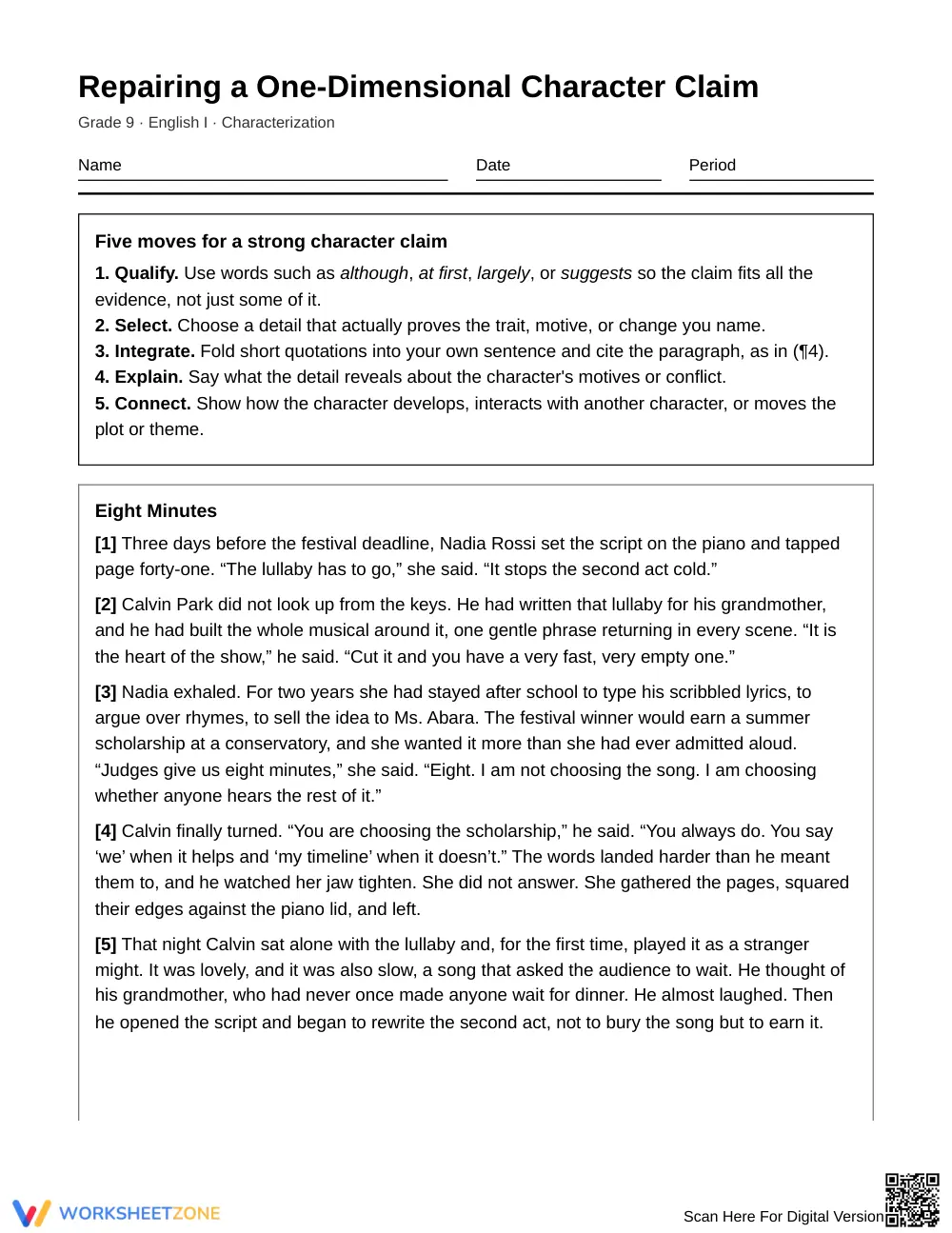
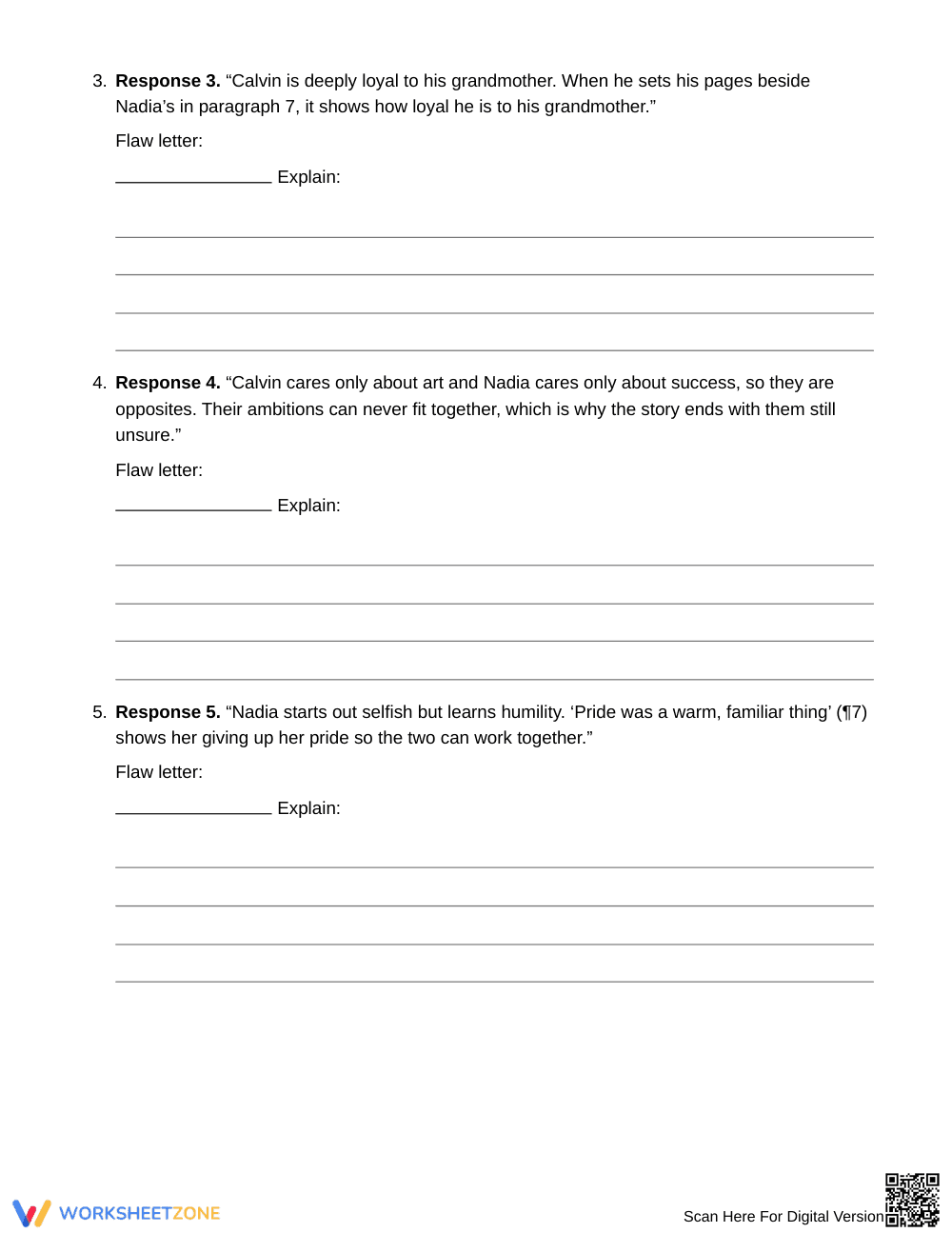
This worksheet teaches Grade 9 students to spot why a character claim fails and rewrite it so the evidence supports it. Students diagnose five flawed responses to a short story, then repair five claims using qualification, accurate quotation, paragraph citations, and explanation.
At a Glance
- Grade: 9 · Subject: English I
- Standard:
RL.9-10.3— Explain how characters develop and interact, using accurate evidence from the text- Skill Focus: Revising one-dimensional character claims
- Format: 6 pages · 10 problems · Answer key included · PDF
- Best For: Revising character claims after instruction
- Time: 45–60 minutes
What's Inside
The 6-page PDF opens with a five-move rule box and a worked example that repairs a flawed response. Part A has five diagnosis tasks with a lettered flaw bank, and Part B has five repair-writing tasks. Students work from an original short story with numbered paragraphs, and a 3-page answer key supports scoring.
Skill Progression
- Guided practice: a worked model repairs a flawed response about Calvin, with each of the five moves labeled.
- Supported practice: 5 diagnosis tasks (Part A) using a lettered flaw bank and paragraph citations.
- Independent practice: 5 repair tasks (Part B) with task-specific prompts and no sentence frames.
The sequence follows gradual release: I Do, We Do, You Do.
Standards Alignment
RL.9-10.3 — Analyze how complex characters (those with multiple or conflicting motivations) develop over the course of a text, interact with other characters, and advance the plot or develop the theme. This standard code can be copied directly into lesson plans, IEP goals, or district curriculum mapping tools.
How to Use It
- After direct instruction: Use it as classroom practice once students know the five moves. Allow 45–60 minutes, or split Parts A and B across two days.
- Before drafting: Use Part B as a revision workshop ahead of a literary analysis paragraph.
Formative tip: as students work, check that each quotation matches the character named in the claim.
Who It's For
Built for Grade 9 English I students learning to support character claims with accurate evidence. The model, rule box, and flaw bank scaffold developing writers, while stronger writers can add a second repair. Pair it with a characterization anchor chart or a lesson on direct and indirect characterization.
RL.9-10.3 asks Grade 9 students to analyze how complex characters with conflicting motives develop, interact, and advance the plot or theme. This worksheet, Repairing a One-Dimensional Character Claim, teaches that skill through revision: students diagnose five flawed responses to a short story, then write five repaired claims that qualify, select, integrate, explain, and connect. Its structure follows the gradual release of responsibility described by Fisher & Frey (2014), moving from a modeled repair to guided diagnosis to independent writing. Across 10 tasks, students practice replacing absolute labels with qualified claims, matching quotations to the right character, and citing paragraph numbers. Teachers can use it after direct instruction as a formative check on whether students treat characters as complex rather than fixed. A 3-page answer key supports quick, consistent feedback on every task.


