































Ready Bonding & Properties Worksheet | Grade 11 Chemistry

Paste this activity's link or code into your existing LMS (Google Classroom, Canvas, Teams, Schoology, Moodle, etc.).
Students can open and work on the activity right away, with no student login required.
You'll still be able to track student progress and results from your teacher account.
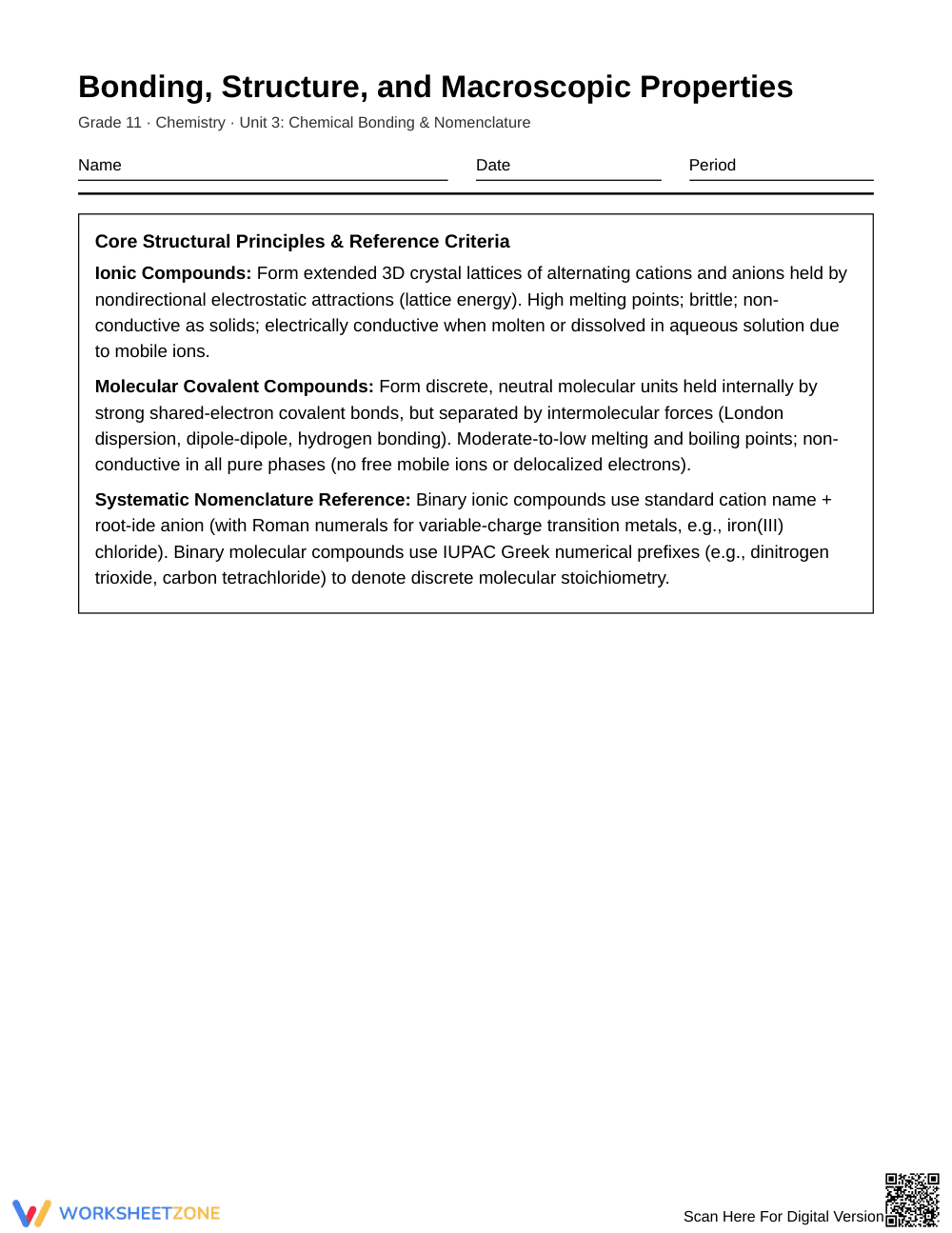
This Grade 11 chemistry worksheet trains students to explain macroscopic physical properties through microscopic bonding models and crystal structure. Learners analyze empirical data across ionic and covalent compounds to connect lattice energy, intermolecular forces, and electrical conductivity, building a solid foundation in chemical structure analysis.
At a Glance
- Grade: 11 · Subject: Chemistry
- Standard: Structure & Properties — Relate bulk physical properties to particle-level bonding models and electrostatic attractions
- Skill Focus: Explain Properties from Bonding and Structure
- Format: 5 pages · 10 problems · Answer key included · PDF
- Best For: Post-instruction conceptual review and data analysis
- Time: 45–60 minutes
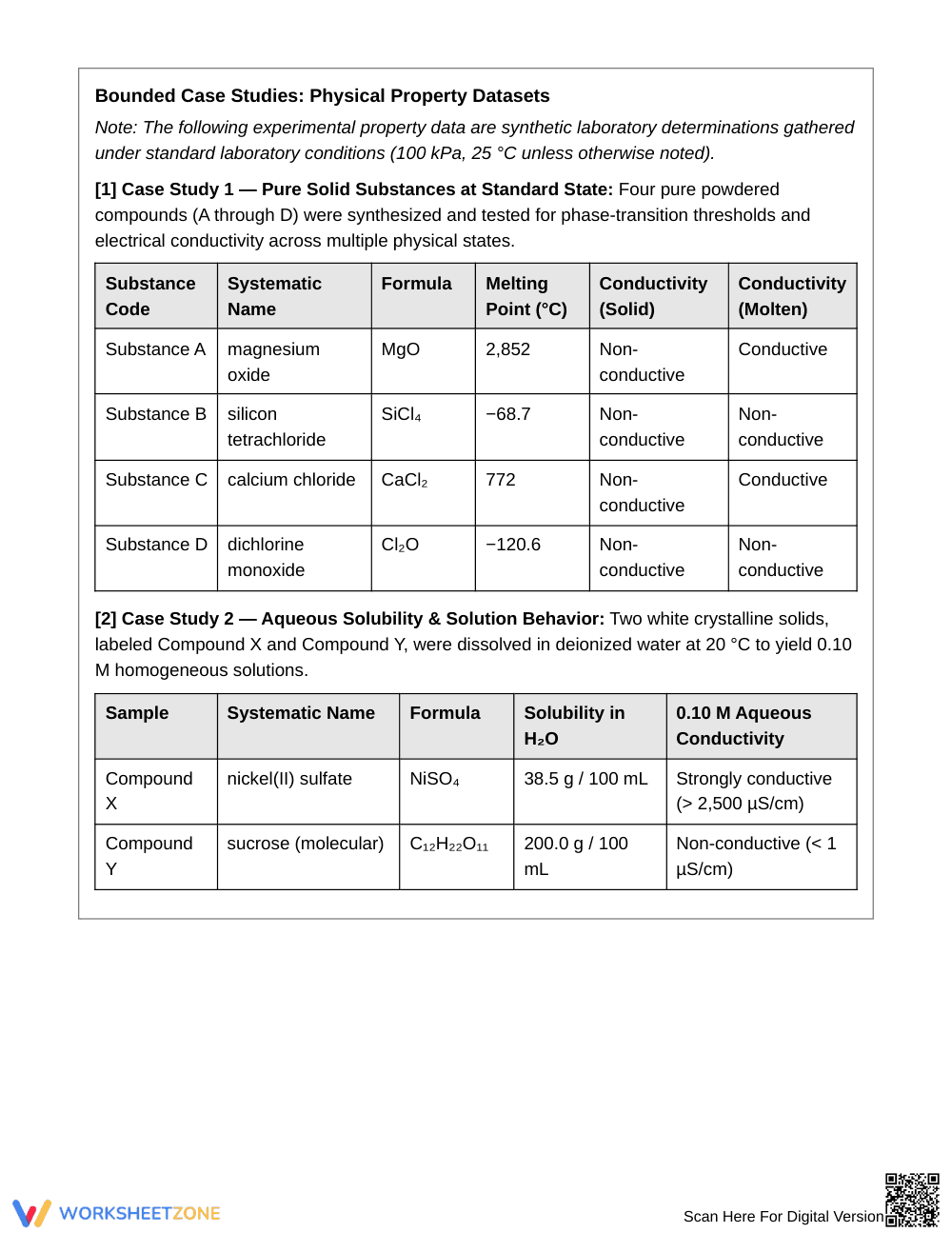
This 5-page worksheet includes two bounded laboratory case studies, structural reference criteria, and 10 multi-part analytical items. Students analyze synthetic property tables detailing melting points, state phases, and aqueous conductivity for compounds including magnesium oxide and silicon tetrachloride. A 4-page answer key provides complete Coulombic justifications and scoring explanations.
Skill Progression
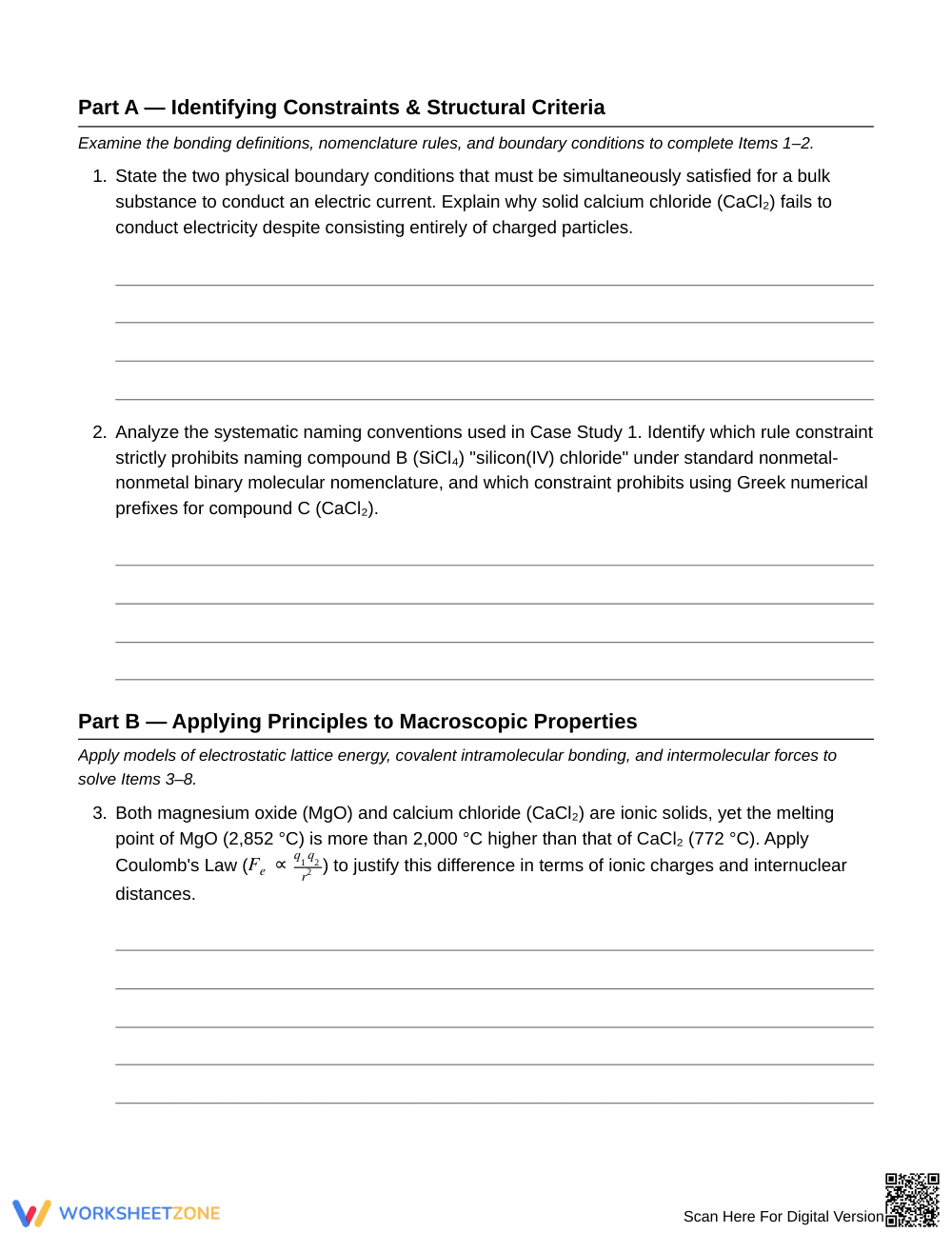
- Guided practice (Items 1–2): Students examine reference criteria to state conductivity boundary conditions and identify nomenclature constraints.
- Supported practice (Items 3–8): Learners apply Coulomb's Law and intermolecular force models across 6 items to justify melting points, dissolution, and mechanical brittleness.
- Independent practice (Items 9–10): Students evaluate scientific claims regarding covalent bond strength and solubility data, writing counterarguments without scaffolding.
This sequence mirrors the gradual release of responsibility model, transitioning students from foundational criteria to independent critique.
Standards Alignment
This resource aligns with high school chemistry expectations for communicating how sub-microscopic structure determines observable bulk properties. Students gather evidence from laboratory case studies to differentiate lattice-bound ionic compounds from discrete molecular substances. Supporting standards focus on using Coulomb's Law to predict electrostatic force magnitudes. Both standard codes can be copied directly into lesson plans, IEP goals, or district curriculum mapping tools.
How to Use It
Assign this worksheet following direct instruction on chemical bonding and nomenclature. It serves as an effective small-group analysis or an individual summative review. Formative assessment tip: inspect Item 5 to confirm students do not confuse intramolecular covalent bonds with intermolecular attractions. The expected completion time is 45 to 60 minutes.
Who It's For
This worksheet is tailored for Grade 11 Chemistry students refining particle-level reasoning. The reference criteria and structured tables support struggling learners, while the quantitative Coulombic justifications challenge advanced thinkers. Pair this activity with a precipitation laboratory or an interactive digital crystal lattice simulation.
High school chemistry learners master the core skill of explaining macroscopic physical properties from chemical bonding and sub-microscopic structure through structured, evidence-based inquiry. By evaluating empirical melting point and electrical conductivity datasets across ionic lattices and molecular covalent compounds, students develop the analytical ability to differentiate strong electrostatic lattice attractions from weaker intermolecular forces. According to Fisher & Frey (2014), structuring science tasks around explicit gradual-release progressions—moving from guided structural constraints to independent critique of scientific claims—dramatically deepens student conceptual retention and mitigates persistent chemical misconceptions. This 10-task worksheet reinforces critical scientific thinking by prompting learners to justify phenomena using Coulomb's Law and evaluate authentic student claims with laboratory counter-evidence. Educators utilize this comprehensive 5-page resource to bridge theoretical bonding models and observable phenomena, ensuring upper-secondary students achieve rigorous mastery in chemical structure analysis and scientific argumentation.


