
































Ready Bonding & Nomenclature Worksheet | Grade 11 Chemistry

Paste this activity's link or code into your existing LMS (Google Classroom, Canvas, Teams, Schoology, Moodle, etc.).
Students can open and work on the activity right away, with no student login required.
You'll still be able to track student progress and results from your teacher account.
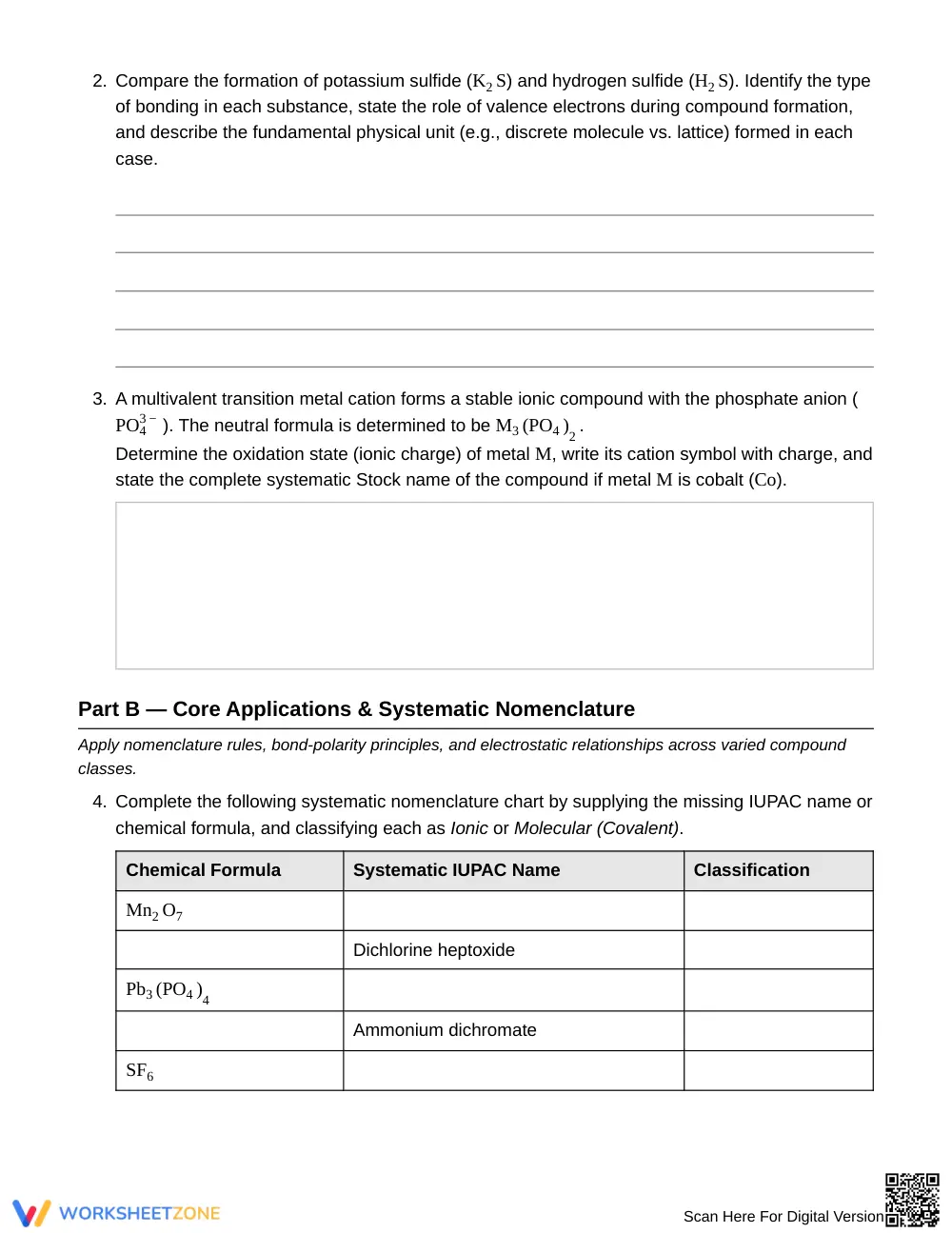
This Grade 11 chemistry worksheet guides students through chemical bonding principles and systematic IUPAC nomenclature across ionic and covalent compounds. Learners analyze particle structures, calculate electronegativity differences, and evaluate empirical property data to connect macroscopic observations with electrostatic forces, building mastery for secondary chemistry exams.
At a Glance
- Grade: 11 · Subject: Chemistry
- Standard: Chemistry Curriculum Standards — Classify chemical bonds and apply systematic IUPAC nomenclature
- Skill Focus: Bonding and Nomenclature
- Format: 5 pages · 12 problems · Answer key included · PDF
- Best For: Comprehensive unit review and exam prep
- Time: 45–60 minutes
What's Inside
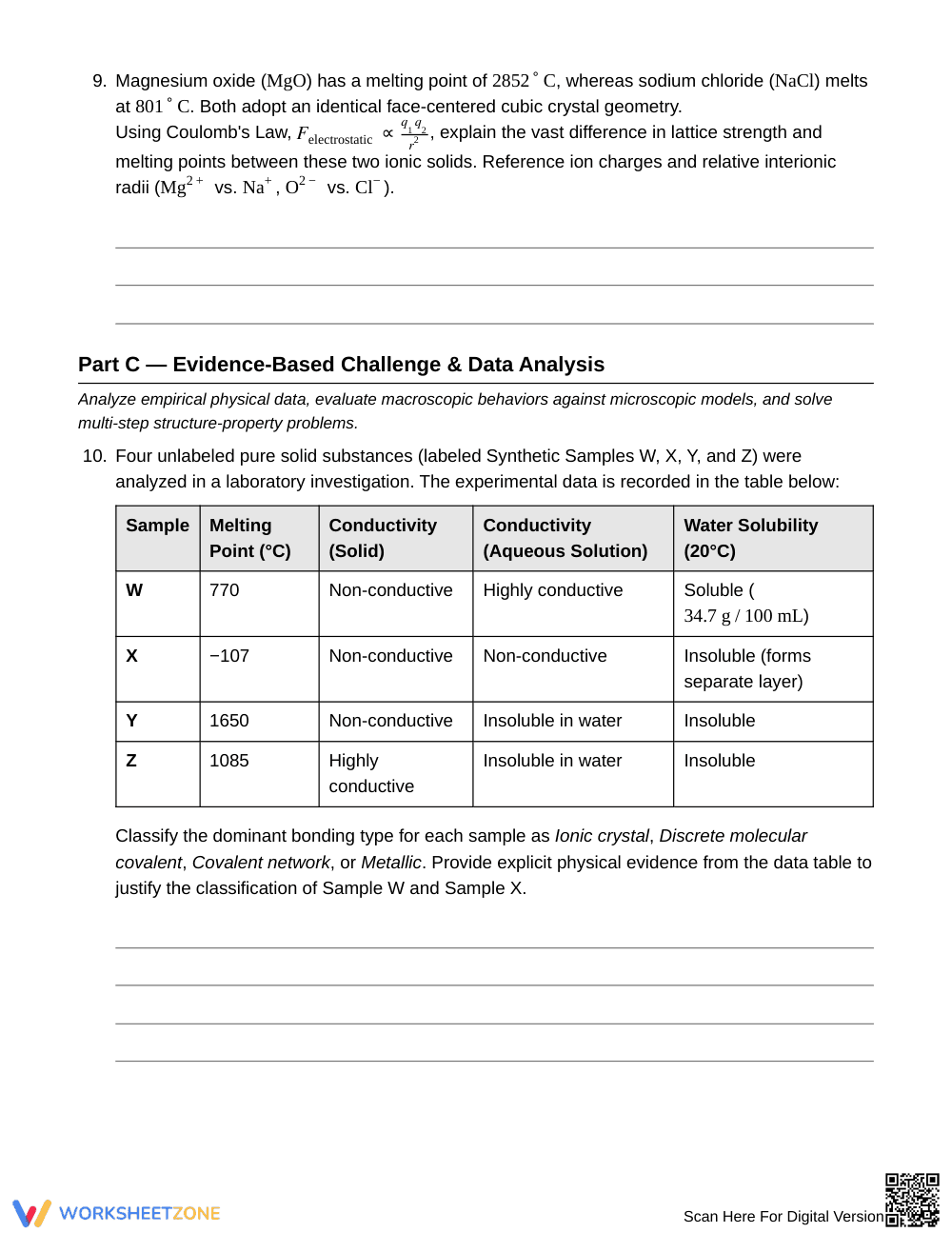
This 5-page printable worksheet includes 12 multi-part chemistry problems and a complete 5-page answer key. Students reference an opening guide on IUPAC naming conventions and intramolecular bonds, complete nomenclature charts, critique statements on conductivity, apply Coulomb's Law, and classify unknown substances using laboratory solubility and melting point data.
Skill Progression
- Guided Practice (Part A, Tasks 1–3): Students review core bonding models and baseline nomenclature, identifying correct formula-structure pairs and determining multivalent transition metal oxidation states with reference guide support.
- Supported Practice (Part B, Tasks 4–9): Learners classify mixed polyatomic compounds, calculate electronegativity differences, balance acid names, and evaluate lattice strength differences using Coulomb's Law.
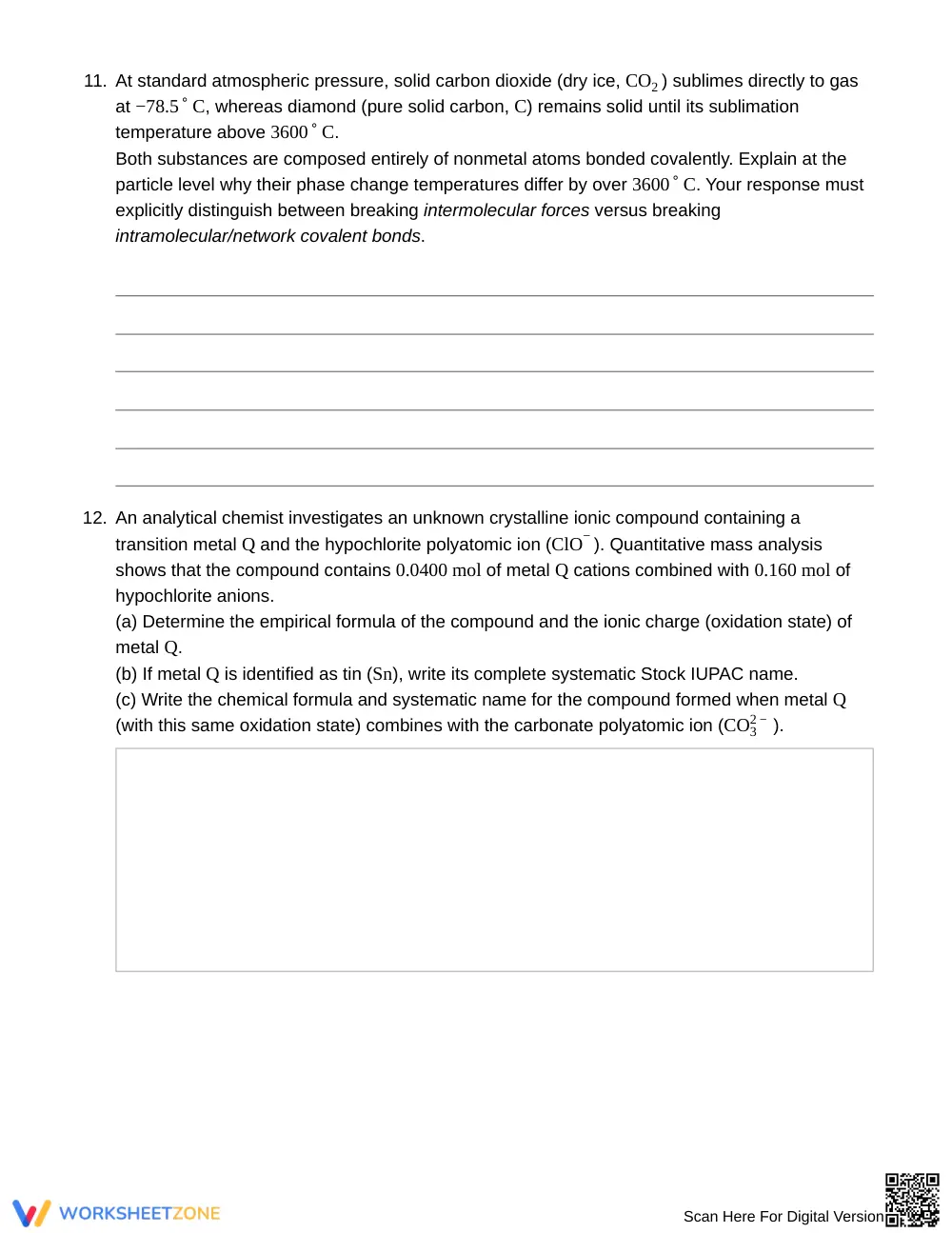
- Independent Practice (Part C, Tasks 10–12): Students autonomously analyze laboratory data tables, differentiate covalent network from molecular sublimation, and calculate empirical formulas from molar quantities.
This structure follows the gradual-release model, progressing from scaffolded concept checks to independent empirical analysis.
Standards Alignment
This worksheet aligns with high school chemistry standards on chemical bonding and properties of matter. Students construct explanations for macroscopic behaviors by examining valence electrons, ionic charges, and bond polarities. Both standard codes can be copied directly into lesson plans, IEP goals, or district curriculum mapping tools.
How to Use It
Use this worksheet after direct instruction on ionic and covalent bonding as a summative unit review. Alternatively, assign Part C for small-group inquiry. During classwork, check whether students attribute melting point differences to ionic charge rather than atomic size. Expected completion time is 45 to 60 minutes.
Who It's For
This resource serves eleventh-grade general, honors, and AP Chemistry students preparing for bonding assessments. Support emerging learners by providing a polyatomic ion reference sheet, and pair this resource with an electronegativity periodic table for optimal instruction.
According to research by Fisher & Frey (2014) on the gradual-release framework, structured instructional progressions that move deliberately from foundational conceptual models to evidence-based problem solving produce significant gains in student scientific literacy. This Grade 11 chemistry resource targets bonding and nomenclature mastery through twelve multi-step problems that link macroscopic substance properties to microscopic attractions. Aligned with rigorous high school chemistry standards, the activity systematically strengthens learner competence in classifying ionic lattices, covalent molecules, and network solids, calculating electronegativity differences, and applying systematic IUPAC naming rules. By requiring students to interpret empirical physical data tables rather than rely on rote formula memorization, this instructional material provides secondary educators with an assessment-ready diagnostic tool that reinforces high-leverage chemical concepts, supports targeted remediation, and deepens conceptual STEM understanding across advanced high school science classrooms.


