




























Views
Downloads

Ready Antiderivative Families Worksheet | Grade 12 Calculus

Paste this activity's link or code into your existing LMS (Google Classroom, Canvas, Teams, Schoology, Moodle, etc.).
Students can open and work on the activity right away, with no student login required.
You'll still be able to track student progress and results from your teacher account.
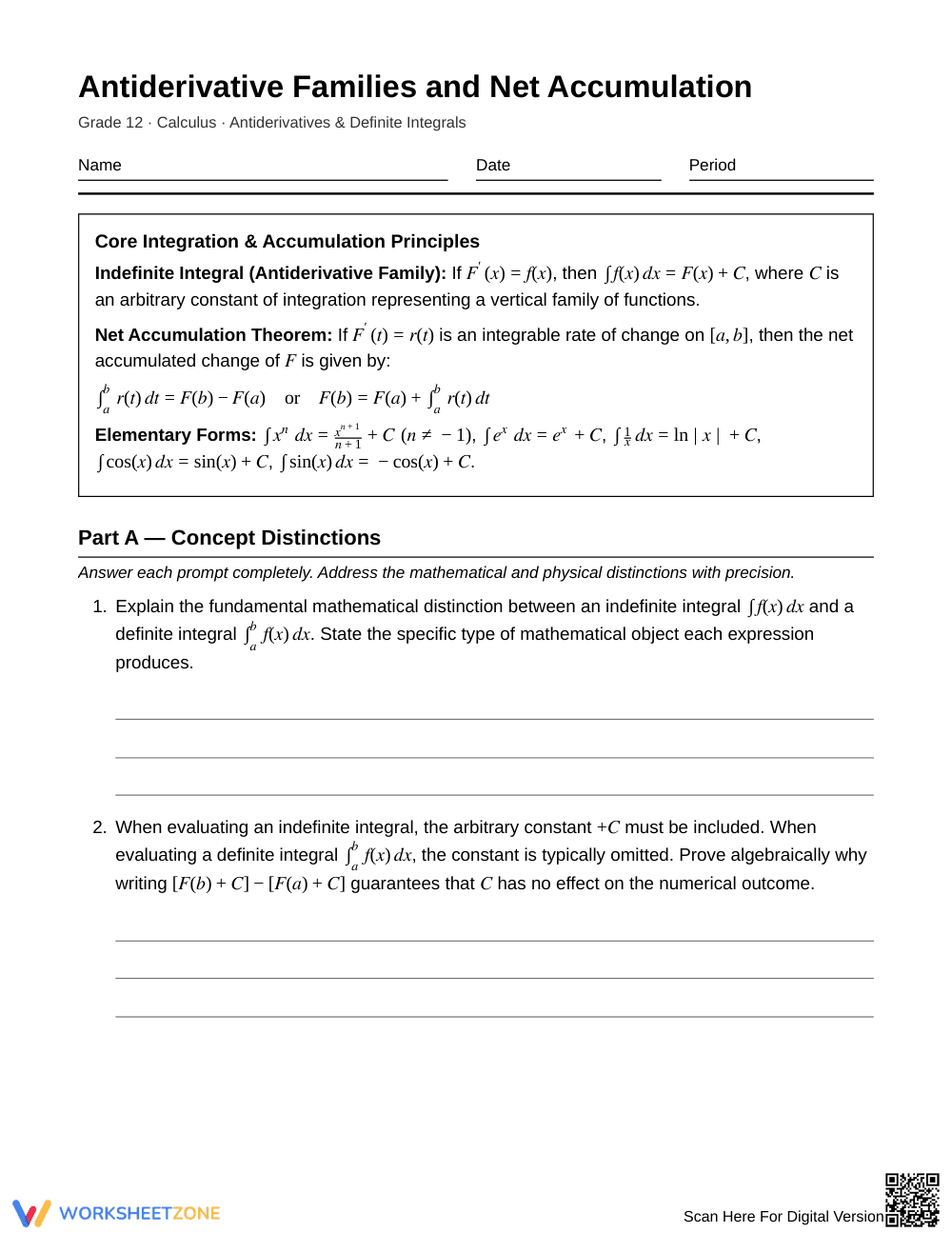
This Grade 12 calculus worksheet guides students through antiderivative families, indefinite integrals, and net accumulation principles. Learners examine the role of the arbitrary constant, solve initial-value problems, and analyze dynamic physical scenarios. The resource connects procedural antidifferentiation directly to authentic rate-of-change modeling, fostering robust calculus comprehension.
At a Glance
- Grade: 12 · Subject: Calculus
- Standard: Calculus Core — Calculate antiderivatives and model physical quantities using net accumulation
- Skill Focus: Antiderivative Families and Accumulation
- Format: 5 pages · 16 problems · Answer key included · PDF
- Best For: Advanced placement calculus review
- Time: 45–60 minutes
What's Inside
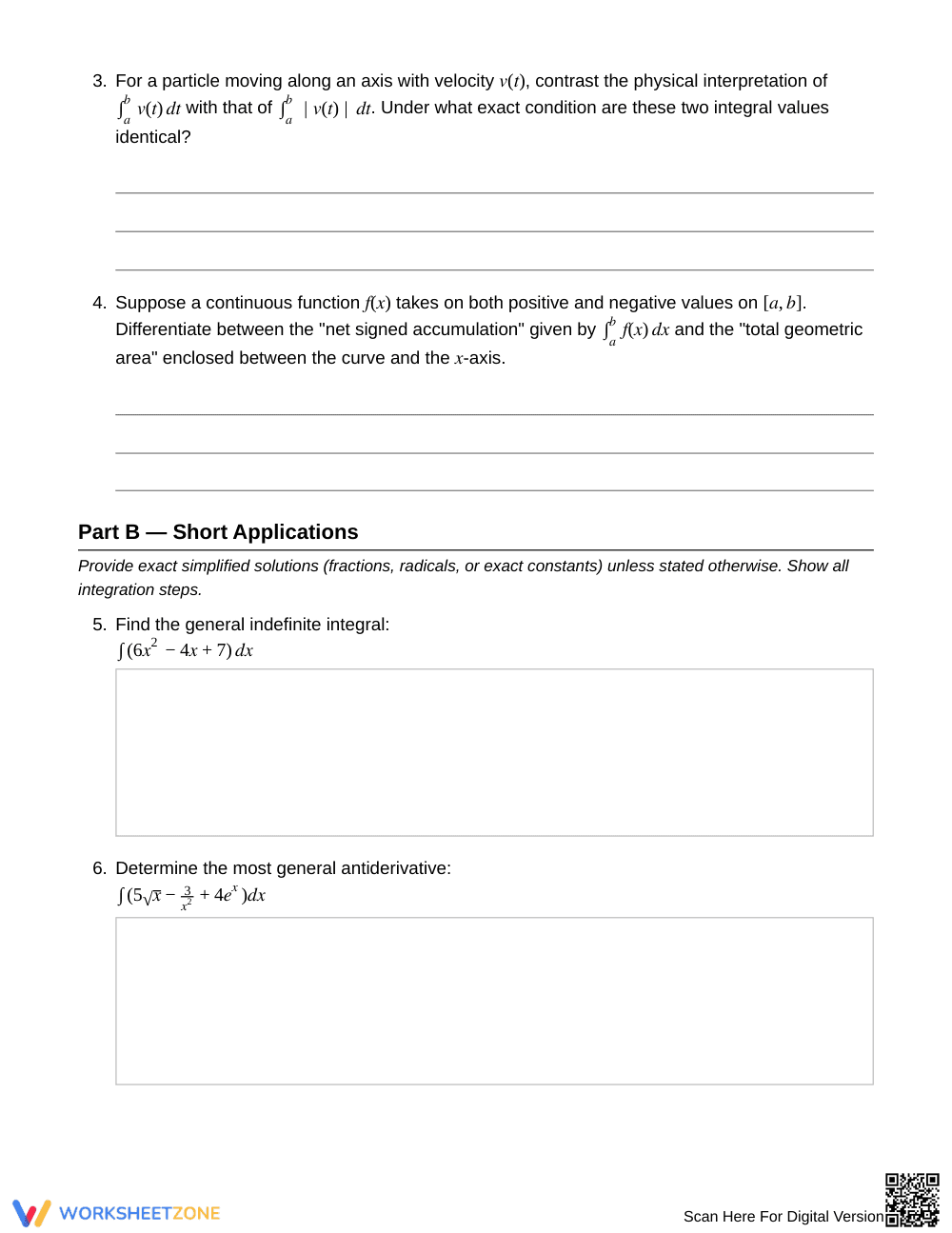
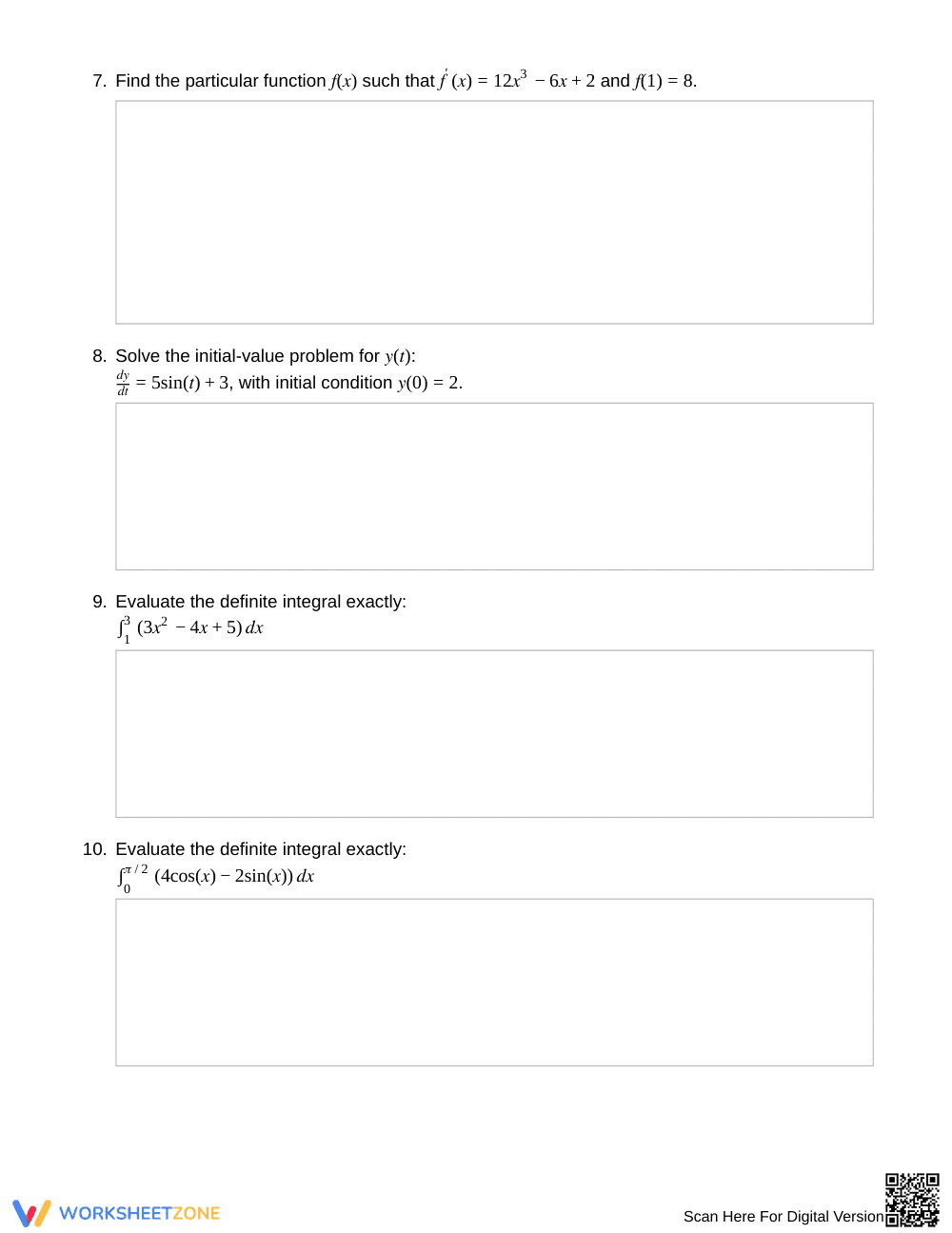
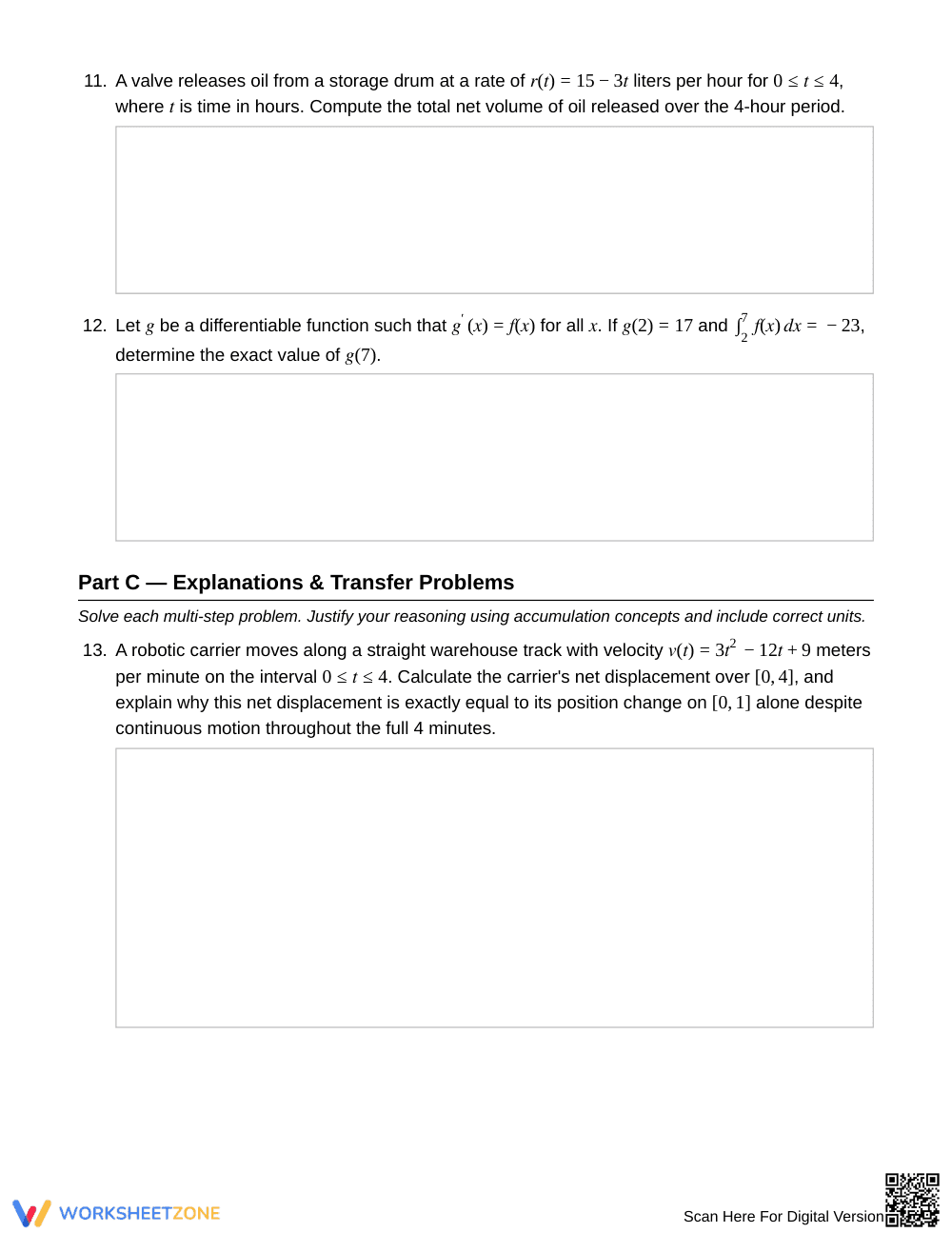
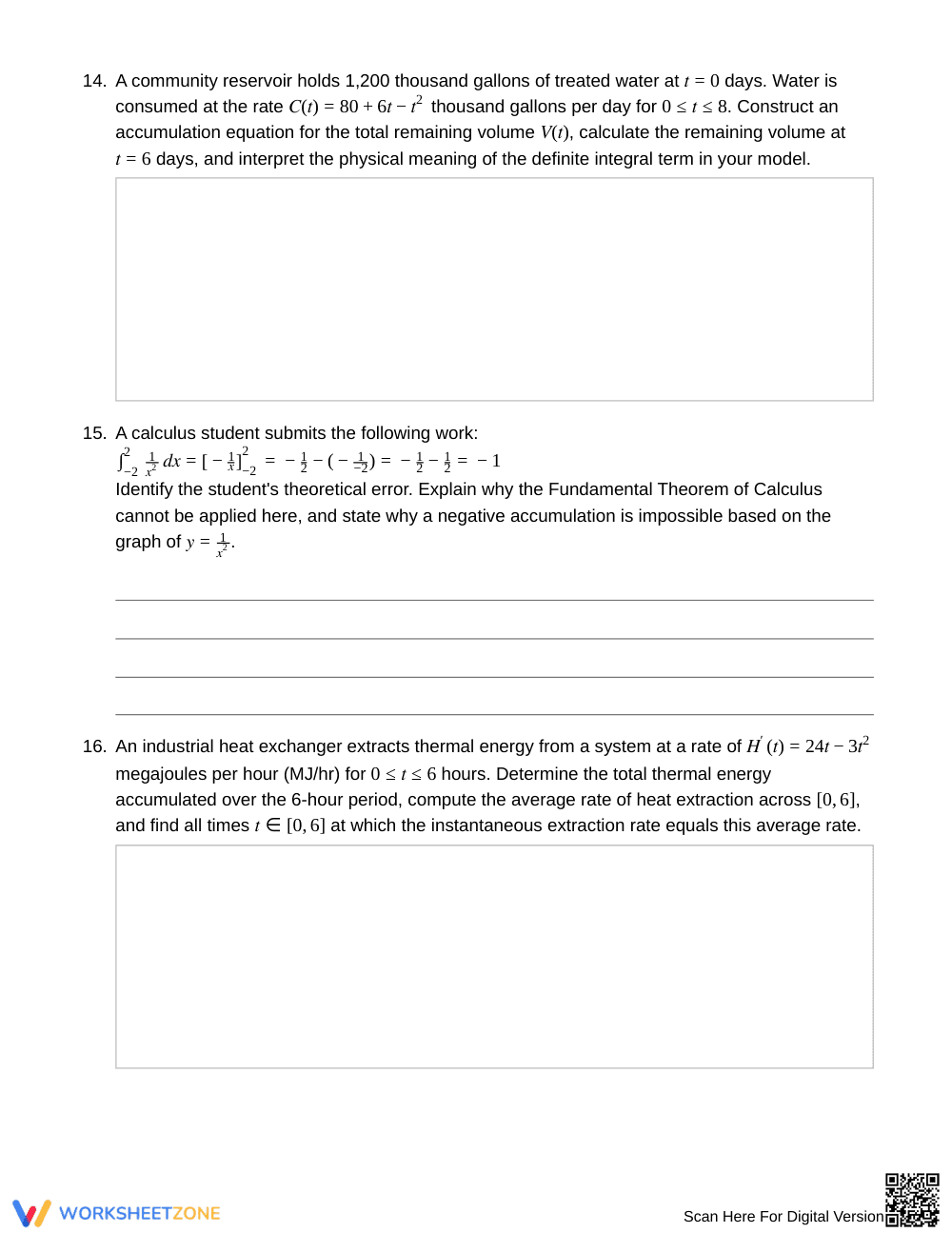
This 5-page worksheet provides a reference box with integration rules followed by 16 rigorous tasks. Problems include conceptual proofs regarding integration constants, initial-value computations, and contextual modeling problems involving velocity, fluid storage, and thermal energy. A comprehensive 4-page answer key provides step-by-step solutions and conceptual explanations.
Skill Progression
- Guided practice (Part A, Problems 1–4): Conceptual prompts require students to contrast indefinite and definite integrals while proving why constants cancel algebraically.
- Supported practice (Part B, Problems 5–12): Computational items build fluency with elementary antiderivatives, initial-value problems, and definite accumulation evaluations.
- Independent practice (Part C, Problems 13–16): Multi-step transfer tasks demand contextual accumulation modeling, error analysis of discontinuous integrands, and rate comparisons.
This gradual-release structure moves students methodically from foundational principles to independent problem solving.
Standards Alignment
This resource aligns with high school and introductory college calculus standards focusing on integral calculus. Students evaluate indefinite integrals as families of antiderivatives, apply initial conditions to find particular solutions, and use definite integrals to compute net change. Both concepts integrate directly into lesson plans and curriculum mapping tools.
How to Use It
Assign Parts A and B immediately after introducing accumulation theorems to solidify mechanics and conceptual definitions. Reserve Part C for small-group collaborative problem solving during a 45-minute practice session. As a formative check, review student explanations on the Part C error-analysis item to confirm they check integrand continuity before integrating.
Who It's For
This worksheet is tailored for Grade 12 AP Calculus AB/BC or introductory college calculus students. The core principles box supports students needing formula reinforcement, while the transfer items challenge advanced problem solvers. Pair this assignment with graphical curve-family demonstrations to build visual intuition before analytical work begins.
Mastering calculus requires secondary students to build conceptual fluency alongside mechanical computation. In advanced high school mathematics curricula, analyzing antiderivative families and accumulation functions enables learners to interpret definite integrals as dynamic accumulation totals rather than mere geometric area calculations. According to Fisher & Frey (2014), purposeful instructional scaffolding that deliberately transitions from foundational knowledge prompts to complex contextual problem solving fosters durable mathematical transfer and deep conceptual retention. By combining explicit algebraic proofs of integration constants with authentic physical applications—such as particle kinematics, reservoir fluid consumption, and thermal energy extraction—this 16-problem resource ensures Grade 12 students bridge procedural calculation and analytical reasoning. The targeted inclusion of non-routine error analysis further reinforces the prerequisite continuity hypotheses of the Fundamental Theorem of Calculus, equipping calculus students to identify invalid integration steps and communicate mathematical conclusions using precise technical vocabulary.


