


























Views
Downloads

2.MD.C.7 Worksheet: Reading Analog Time — Grade 2-4 Aligned
Paste this activity's link or code into your existing LMS (Google Classroom, Canvas, Teams, Schoology, Moodle, etc.).
Students can open and work on the activity right away, with no student login required.
You'll still be able to track student progress and results from your teacher account.
This Grade 2-4 math worksheet provides a comprehensive pathway to telling time mastery. Students progress through four distinct phases of learning, from basic clock reading to complex elapsed time calculations. By the final task, learners demonstrate total confidence in interpreting analog faces and applying time logic to real-world scenarios.
At a Glance
- Grade: 2–4 · Subject: Math
- Standard:
2.MD.C.7— Tell and write time accurately to the nearest five minutes from analog and digital clocks using a.m. and p.m.- Skill Focus: Analog Clock Interpretation
- Format: 4 pages · 18 problems · Answer key included · PDF
- Best For: Comprehensive unit assessment or mastery practice
- Time: 25–35 minutes
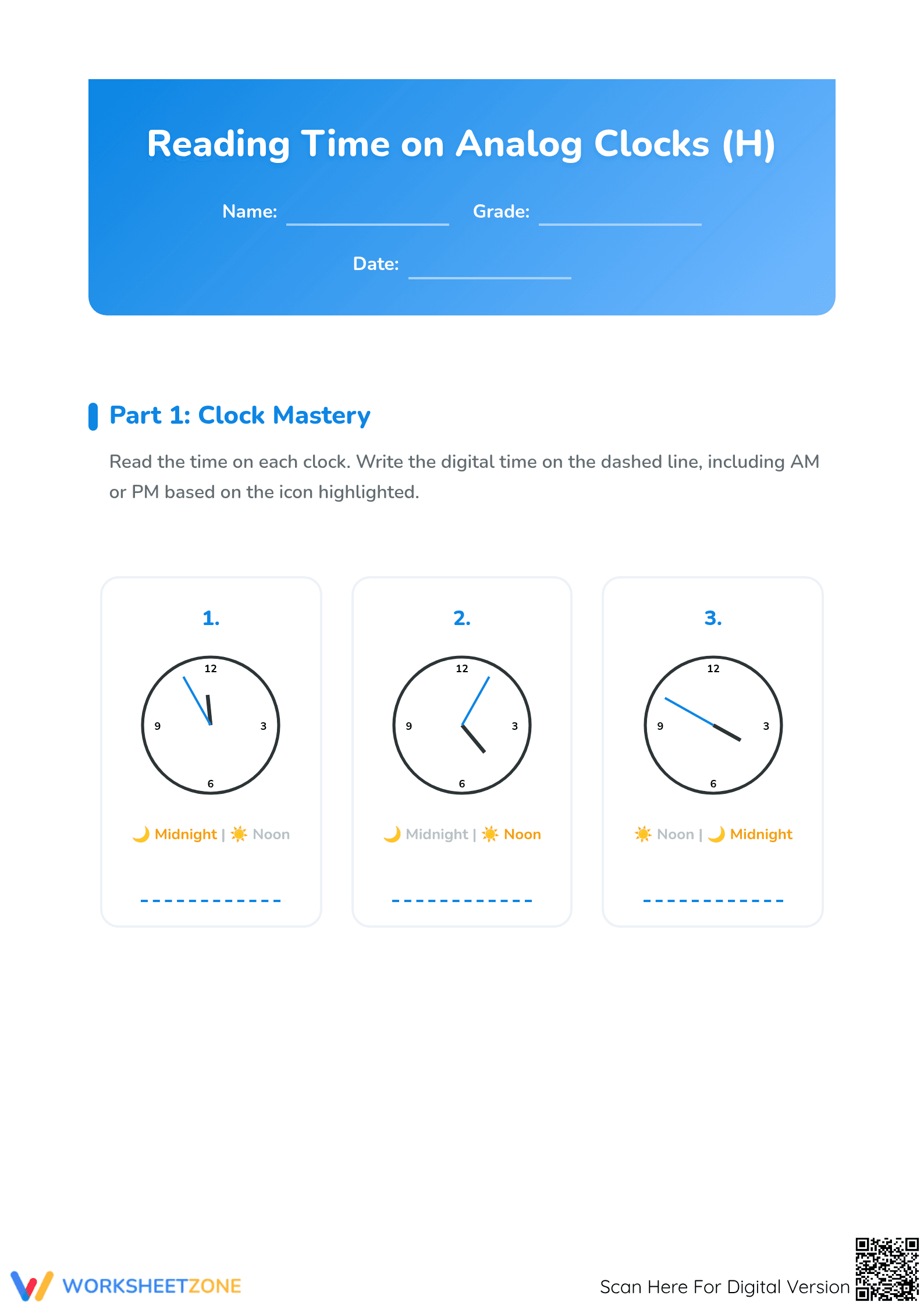
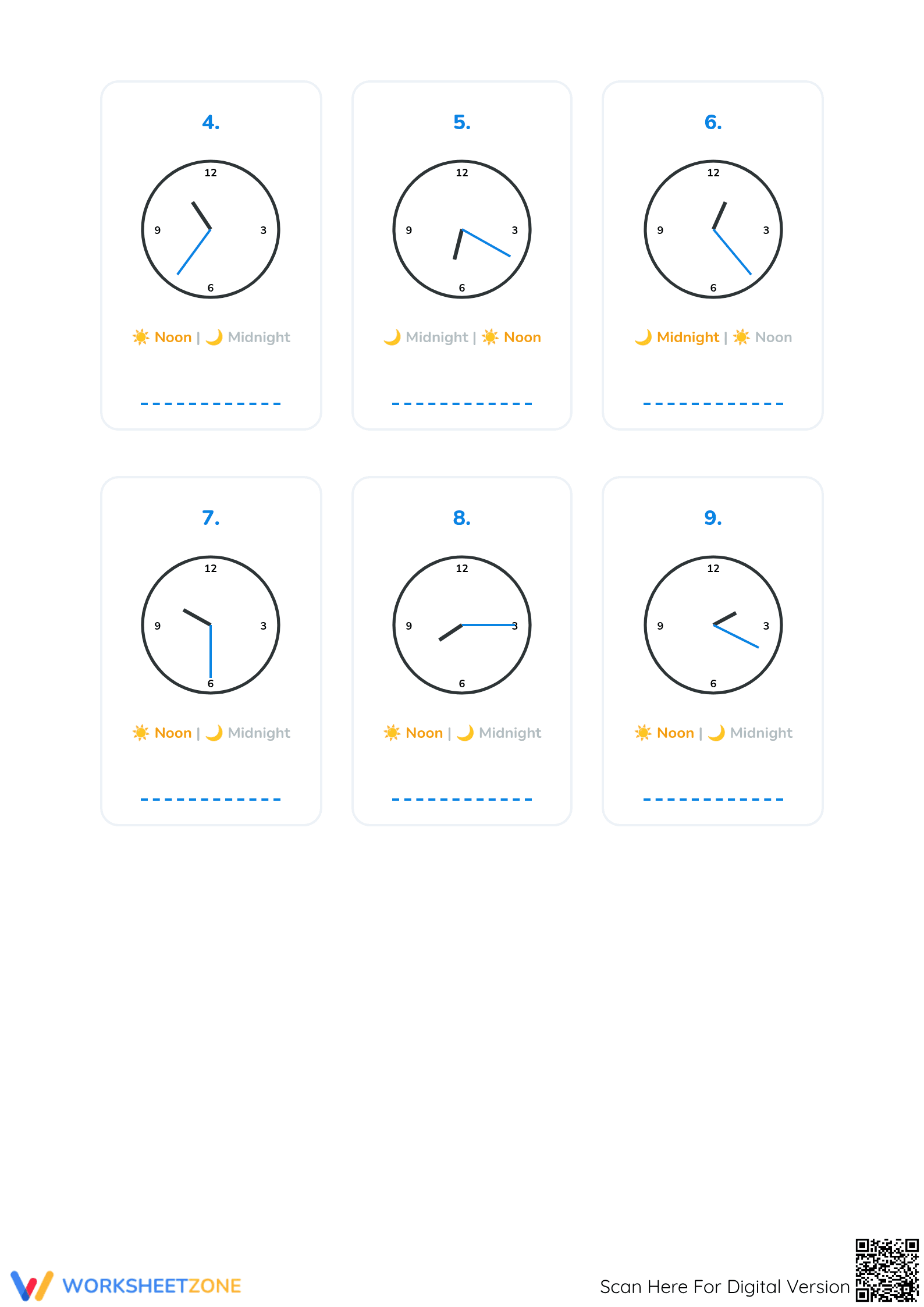
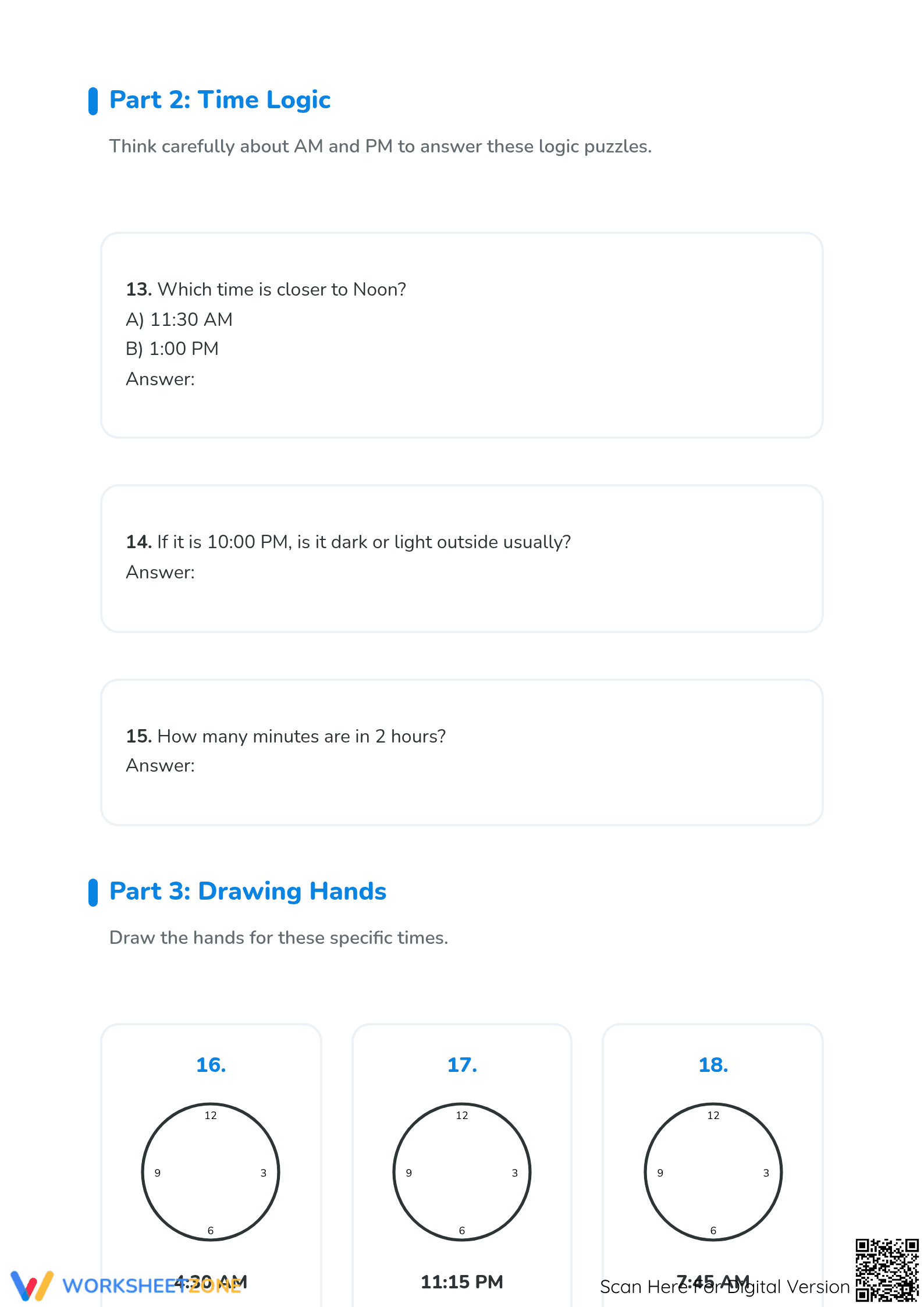
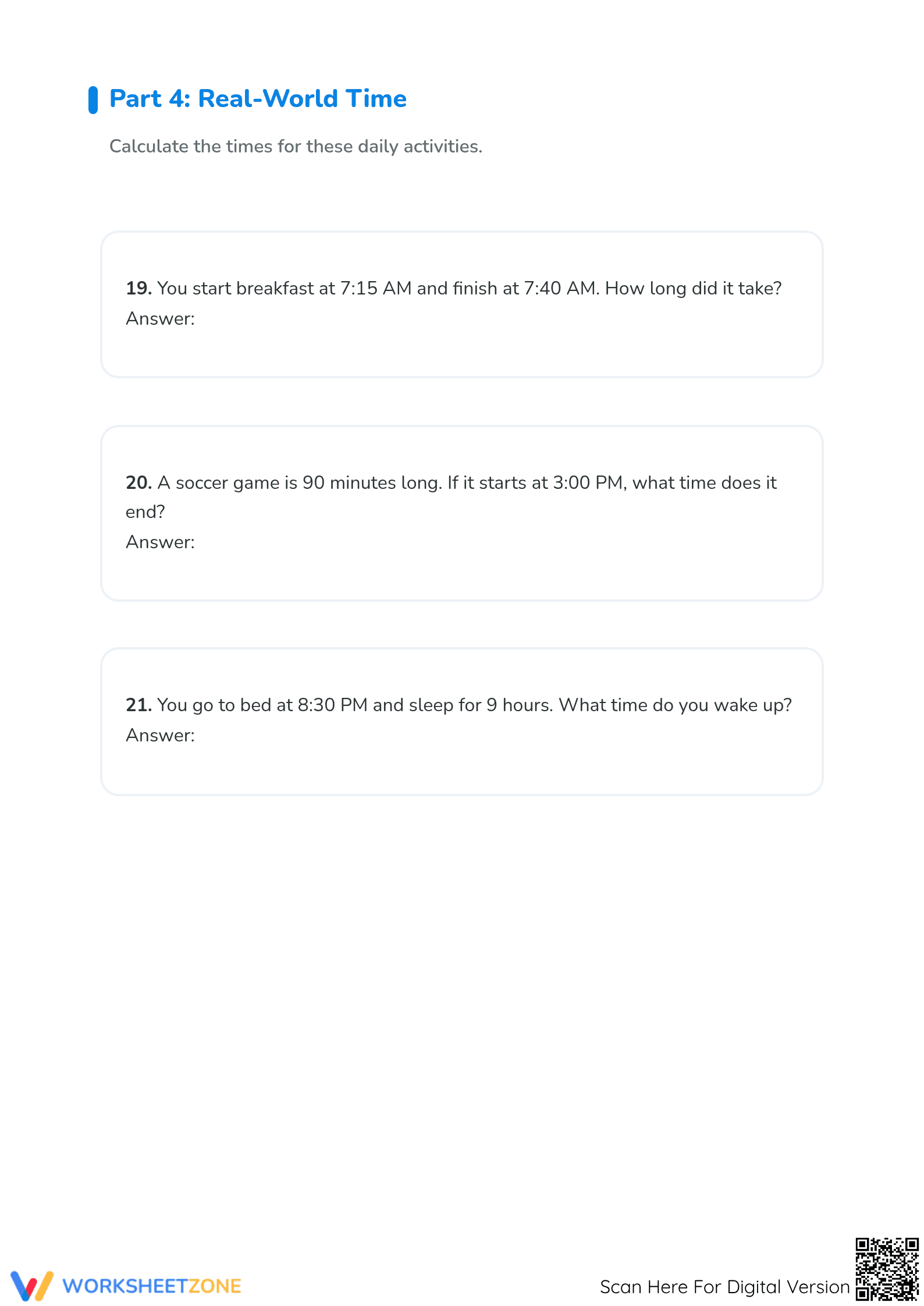
This four-page PDF includes 18 structured tasks. Part 1 features analog clocks for digital transcription. Part 2 presents three AM/PM logic puzzles. Part 3 requires students to draw hands on three blank clock faces. Part 4 concludes with three multi-step word problems focused on elapsed time. A full answer key ensures immediate feedback and easy grading for teachers.
Mastery Evidence
This packet is specifically designed to provide evidence of student mastery across tiered levels of complexity. Tasks in Part 1 map directly to identifying minute hand positions, while Part 2 assesses the conceptual understanding of daily cycles. Part 3 serves as a performance task for spatial awareness, and Part 4 measures the application of arithmetic to temporal units. Teachers can use the discrete scores from each section to identify specific student gaps in accordance with 2.MD.C.7.
Standards Alignment
The primary focus is 2.MD.C.7: "Tell and write time from analog and digital clocks to the nearest five minutes, using a.m. and p.m." It also supports Grade 3 measurement standards by bridging the gap between discrete time intervals and continuous elapsed time calculation. This standard code can be copied directly into lesson plans or IEP goals.
How to Use It
This resource is ideal for use after direct instruction as a summative assessment. During the independent work phase, observe students as they complete Part 3; if they struggle to place the hour hand between numbers, it indicates a need for remediation on gradual hour movement. Expect a completion time of 30 minutes. Use the results to group students for differentiated small-group instruction based on their specific section performance.
Who It's For
Designed for Grade 2 students entering the standard and Grade 3-4 students requiring fluency review. It is particularly effective for learners who rely on visual cues, as each clock includes day/night icons for AM/PM context. Pair this with a physical manipulative clock or an interactive whiteboard demonstration to reinforce the tactile-to-abstract transition in time-telling skills.
According to the NAEP 2024 framework, the ability to translate between analog and digital time formats remains a critical benchmark for early elementary spatial reasoning and mathematical literacy. This 2.MD.C.7 worksheet targets the "five-minute interval" threshold, which research by Fisher & Frey (2014) identifies as a pivotal moment in the gradual release of responsibility for temporal awareness. By integrating multiple modalities—reading, drawing, and logical deduction—this resource ensures that students do not merely memorize clock positions but develop a functional understanding of how time elapsed relates to daily routines. The inclusion of AM/PM logic puzzles aligns with ScienceDirect analysis suggesting that contextual clues significantly improve retention in younger learners. This comprehensive 18-task set provides the exact data points necessary for educators to document growth and ensure that Grade 2-4 students are fully prepared for higher-level measurement and data standards in subsequent years.


