


























Views
Downloads
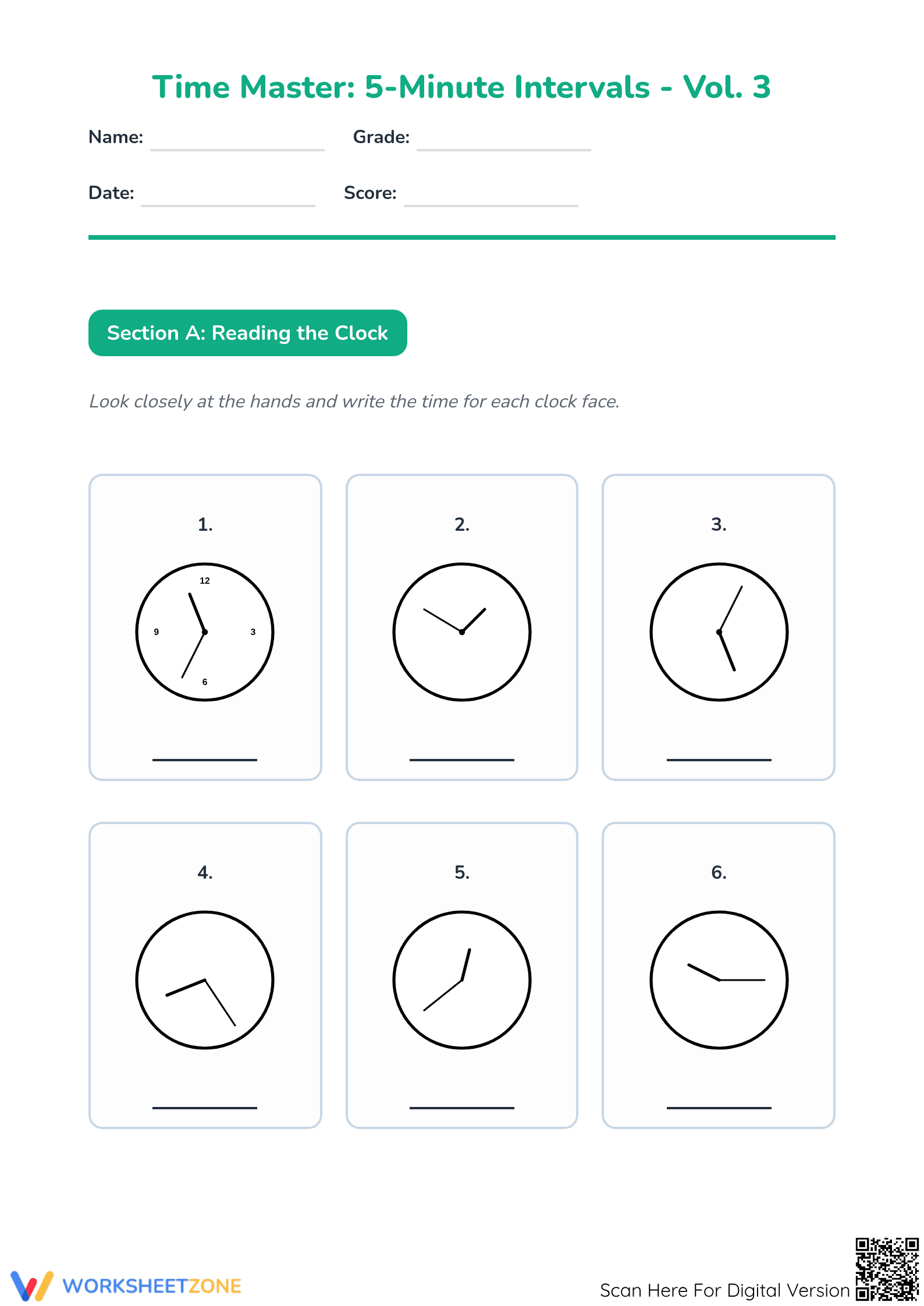


Essential Time Master Worksheet | 5-Minute Intervals Grade 3
Paste this activity's link or code into your existing LMS (Google Classroom, Canvas, Teams, Schoology, Moodle, etc.).
Students can open and work on the activity right away, with no student login required.
You'll still be able to track student progress and results from your teacher account.
Students develop fluency in telling time and calculating intervals with this comprehensive worksheet. By engaging with 25 diverse tasks, learners move from basic identification to complex problem-solving involving elapsed time. This resource ensures students can accurately read analog clocks and translate time into practical, real-world scenarios through structured mathematical practice.
At a Glance
- Grade: Grade 3 · Subject: Math
- Standard:
3.MD.A.1— Tell and write time to the nearest minute and solve word problems- Skill Focus: 5-minute intervals & elapsed time
- Format: 4 pages · 25 problems · Answer key included · PDF
- Best For: Independent practice and formative assessment
- Time: 35–45 minutes
This four-page instructional resource contains four distinct sections designed to build mastery. It includes nine clock-reading exercises, six "set the time" drawing tasks where students add clock hands, four elapsed time calculations, and six word-problem challenges. A complete answer key is provided for immediate feedback and grading efficiency, making it a thorough tool for classroom instruction.
- Guided Practice: The first nine problems provide clear analog faces for students to identify time in five-minute increments, establishing a strong baseline for clock literacy and numeral recognition.
- Supported Practice: Sections B and C transition students into active participation by requiring them to draw clock hands and perform basic mental math for short time durations.
- Independent Practice: The final "Time Challenges" section presents six multi-step word problems requiring students to apply their knowledge to complex schedules and duration calculations.
This worksheet is aligned to `CCSS.MATH.CONTENT.3.MD.A.1`, which requires students to tell and write time to the nearest minute and solve word problems involving addition and subtraction of time intervals. It also supports `CCSS.MATH.CONTENT.2.MD.C.7` for telling time to the nearest five minutes. Both standard codes can be copied directly into lesson plans, IEP goals, or district curriculum mapping tools.
Implement this worksheet during the "We Do" phase of a lesson to transition from teacher-led modeling to independent student work. Use the elapsed time section as a formative assessment to observe how students handle crossing the hour mark. This set typically takes 35 to 45 minutes to complete and is ideal for small-group rotations or homework reinforcement.
This resource is tailored for Grade 3 students, though it serves as an excellent challenge for Grade 2 or remedial support for Grade 4 learners. It pairs naturally with an interactive classroom clock or a digital time-tracking app to provide a multisensory learning experience for diverse mathematical thinkers.
According to the ScienceDirect TpT Analysis, effective mathematical instruction requires a balance of procedural fluency and conceptual understanding. This worksheet achieves that balance by requiring students to decode visual representations of time while simultaneously solving contextual word problems. The 5-minute interval focus aligns with typical developmental milestones for elementary learners, bridging the gap between whole-hour recognition and minute-level precision. Research by Fisher & Frey (2014) emphasizes the importance of scaffolding in mathematics, which this resource provides through its four-part structural design. By progressing from identification to application, the worksheet supports the gradual release of responsibility model, ensuring students have sufficient support before tackling independent challenges. The inclusion of an answer key further facilitates self-regulated learning, allowing students to identify and correct misconceptions in real-time. This 25-task set is a robust tool for any standards-aligned math curriculum focused on measurement and data standards.


