


























Views
Downloads


Printable Reading Comprehension Worksheet | Grade 1-2 ELA
Paste this activity's link or code into your existing LMS (Google Classroom, Canvas, Teams, Schoology, Moodle, etc.).
Students can open and work on the activity right away, with no student login required.
You'll still be able to track student progress and results from your teacher account.
This worksheet provides a focused reading experience for early elementary students. By reading the short story "My Friend," learners practice extracting specific information and identifying the central message of the narrative. This resource ensures students develop the foundational skills necessary for literal comprehension and basic literary analysis in Grade 1 and Grade 2.
At a Glance
- Grade: 1-2 · Subject: ELA
- Standard:
CCSS.ELA-LITERACY.RL.1.1— Ask and answer questions about key details in a text- Skill Focus: Literal Comprehension & Detail Extraction
- Format: 2 pages · 7 problems · Answer key included · PDF
- Best For: Independent reading practice or quick formative assessment
- Time: 10–15 minutes
What's Inside
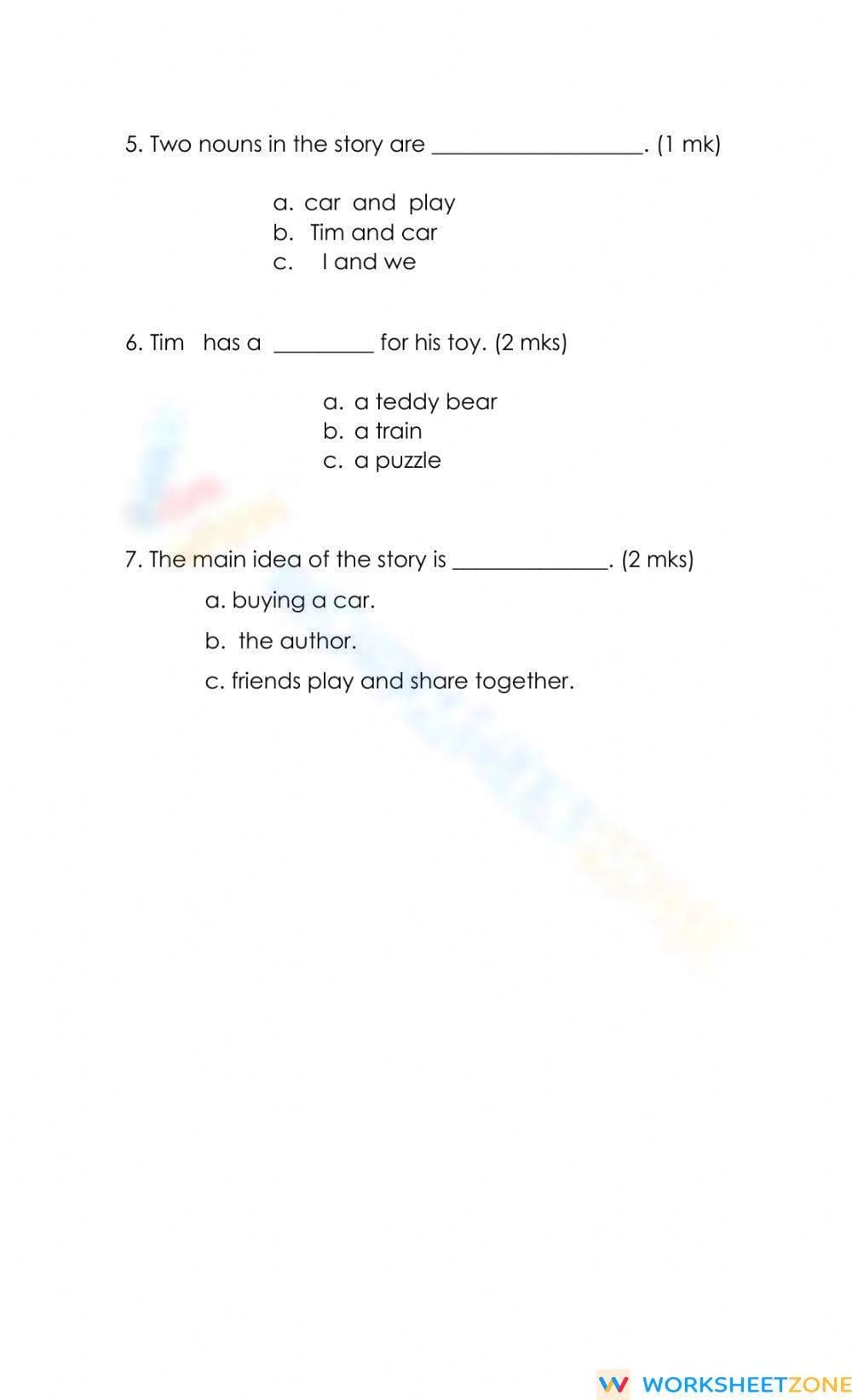
The resource consists of a two-page PDF featuring a simple narrative passage followed by seven structured comprehension questions. The story, "My Friend," uses high-frequency words suitable for emerging readers. Tasks include multiple-choice questions for identifying the author, character traits, and objects, along with a grammar task focused on noun identification.
Zero-Prep Workflow
- Print (30 seconds): Open the PDF and send the two pages to your classroom printer. No complex double-sided formatting is required for this layout.
- Distribute (30 seconds): Pass the sheets out to your Grade 1 or Grade 2 students during their literacy block or independent reading center time.
- Review (1 minute): Use the included answer key to quickly grade the seven responses or review them as a whole-group closing activity.
Standards Alignment
Aligned to CCSS.ELA-LITERACY.RL.1.1: "Ask and answer questions about key details in a text." This worksheet requires students to return to the text to verify facts about the characters and plot. It also supports CCSS.ELA-LITERACY.RL.1.2 by asking students to identify the central message. Both standard codes can be copied directly into lesson plans.
How to Use It
This resource is ideal after a lesson on finding evidence in a text. Teachers can model circling the answer in the passage before students work independently. Alternatively, use it as a formative assessment to identify students who struggle with literal recall or identifying authors versus characters. Total completion time ranges from 10 to 15 minutes.
Who It's For
Designed for Grade 1 and Grade 2 students, this worksheet is perfect for general education, ELL support, or special education settings. It pairs naturally with an anchor chart on "The 5 W's" or a classroom library of "First Reader" level books. This simple format reduces anxiety for struggling readers while maintaining educational rigor.
Literacy development in the early grades depends heavily on moving from decoding to literal comprehension. According to Fisher & Frey (2014), the gradual release of responsibility model is most effective when students are provided with scaffolded opportunities to interact with text independently. This Grade 1 and Grade 2 worksheet aligns with that research by providing a controlled text environment where learners practice CCSS.ELA-LITERACY.RL.1.1 without being overwhelmed by complex vocabulary. By identifying details such as the author, specific nouns, and the central message, students build the cognitive pathways required for later, more complex inferential reasoning. The seven-question format provides enough data points for a reliable formative assessment while maintaining a manageable length for young learners. This resource ensures that the foundational skill of detail extraction is mastered, setting the stage for future reading success and evidence-based writing.


