


























Views
Downloads

Essential Grade 7 Reading: Meerfus the Magician
Paste this activity's link or code into your existing LMS (Google Classroom, Canvas, Teams, Schoology, Moodle, etc.).
Students can open and work on the activity right away, with no student login required.
You'll still be able to track student progress and results from your teacher account.
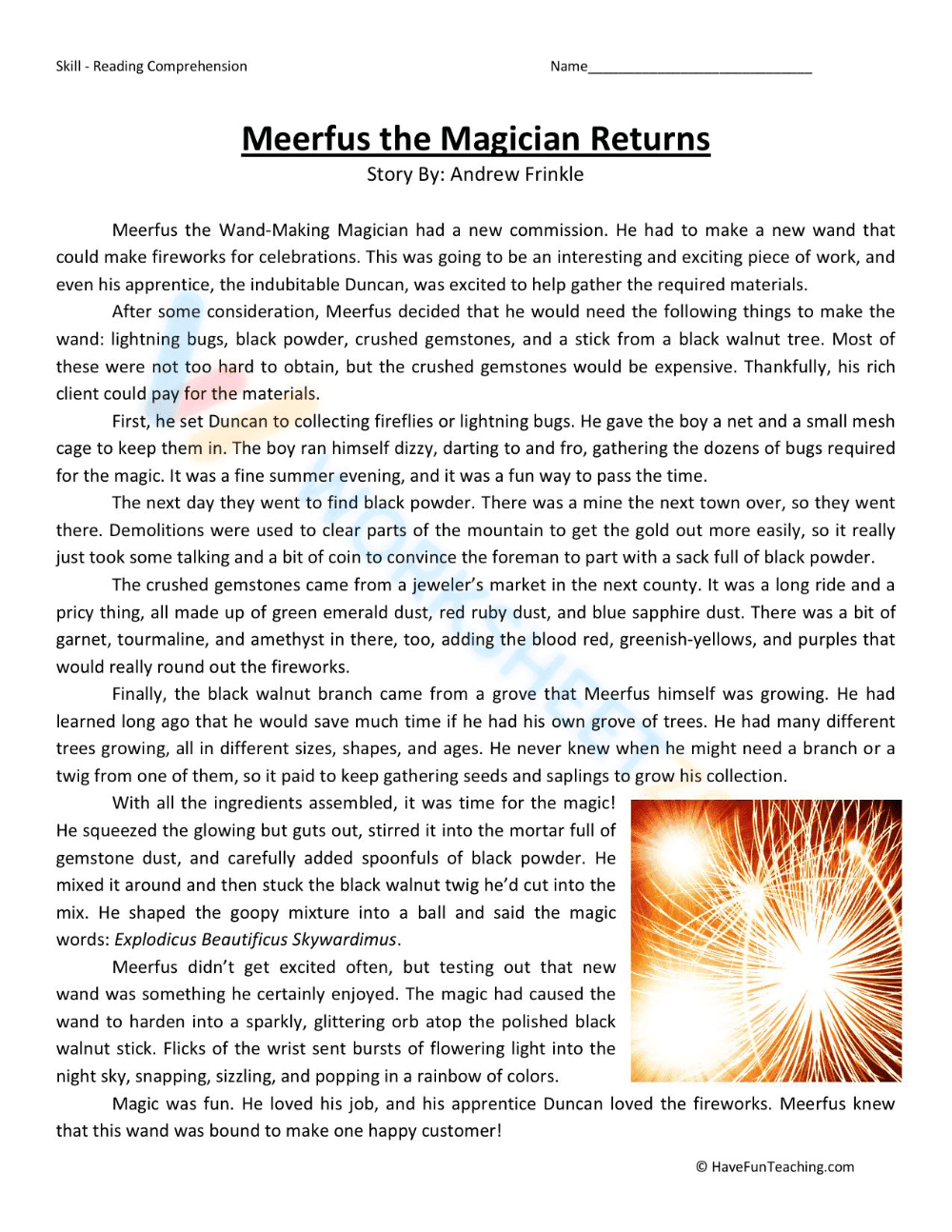
This Grade 7 reading comprehension worksheet helps students master the ability to analyze fictional narratives and draw logical conclusions from text. By engaging with a complete short story, learners practice identifying explicit details and making character-based inferences. This resource ensures students can provide evidence-based answers to improve their overall literacy and critical thinking skills.
At a Glance
- Grade: 7 · Subject: ELA
- Standard:
CCSS.ELA-LITERACY.RL.7.1— Cite textual evidence to support analysis of explicit text and inferences.- Skill Focus: Literal and Inferential Comprehension
- Format: 3 pages · 5 problems · Answer key included · PDF
- Best For: Independent practice or formative assessment
- Time: 15–20 minutes
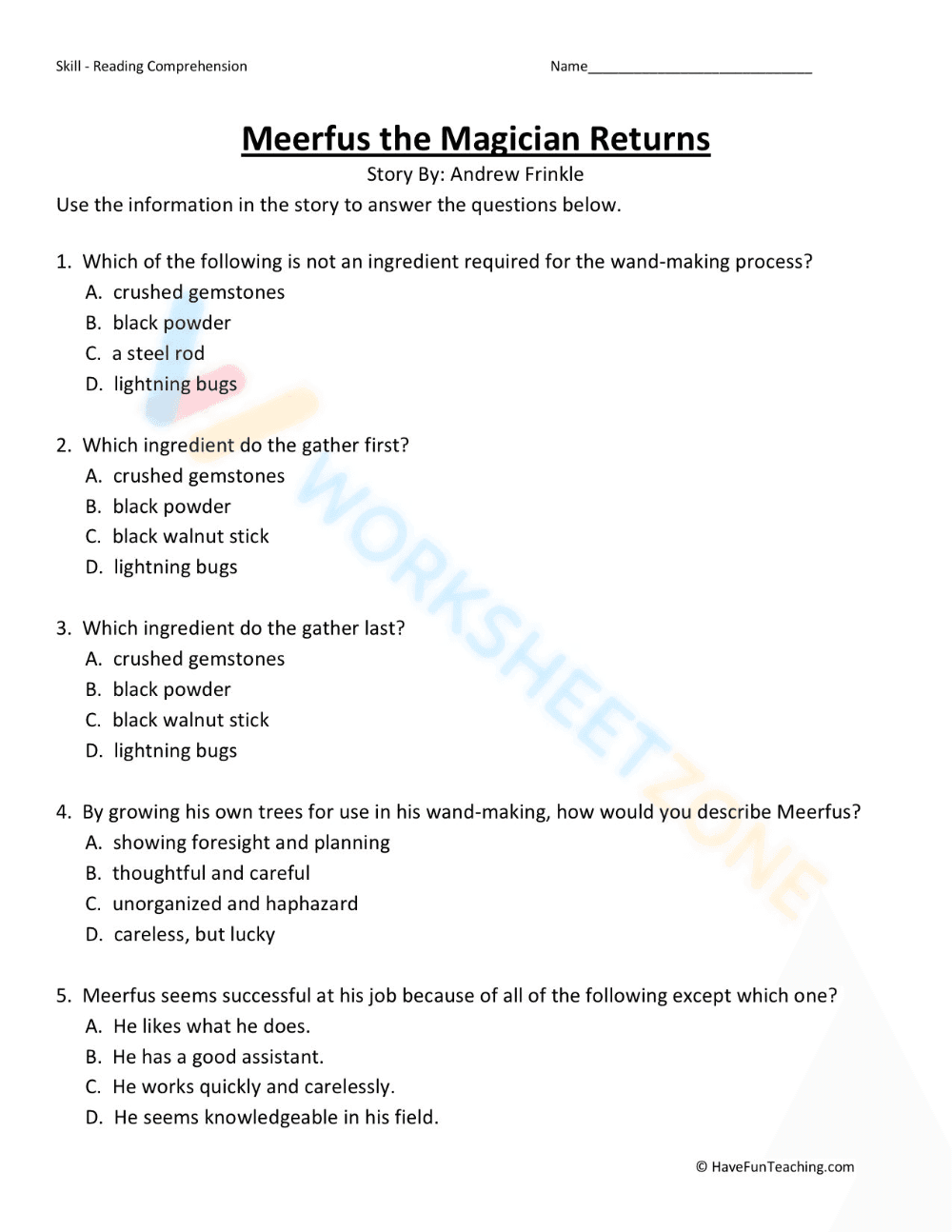
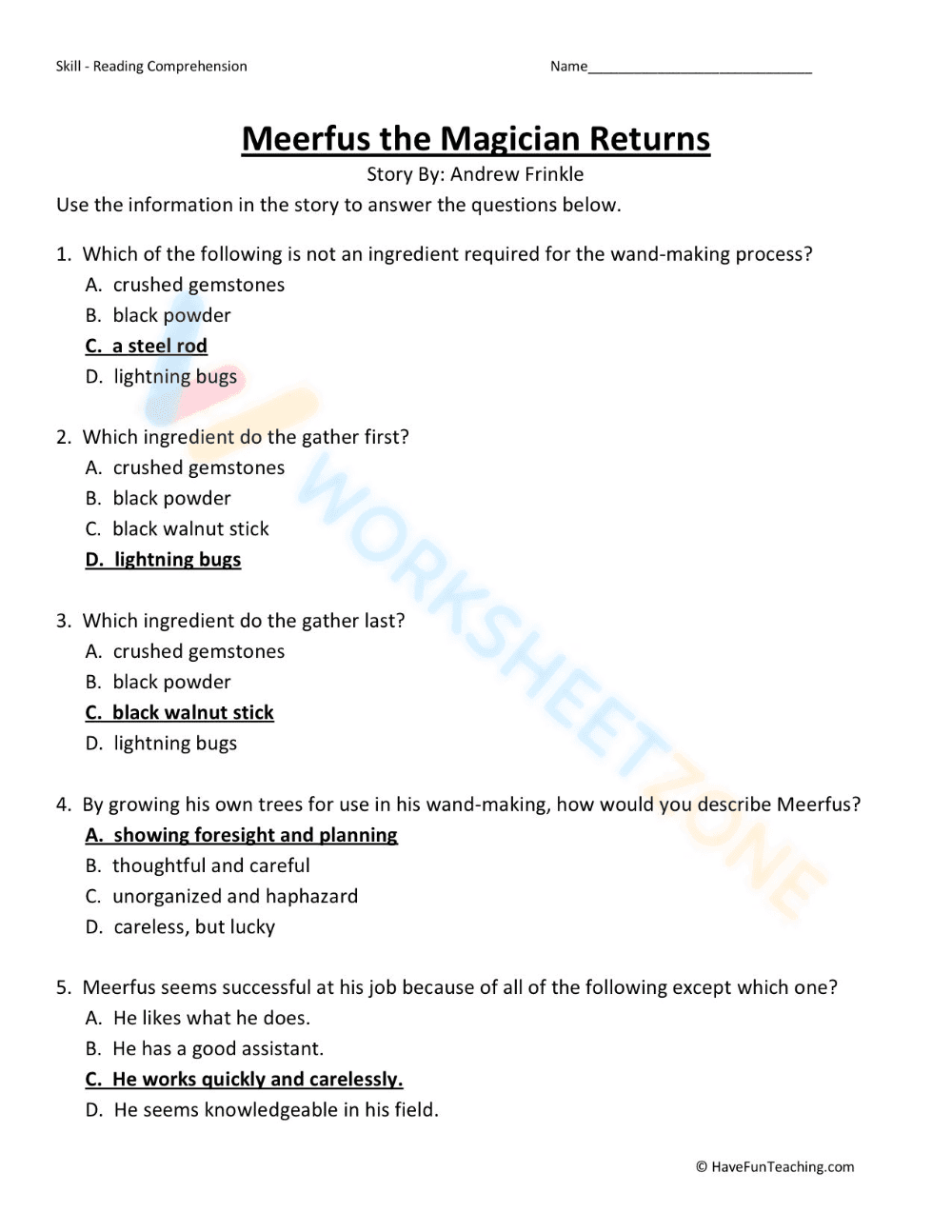
What's Inside: This comprehensive 3-page PDF includes a high-interest fictional passage titled "Meerfus the Magician Returns" by Andrew Frinkle. The second page contains 5 multiple-choice questions designed to test both recall and analytical skills. A full answer key is provided on the final page, featuring underlined correct responses for quick and easy grading by teachers or parents.
Skill Progression
- Guided Practice: Students begin by reading a structured narrative that introduces specific vocabulary and character motivations, providing a foundation for understanding.
- Supported Practice: The first 3 questions focus on literal comprehension, requiring students to locate specific ingredients and sequences mentioned directly in the text.
- Independent Practice: The final 2 questions challenge students to infer character traits and evaluate success based on textual clues, requiring higher-order thinking.
This sequence follows a gradual-release model, moving students from basic identification to complex analysis of the author's intent.
Standards Alignment
This resource is aligned to `CCSS.ELA-LITERACY.RL.7.1`: "Cite several pieces of textual evidence to support analysis of what the text says explicitly as well as inferences drawn from the text." It also supports vocabulary acquisition in context. Both standard codes can be copied directly into lesson plans, IEP goals, or district curriculum mapping tools.
How to Use It
Use this worksheet during the independent practice phase of a lesson on citing evidence. It works effectively as a warm-up activity or a quick formative assessment to check for understanding after a direct instruction session on inference. Teachers should observe if students refer back to the text to find the specific ingredients listed in the story. Expected completion time is 15 to 20 minutes.
Who It's For
This worksheet is designed for 7th-grade students working at or near grade level. It is also suitable for 8th graders needing a review of evidence-based questioning or 6th graders ready for a challenge. Pair this resource with a graphic organizer for character mapping or an anchor chart on making inferences for a complete instructional experience.
This Grade 7 reading comprehension resource is specifically designed to address the requirements of CCSS.ELA-LITERACY.RL.7.1, which focuses on citing textual evidence to support analysis of what a text says explicitly as well as inferences drawn from the narrative. By engaging with the story "Meerfus the Magician Returns," students practice identifying key plot details and character traits through 5 targeted multiple-choice questions. Research from Fisher & Frey (2014) emphasizes that the gradual release of responsibility model, supported by high-quality text-dependent questions, is essential for developing adolescent literacy. This worksheet provides the necessary scaffolding for students to move from literal recall to higher-order thinking. The inclusion of a clear answer key allows for immediate feedback, a critical component in the learning process. Educators can utilize this tool to measure student mastery of evidence-based reading, ensuring that learners are prepared for the rigorous demands of middle school English Language Arts curriculum and standardized testing environments.


