


























Views
Downloads

Sun and Moon Reading Comprehension | Essential Grade 2 ELA
Paste this activity's link or code into your existing LMS (Google Classroom, Canvas, Teams, Schoology, Moodle, etc.).
Students can open and work on the activity right away, with no student login required.
You'll still be able to track student progress and results from your teacher account.
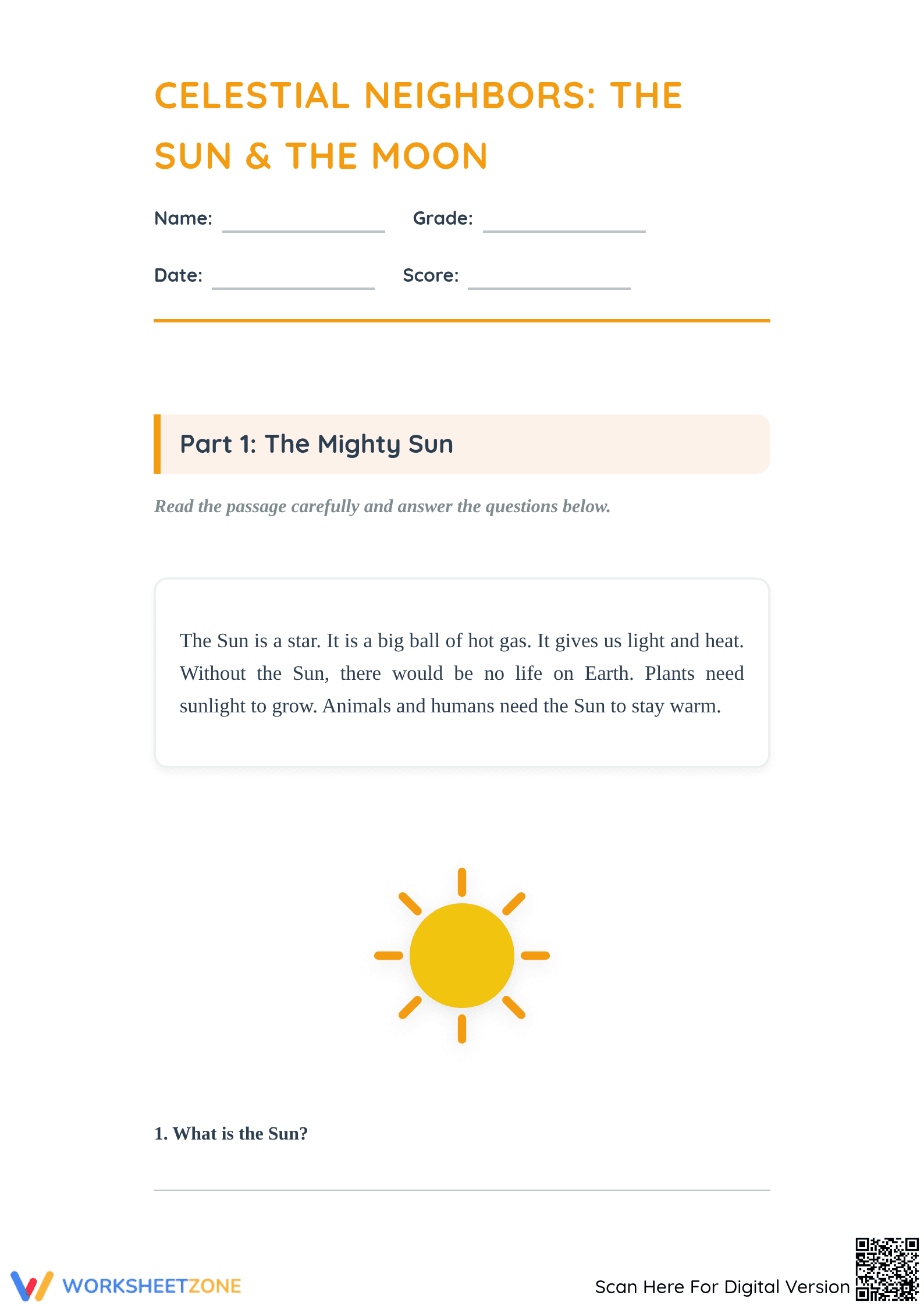
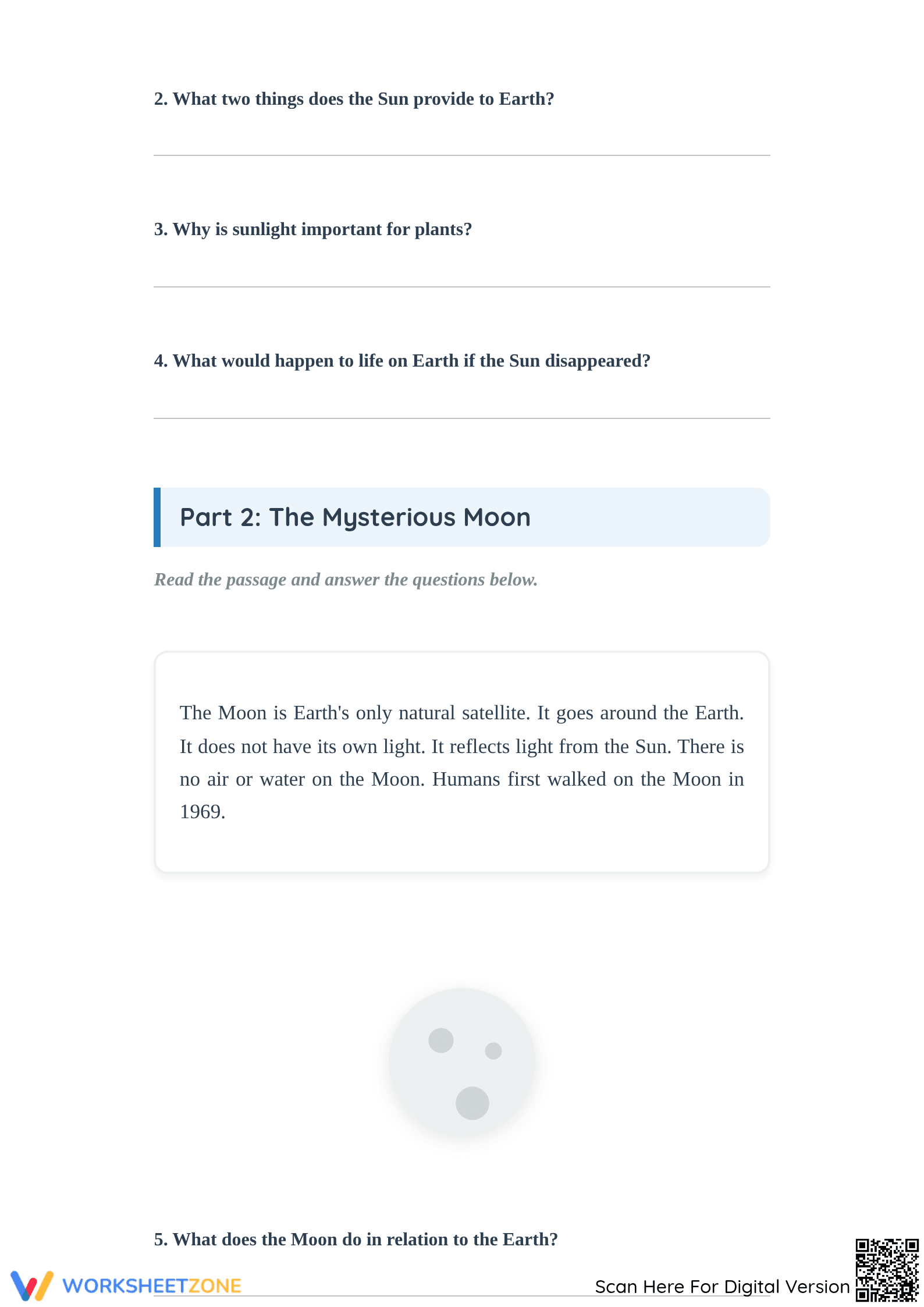
This Grade 2 informational text worksheet helps students build foundational literacy skills by exploring the relationship between the Sun and the Moon. Students engage with two short passages to identify key facts and draw comparisons. It provides a structured way to improve reading stamina and evidence-based answering while exploring basic celestial science.
At a Glance
- Grade: 2 · Subject: ELA
- Standard:
CCSS.ELA-LITERACY.RI.2.1— Ask and answer such questions as who, what, where, when, why, and how- Skill Focus: Informational Text Analysis
- Format: 3 pages · 10 problems · Answer key included · PDF
- Best For: Independent practice or science-integrated ELA
- Time: 20–30 minutes
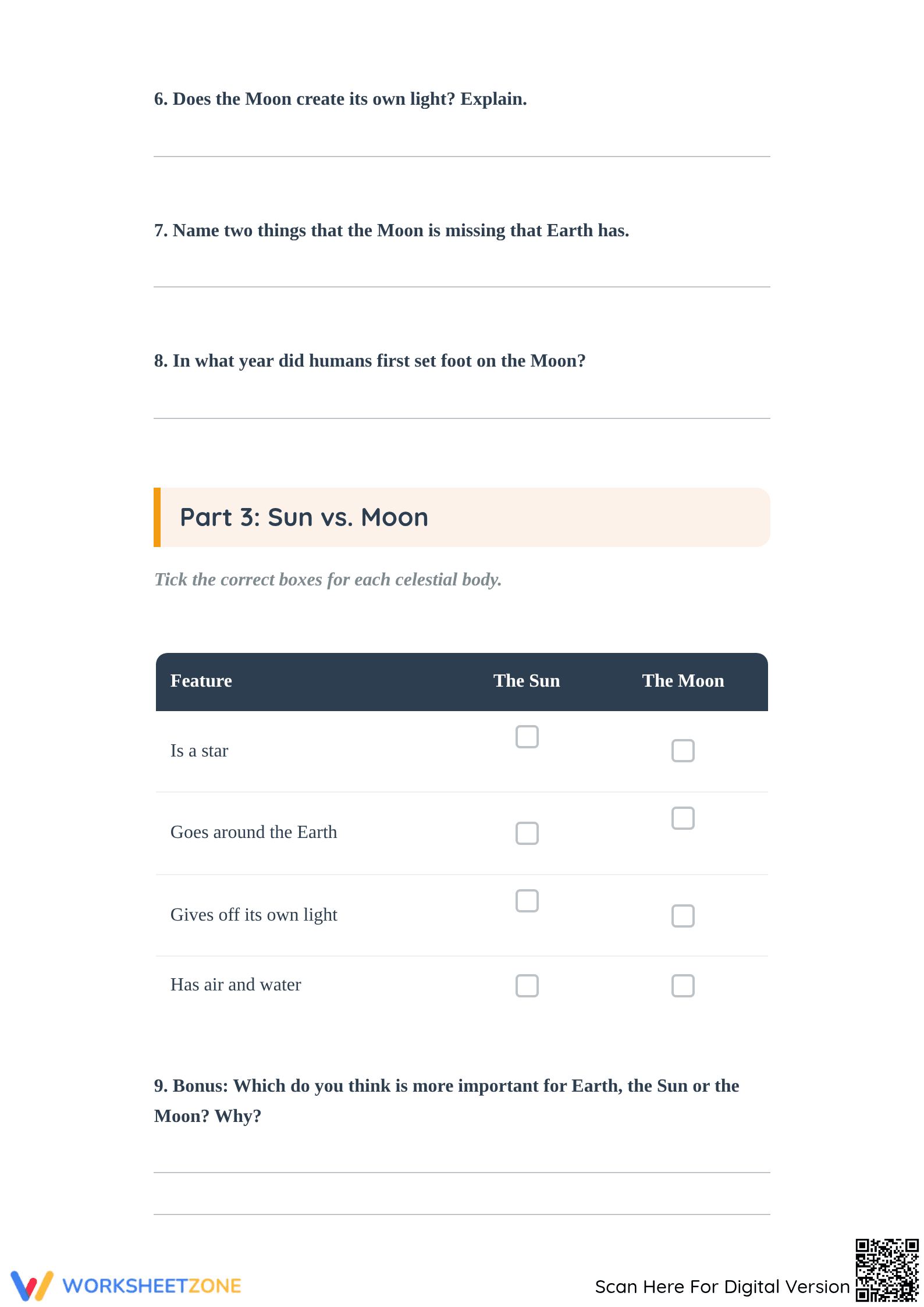
The packet contains three distinct sections across three pages. Part 1 focuses on the Sun, Part 2 covers the Moon, and Part 3 features a comparison table. It includes 8 open-ended comprehension questions, a 4-item comparison grid, and a bonus critical thinking prompt. A full answer key is provided for quick grading and immediate student feedback.
Skill Progression
- Guided practice: The initial passage on the Sun uses simple sentences and direct literal questions to build student confidence and establish the topic.
- Supported practice: The Moon section introduces more complex concepts like light reflection and historical facts, requiring closer reading and attention to detail.
- Independent practice: The final comparison table requires students to synthesize information from both texts without direct prompts, identifying unique and shared traits.
This sequence follows a gradual-release model, moving from basic recall to higher-order comparison and contrast skills.
Standards Alignment
The primary focus is `CCSS.ELA-LITERACY.RI.2.1`, which requires students to ask and answer questions to demonstrate understanding of key details in a text. Additionally, the comparison table supports `CCSS.ELA-LITERACY.RI.2.9` by asking students to compare and contrast the most important points presented by two texts on the same topic. Both standard codes can be copied directly into lesson plans, IEP goals, or district curriculum mapping tools.
How to Use It
Use this resource during the independent practice phase of a lesson on informational text features. It works well as a formative assessment after a whole-class reading of a science-themed book. Teachers should observe if students refer back to the text to answer question 6 regarding light reflection. Expected completion time is approximately 25 minutes for most second-grade learners.
Who It's For
This is designed for second-grade students but is suitable for first-grade enrichment or third-grade intervention. It pairs naturally with an anchor chart about "Key Details" or a science lesson on the solar system. The clear layout also makes it an excellent choice for English Language Learners (ELLs) who need high-interest, low-complexity reading materials.
According to the RAND AIRS 2024 report on elementary literacy, integrating science content into ELA instruction significantly improves vocabulary acquisition and reading comprehension for early learners. This worksheet aligns with those findings by using high-interest celestial topics to practice `CCSS.ELA-LITERACY.RI.2.1`. By requiring students to locate specific facts about the Sun and Moon, the resource reinforces the habit of evidence-based reading. Research from Fisher & Frey (2014) emphasizes that informational text mastery is a predictor of later academic success, particularly when students are asked to compare and contrast related concepts. This 3-page packet provides the necessary scaffolding to move students from literal comprehension to conceptual synthesis. The inclusion of a clear answer key ensures that feedback can be provided promptly, which is essential for correcting misconceptions in early reading development.


