


























Views
Downloads
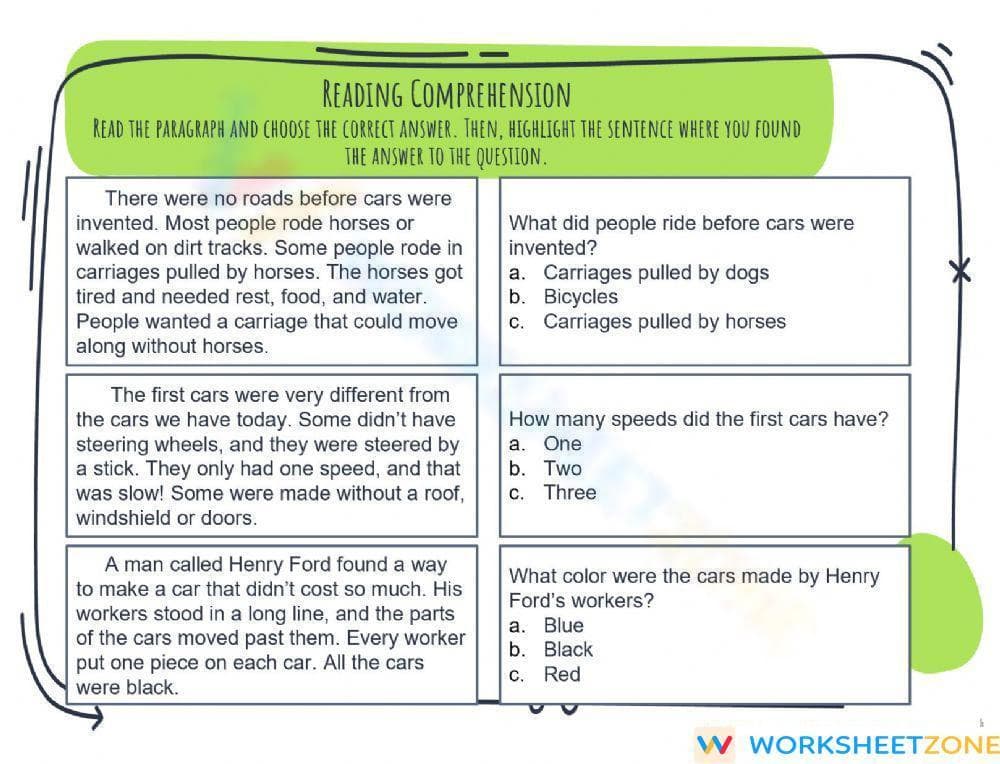

Grade 3 History of Cars — Printable No-Prep Worksheet
Paste this activity's link or code into your existing LMS (Google Classroom, Canvas, Teams, Schoology, Moodle, etc.).
Students can open and work on the activity right away, with no student login required.
You'll still be able to track student progress and results from your teacher account.
This Grade 3 reading comprehension worksheet focuses on the history of cars and Henry Ford, requiring students to extract specific details from informational text. By combining multiple-choice questions with a sentence-highlighting requirement, the resource ensures students don't just guess but instead anchor their understanding in observable textual evidence. It is a perfect addition to any elementary history or literacy unit.
At a Glance
- Grade: 3 · Subject: ELA
- Standard:
CCSS.ELA-LITERACY.RI.3.1— Ask and answer questions to demonstrate understanding by referring explicitly to the text- Skill Focus: Informational Text Evidence
- Format: 1 page · 3 problems · Answer key included · PDF
- Best For: Independent practice or literacy centers
- Time: 10–15 minutes
The worksheet consists of one structured page featuring three distinct informational paragraphs. Each paragraph is paired with a multiple-choice question designed to test recall and comprehension. A unique instructional layer requires students to highlight the specific sentence where they located their answer, reinforcing the habit of citing evidence. The layout is clean, high-contrast, and includes an answer key for rapid grading.
The zero-prep design follows a three-step professional workflow. First, print the single-page PDF (approx. 10 seconds). Second, distribute the materials to students with a brief explanation of the highlighting requirement (approx. 45 seconds). Third, review the answers using the included key or through a quick peer-grading session (approx. 60 seconds). This resource is ideal for substitute plans or morning work where teacher preparation time must remain under two minutes.
The primary alignment is CCSS.ELA-LITERACY.RI.3.1, which asks students to "ask and answer questions to demonstrate understanding of a text, referring explicitly to the text as the basis for the answers." The highlighting task directly satisfies the "referring explicitly" component of the anchor standard. Both standard codes can be copied directly into lesson plans, IEP goals, or district curriculum mapping tools.
Use this resource during the "Independent Practice" phase of a gradual release model. It serves as an excellent formative assessment tool; as students work, observe whether they are correctly identifying the evidence sentences or merely selecting the correct multiple-choice bubble. For best results, allow 15 minutes for completion, followed by a whole-class review of the specific sentences highlighted to model strong evidentiary support.
This worksheet is primarily designed for Grade 3 students but provides significant value for Grade 4 students needing a text-evidence refresher or Grade 2 students working above grade level. It pairs naturally with informational passages about transportation history or an anchor chart detailing "How to Find Evidence in a Text." The accessible language makes it suitable for English Language Learners developing academic vocabulary.
Rigorous reading comprehension depends on the student's ability to locate and verify information within a source text. This resource targets CCSS.ELA-LITERACY.RI.3.1 by asking students to answer questions while explicitly identifying the textual basis for their choices. According to Fisher & Frey (2014), the habit of returning to the text to justify an answer is a fundamental component of close reading that prevents misconceptions and builds long-term academic stamina. By providing 3 focused tasks on the history of cars, this worksheet ensures students practice these high-leverage literacy skills in a manageable, 1-page format. It meets the current EdReports 2024 criteria for instructional alignment by providing a direct connection between informational text structures and evidence-based response requirements. This standalone summary confirms the worksheet's utility as a research-backed tool for improving student outcomes in elementary literacy.


