


























Views
Downloads
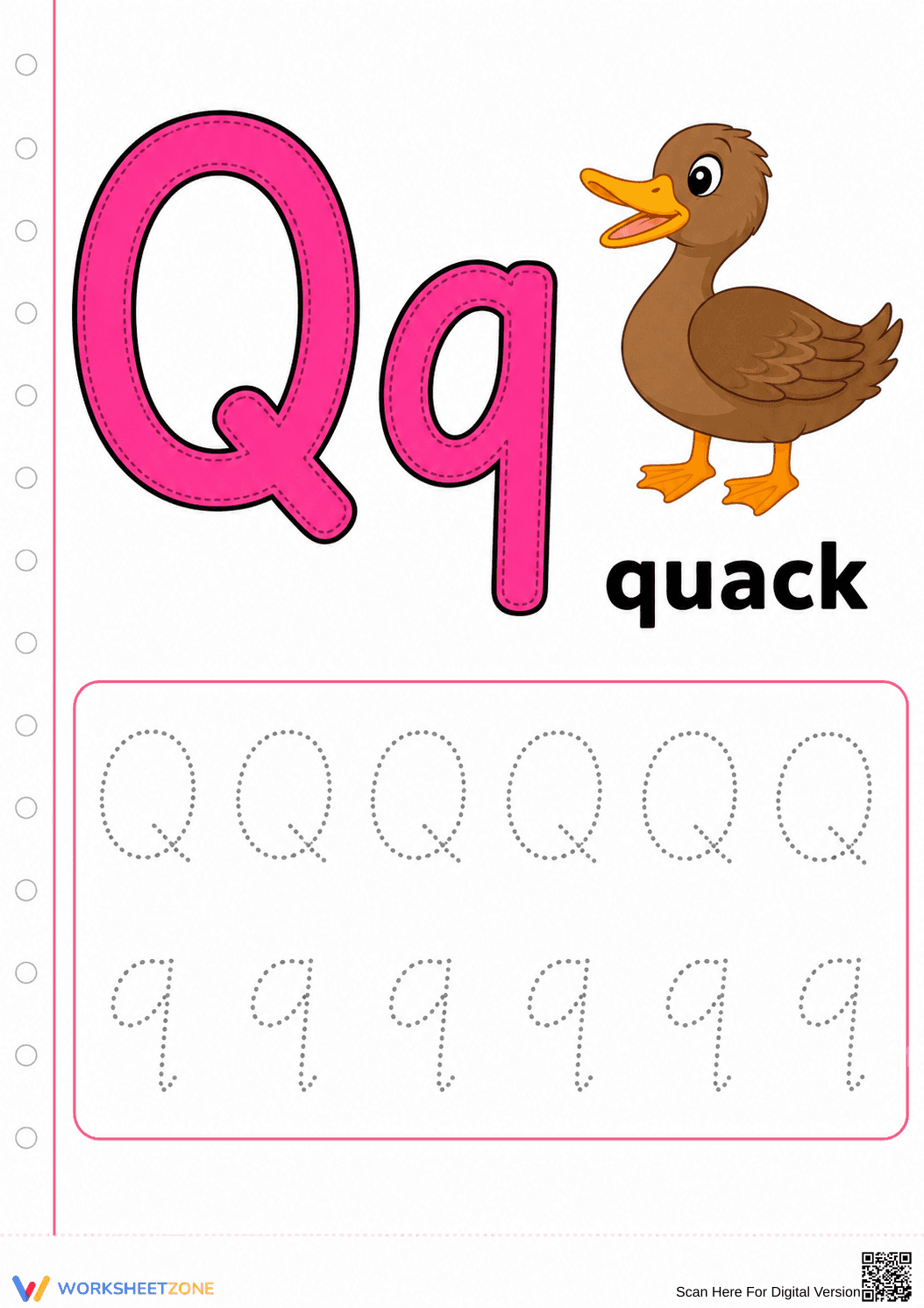

Printable Letter Q Tracing Worksheet | Kindergarten ELA
Paste this activity's link or code into your existing LMS (Google Classroom, Canvas, Teams, Schoology, Moodle, etc.).
Students can open and work on the activity right away, with no student login required.
You'll still be able to track student progress and results from your teacher account.
This Kindergarten letter tracing worksheet provides young learners with focused handwriting practice for the letter Q. By tracing both uppercase and lowercase forms, students develop fine motor control and letter recognition skills. The visual cue of a duck and the word "quack" reinforces beginning sound associations.
At a Glance
- Grade: Kindergarten · Subject: ELA
- Standard:
CCSS.ELA-LITERACY.L.K.1.A— Print many upper- and lowercase letters- Skill Focus: Letter Q Tracing and Recognition
- Format: 1 page · 12 problems · No answer key needed · PDF
- Best For: Independent morning work
- Time: 5–10 minutes
Inside this single-page resource, educators will find a straightforward layout designed for early writers. The top section features a large, colorful uppercase and lowercase letter Q alongside an engaging illustration of a duck to anchor the "quack" vocabulary word. The bottom section contains a dedicated tracing block with six dashed uppercase Qs and six dashed lowercase qs, providing ample repetition for muscle memory development.
This resource is designed for immediate classroom implementation with a highly efficient workflow:
- Print (1 minute): Simply download the PDF and print the required number of copies. The clear black-and-white tracing lines ensure crisp reproduction.
- Distribute (1 minute): Hand out the sheets along with pencils or crayons. The intuitive design means students know exactly what to do.
- Review (0 minutes): No grading or answer key is required for this foundational motor-skill task.
With under two minutes of total teacher prep time, this worksheet is an excellent addition to any emergency sub plan or last-minute center activity.
This worksheet aligns directly with CCSS.ELA-LITERACY.L.K.1.A: Print many upper- and lowercase letters. It also supports foundational phonics skills by pairing the target letter with a recognizable beginning sound image. Both standard codes can be copied directly into lesson plans, IEP goals, or district curriculum mapping tools.
Teachers can utilize this tracing sheet during morning arrival as a calm, independent task that settles students into the daily routine. Alternatively, it serves as an effective literacy center station following a whole-group phonics lesson on the letter Q. While students work, teachers can conduct quick formative assessments by observing pencil grip and stroke direction. The entire activity typically takes 5 to 10 minutes to complete.
This resource is primarily designed for Kindergarten students mastering their alphabet formation. It is also highly beneficial for pre-K students demonstrating early writing readiness or first graders requiring targeted handwriting intervention. For a comprehensive lesson, pair this tracing sheet with a read-aloud book featuring prominent Q vocabulary or a classroom alphabet anchor chart.
Effective handwriting instruction remains a critical component of early literacy development. According to a recent ScienceDirect TpT Analysis, explicit practice with letter formation significantly impacts subsequent reading fluency and written expression. This worksheet directly supports CCSS.ELA-LITERACY.L.K.1.A by requiring students to print many upper- and lowercase letters. By isolating the letter Q and providing structured tracing paths, the activity reduces cognitive load, allowing young learners to focus entirely on motor execution and spatial awareness. The integration of the visual "quack" cue further bridges the gap between mechanical handwriting and phonemic awareness. Consistent, brief practice sessions using targeted materials like this one help solidify the neural pathways necessary for automatic letter retrieval, setting a strong foundation for future academic success in comprehensive literacy programs.


