


























Views
Plays


Ordering Numbers to 10 Worksheet | Grade 1 Printable
Paste this activity's link or code into your existing LMS (Google Classroom, Canvas, Teams, Schoology, Moodle, etc.).
Students can open and work on the activity right away, with no student login required.
You'll still be able to track student progress and results from your teacher account.
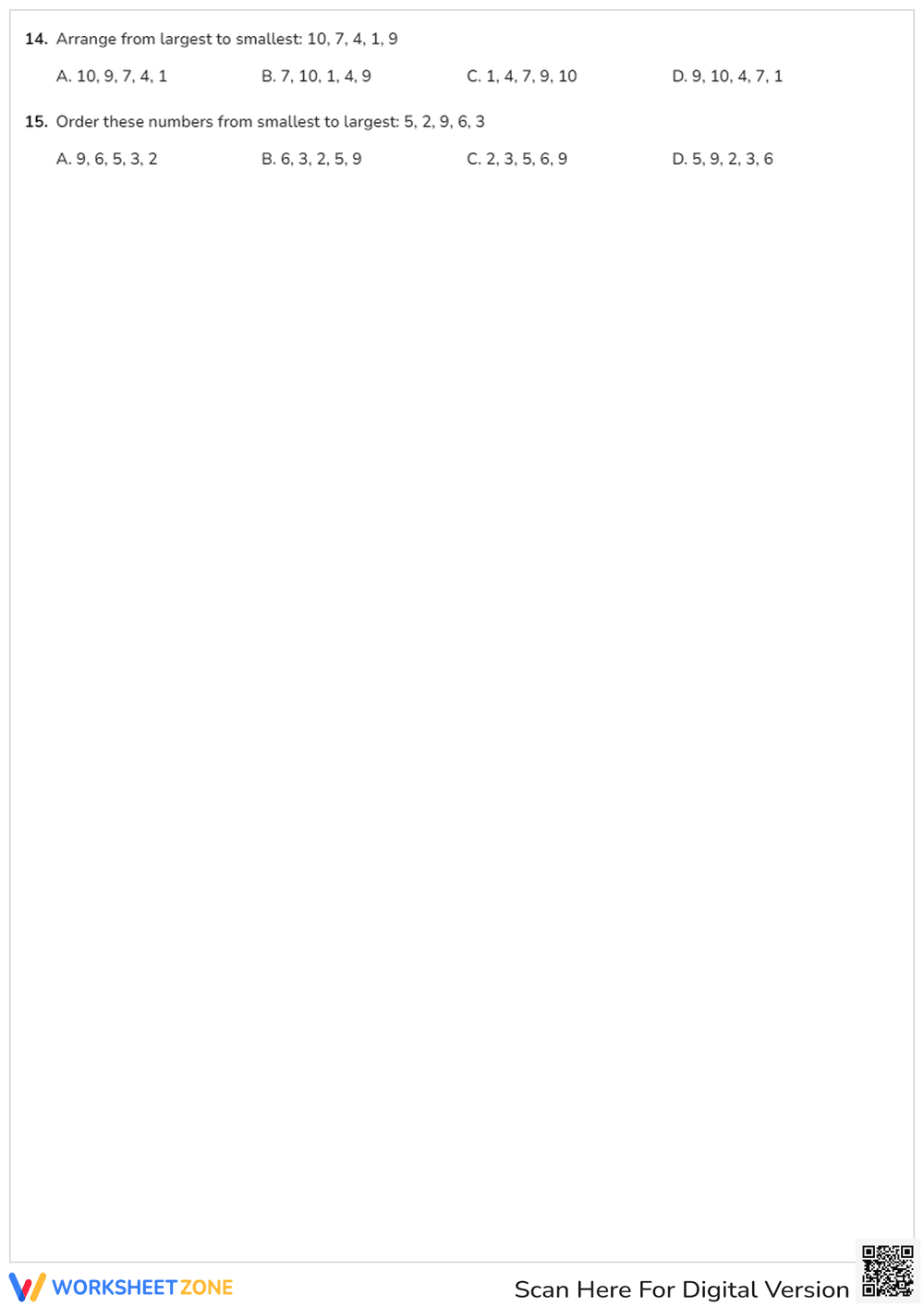
This foundational math worksheet provides targeted practice for early learners mastering number sense. By completing this activity, students will confidently sequence numbers up to 10 in both ascending and descending order. The clear, multiple-choice format allows children to demonstrate their understanding of numerical magnitude and relative position.
At a Glance
- Grade: Kindergarten & 1 · Subject: Math
- Standard:
CCSS.MATH.CONTENT.K.CC.C.7— Compare written numerals between 1 and 10- Skill Focus: Ordering Numbers 0–10
- Format: 2 pages · 15 problems · Answer key included · PDF
- Best For: Independent practice and review
- Time: 10–15 minutes
Inside this resource, educators will find a comprehensive two-page assessment featuring 15 multiple-choice questions. The tasks alternate between asking students to arrange sets of five numbers from smallest to largest and largest to smallest. The layout is clean and distraction-free, ensuring that young learners can focus entirely on the mathematical concepts. A complete answer key is included to streamline the grading process for teachers.
Skill Progression
- Guided practice: The initial questions introduce basic ascending order, allowing educators to model how to identify the smallest number first.
- Supported practice: As students progress, they encounter descending order tasks, requiring them to shift their thinking and identify the largest quantities.
- Independent practice: The final questions mix ascending and descending prompts with randomized number sets, challenging students to apply their skills without visual aids.
This structure perfectly supports a gradual-release model, moving smoothly from I Do, We Do, You Do.
Standards Alignment
This resource is directly aligned with CCSS.MATH.CONTENT.K.CC.C.7, requiring students to compare two or more numbers between 1 and 10 presented as written numerals. It also supports early first-grade standards for understanding place value and numerical order. Both standard codes can be copied directly into lesson plans, IEP goals, or district curriculum mapping tools.
How to Use It
This worksheet is highly versatile and fits easily into daily math routines. Use it as an independent practice activity after direct instruction on number lines, or assign it as a quick morning work task to activate prior knowledge. While students work, teachers can use this as a formative assessment tool by observing whether children rely on counting on their fingers or if they can instantly recognize number magnitudes. Most students will complete the 15 questions within 10 to 15 minutes.
Who It's For
This activity is designed primarily for Kindergarten and first-grade students who are solidifying their basic number sense. It serves as an excellent intervention tool for older students who struggle with numerical sequencing. For differentiated instruction, pair this worksheet with a physical number line or manipulatives for students who need concrete visual support before moving to abstract written numerals.
Developing strong number sense in early childhood is a critical predictor of future mathematical achievement. This resource targets CCSS.MATH.CONTENT.K.CC.C.7, helping students compare written numerals between 1 and 10. According to a recent EdReports 2024 analysis, foundational skills like sequencing and comparing small quantities must be mastered before students can successfully tackle complex addition and subtraction. When young learners practice ordering numbers in both ascending and descending formats, they build cognitive flexibility and a deeper understanding of numerical magnitude. This 15-question worksheet provides the exact type of repeated, focused practice recommended by educational researchers to move these skills from working memory into long-term retention. By integrating this targeted activity into early math instruction, educators ensure that students build the robust conceptual framework necessary for all subsequent elementary mathematics coursework.


