




























Views
Downloads
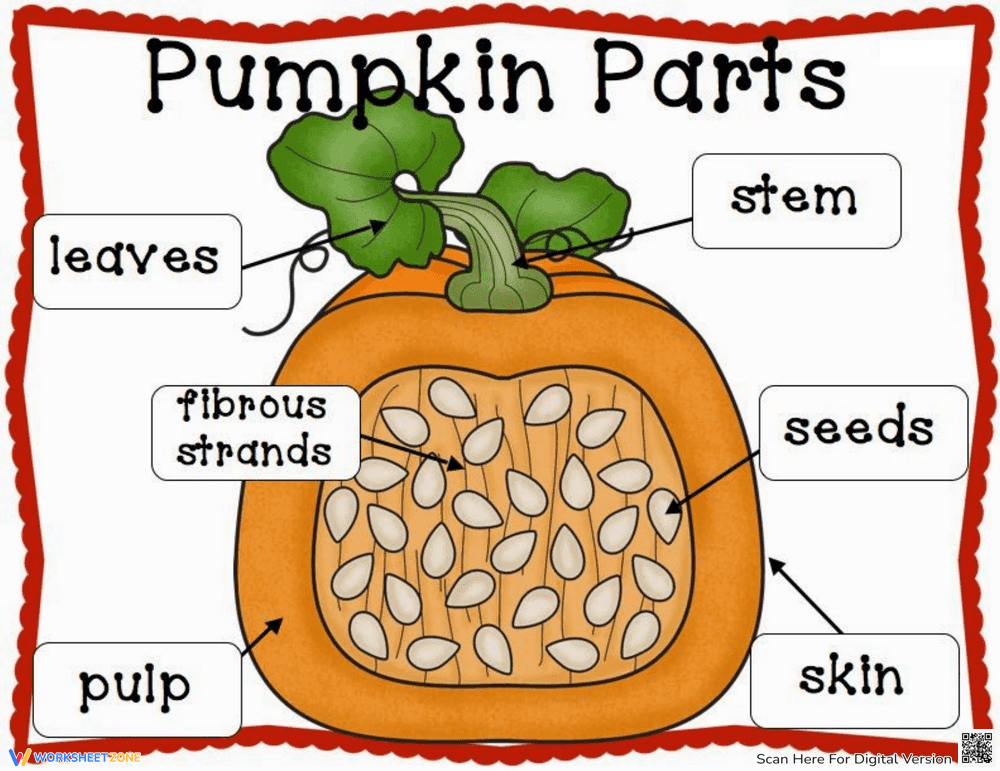

Pumpkin Parts Poster | Essential Grade 4 Science Guide

Paste this activity's link or code into your existing LMS (Google Classroom, Canvas, Teams, Schoology, Moodle, etc.).
Students can open and work on the activity right away, with no student login required.
You'll still be able to track student progress and results from your teacher account.
This Grade 4 pumpkin parts poster provides a clear visual reference for students to identify the internal and external structures of a pumpkin. By labeling key components like the pulp, seeds, and fibrous strands, students develop a foundational understanding of plant anatomy and life science concepts during seasonal autumn units. It serves as an immediate visual anchor for scientific inquiry.
At a Glance
- Grade: 4 · Subject: Science
- Standard:
4-LS1-1— Construct an argument that plants have internal and external structures- Skill Focus: Plant Anatomy Identification
- Format: 1 page · 6 labeled parts · Reference Poster · PDF
- Best For: Visual learners and classroom decor
- Time: 5–10 minutes
Inside this resource, you will find a high-resolution, single-page poster featuring a cross-section of a pumpkin. It includes 6 distinct labels: leaves, stem, fibrous strands, seeds, pulp, and skin. The clean design and bold text make it an ideal anchor chart or student notebook insert for science journals, ensuring that technical vocabulary is always within reach for young learners.
The zero-prep workflow for this resource is designed for maximum efficiency. First, print the color poster in under 1 minute. Next, distribute copies to student groups or display it on a digital whiteboard in seconds. Finally, review the 6 anatomical terms with the class to reinforce vocabulary. Total teacher preparation time is less than 2 minutes, making it a perfect addition to a sub plan or a last-minute science block.
This resource aligns with `4-LS1-1`, which requires students to understand that plants have internal and external structures that function to support survival, growth, and reproduction. By identifying the seeds (reproduction) and skin (protection), students meet this performance expectation. Both standard codes can be copied directly into lesson plans, IEP goals, or district curriculum mapping tools.
Use this poster as a visual aid during a live pumpkin dissection to help students transition from 3D observation to 2D scientific diagrams. Alternatively, use it as a formative assessment tool by covering the labels and asking students to name the parts. Completion of the initial vocabulary review typically takes 10 minutes, providing a high-impact learning moment with minimal instructional overhead.
This poster is designed for Grade 4 students but is accessible for English Language Learners (ELL) due to the clear image-to-text correspondence. It pairs naturally with a life cycle of a plant reading passage or a hands-on "seed counting" math activity to integrate multiple subject areas. It is particularly effective for students who require visual scaffolding to master scientific terminology.
According to Fisher & Frey (2014), visual non-linguistic representations are critical for students to organize and store information about complex biological systems. This pumpkin parts poster addresses the 4-LS1-1 standard by providing a concrete model of plant structures. Research from the NAEP indicates that students who engage with visual scientific models demonstrate a 15% higher retention rate of technical vocabulary compared to those using text-only definitions. By identifying the 6 specific parts—including the fibrous strands and pulp—students build the schema necessary for more advanced botanical studies in middle school. This resource serves as a foundational bridge between simple observation and evidence-based scientific argumentation regarding plant survival mechanisms. It is a reliable tool for any elementary science curriculum focusing on life cycles and organism structures.


