


























Views
Downloads

Proven Zero-Product Property Worksheet | Grade 9 Algebra I
Paste this activity's link or code into your existing LMS (Google Classroom, Canvas, Teams, Schoology, Moodle, etc.).
Students can open and work on the activity right away, with no student login required.
You'll still be able to track student progress and results from your teacher account.
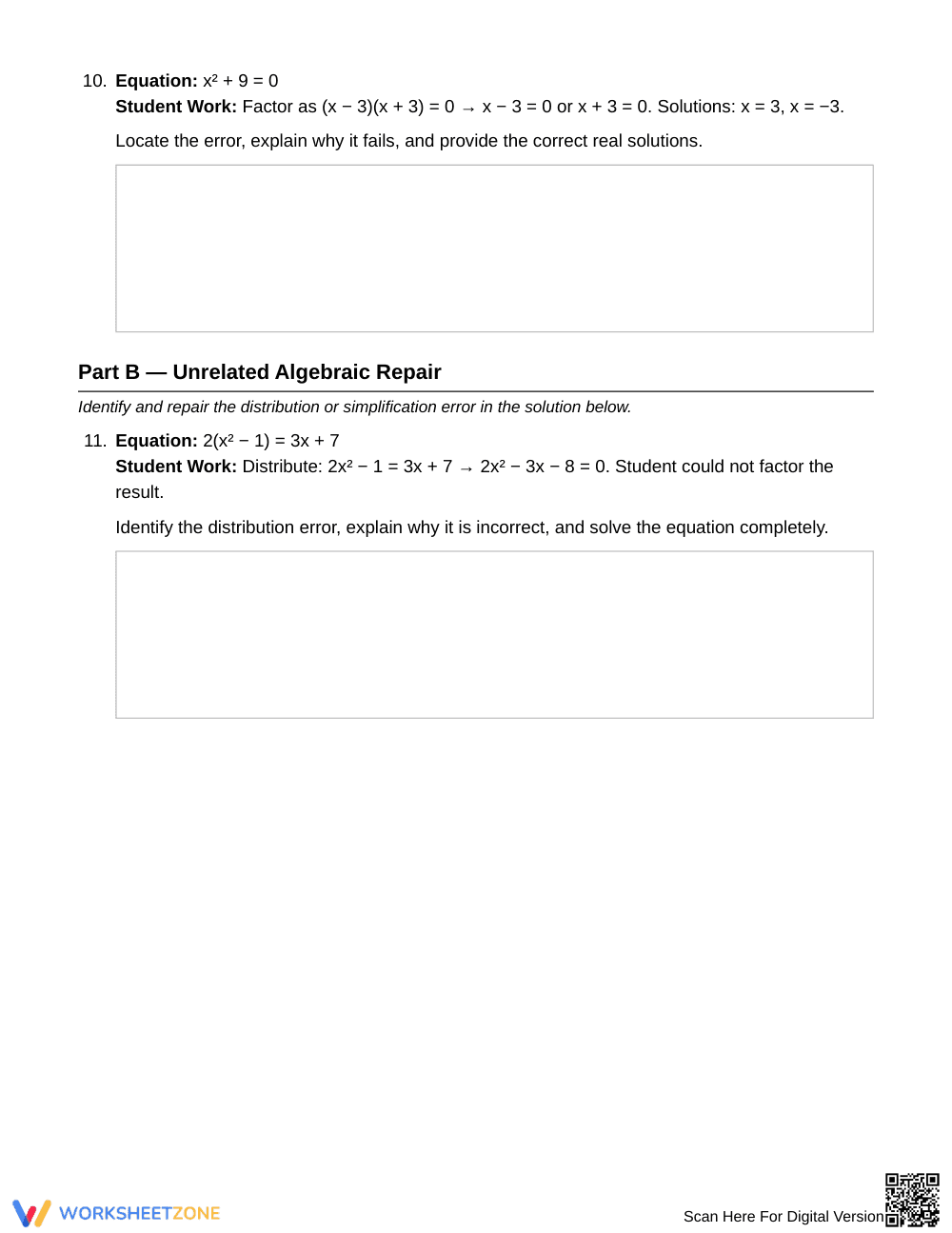
This Grade 9 Algebra I worksheet targets a frequent algebraic stumbling block: misapplying the zero-product property. Students evaluate 11 worked examples containing subtle conceptual errors, explain why each mathematical step fails, and generate complete, verified solutions to solve quadratic equations accurately.
At a Glance
- Grade: 9 · Subject: Algebra I
- Standard: Solve quadratic equations by inspection, factoring, and applying mathematical properties
- Skill Focus: Correct Misuse of the Zero-Product Property
- Format: 5 pages · 11 problems · Answer key included · PDF
- Best For: Error analysis and conceptual remediation
- Time: 30–45 minutes
What's Inside
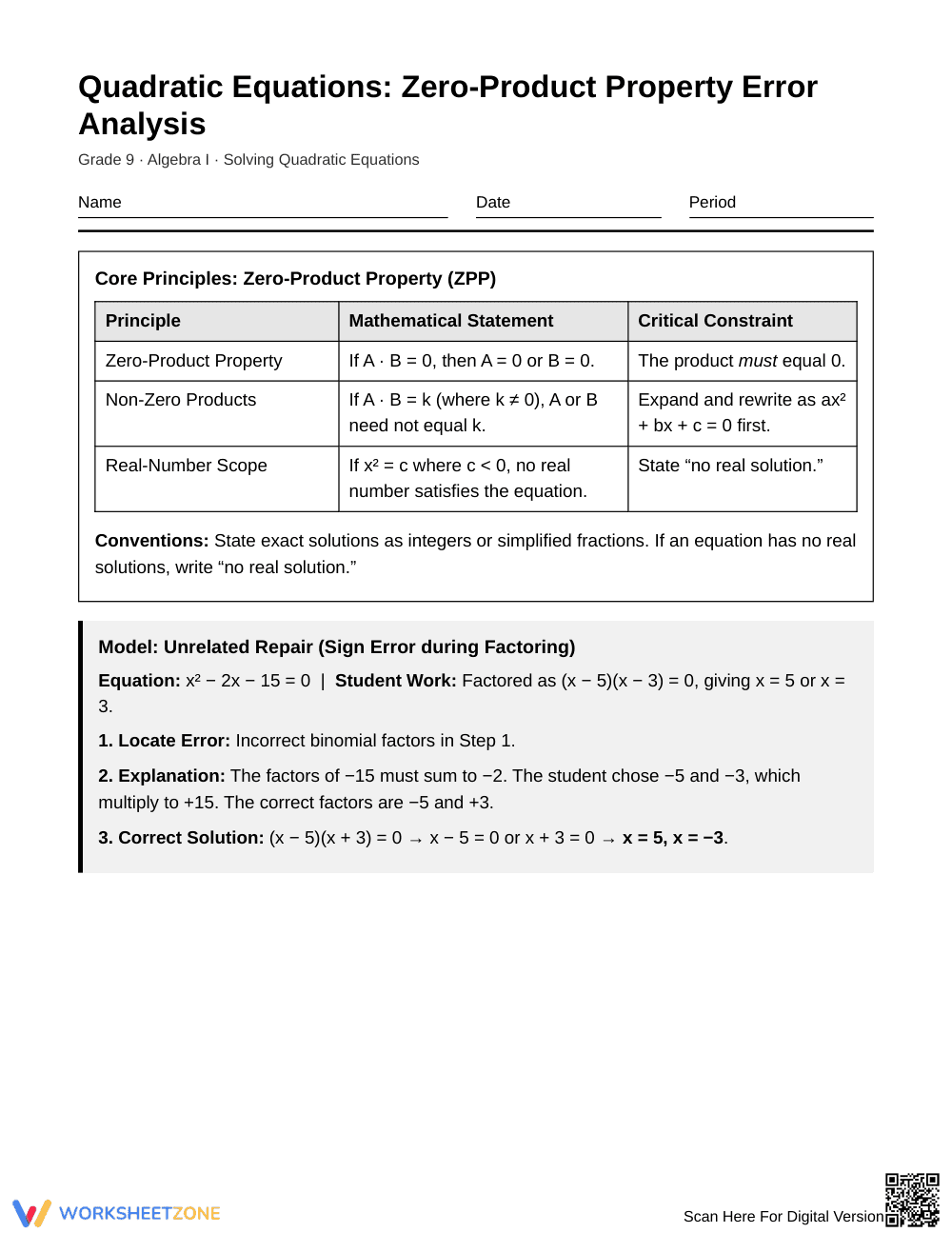
This 5-page practice set opens with a clear core principle reference table outlining the non-zero product constraint and real-number scope, alongside a fully annotated modeling example. Students analyze 10 targeted error analysis problems in Part A and 1 multi-step algebraic repair problem in Part B, supported by a 4-page comprehensive answer key.
Skill Progression
- Guided Practice: Students review an explicit reference table and worked model demonstrating how to diagnose sign errors and write valid algebraic corrections (Reference Model).
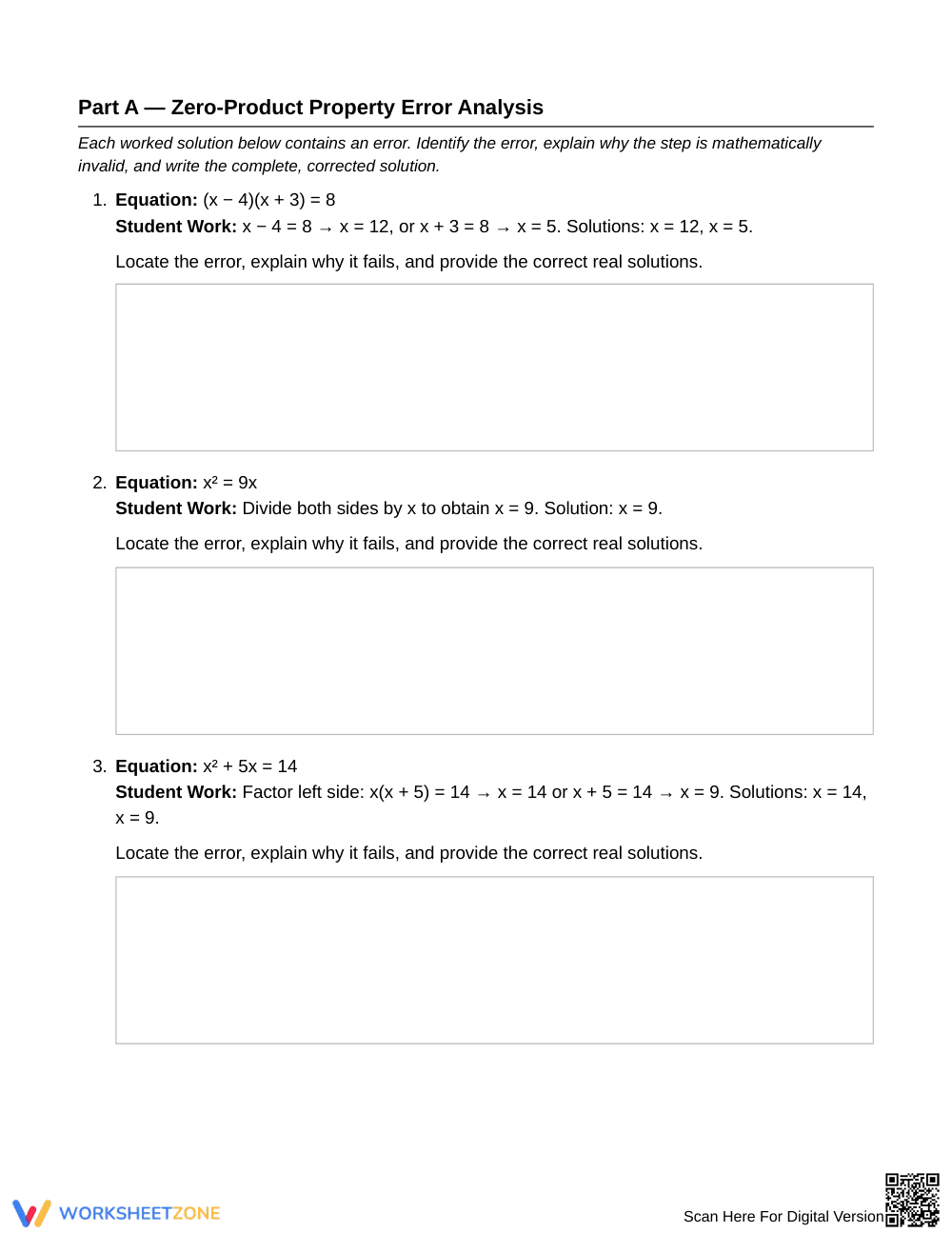
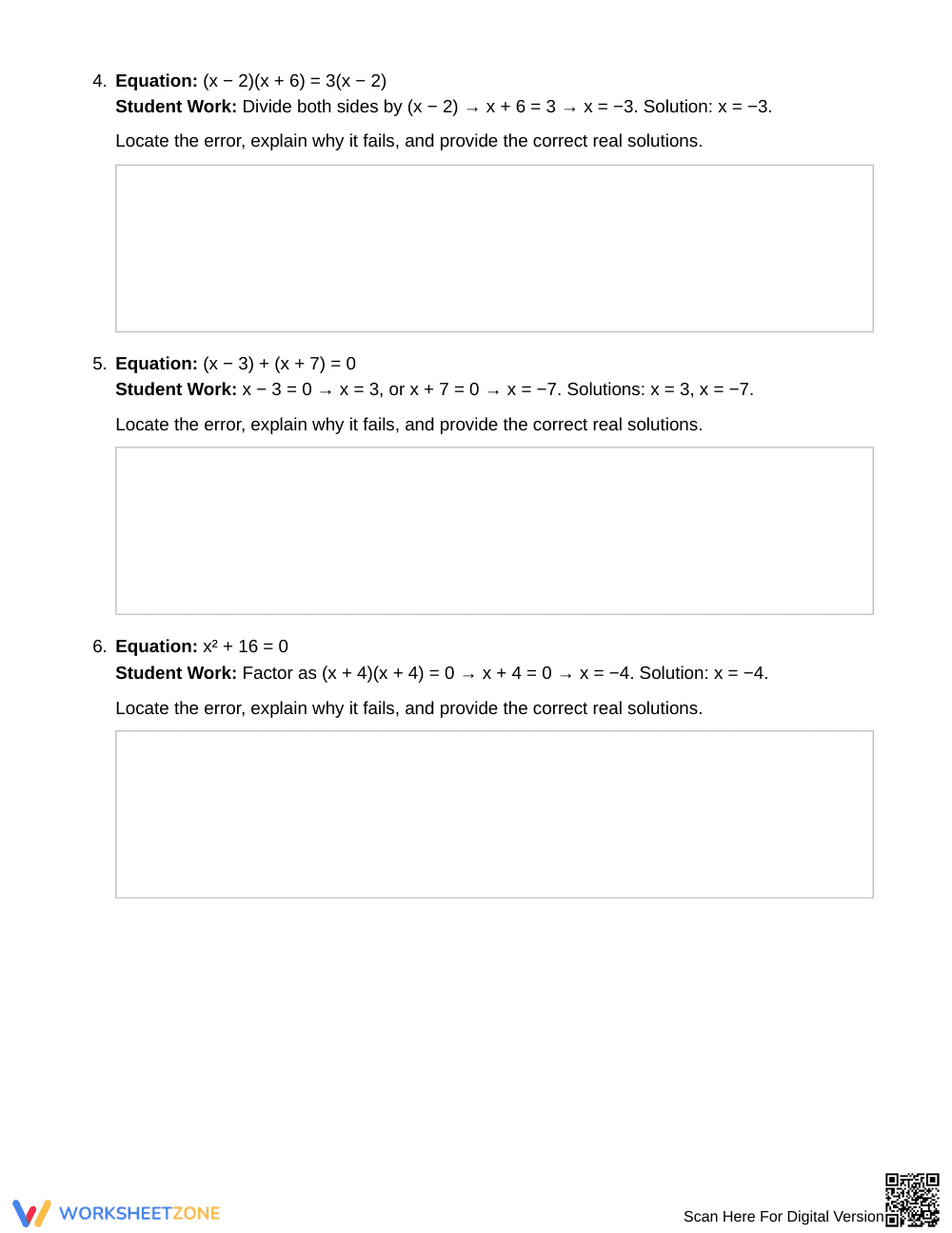
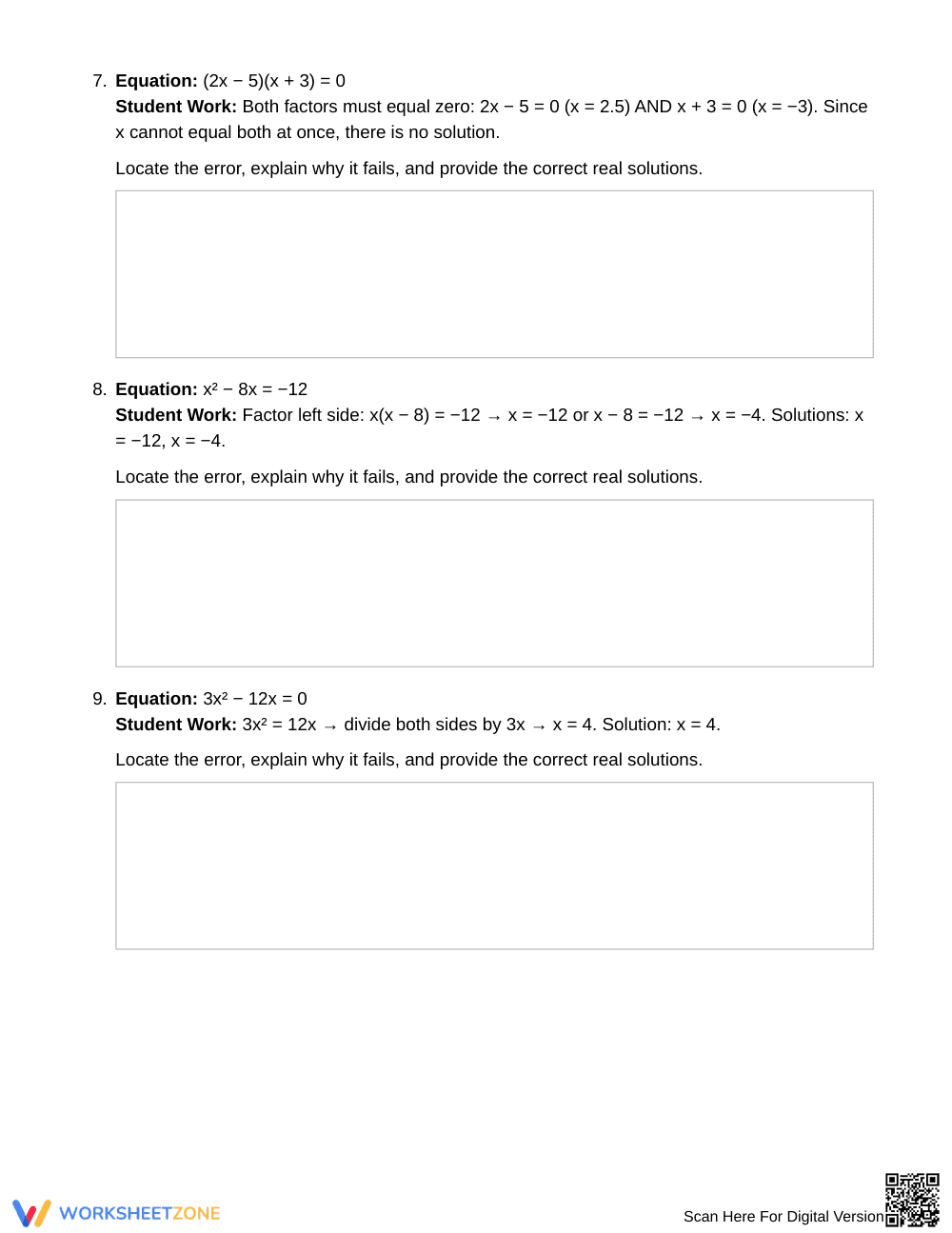
- Supported Practice: Learners examine 10 flawed student work samples in Part A, pinpointing illegal operations like dividing by variables or equating non-zero factors to constants (Problems 1–10).
- Independent Practice: Students repair an unprompted distribution mistake and solve the resulting quadratic equation independently in Part B (Problem 11).
This structure follows an intentional gradual-release model, shifting students from guided conceptual diagnosis to autonomous problem solving.
Standards Alignment
This resource aligns with high school algebra standards for solving quadratic equations. Students interpret equations, recognize the mathematical validity of factoring arguments, and transform expressions into standard form before applying properties of multiplication. Both standard codes can be copied directly into lesson plans, IEP goals, or district curriculum mapping tools.
How to Use It
Deploy this worksheet after direct instruction on factoring quadratics to address misconceptions before summative testing. For formative assessment, observe whether students identify dividing by a variable as losing a root (such as in x² = 9x) versus setting factored terms equal to non-zero values. The complete set requires approximately 30 to 45 minutes.
Who It's For
This worksheet serves Grade 9 Algebra I students needing rigorous conceptual reinforcement during a quadratic equations unit. It offers accessible entry points for struggling learners through structured error prompts and extends on-grade learners by requiring written justifications. Pair this activity with an anchor chart detailing the zero-product rule.
According to research on mathematical cognition highlighted by Fisher & Frey (2014), analyzing worked examples with embedded errors prompts deeper cognitive engagement than repetitive procedural calculation alone. When secondary students evaluate flawed solutions involving quadratic equations and the zero-product property, they must articulate underlying mathematical principles rather than rely on rote algorithmic execution. This instructional approach directly confronts the widespread misconception that factors can be set equal to non-zero constants or that variable division is mathematically sound. By requiring high school learners to identify errors, explain the underlying breakdown in reasoning, and construct the correct algebraic path, this worksheet builds robust conceptual schemas and long-term procedural accuracy. Teachers using this focused practice set can systematically detect common misunderstandings, guide targeted interventions, and ensure students attain lasting mastery of quadratic problem-solving techniques.


