

































Proven Static Field Induction Worksheet | Grade 12 Physics

Paste this activity's link or code into your existing LMS (Google Classroom, Canvas, Teams, Schoology, Moodle, etc.).
Students can open and work on the activity right away, with no student login required.
You'll still be able to track student progress and results from your teacher account.
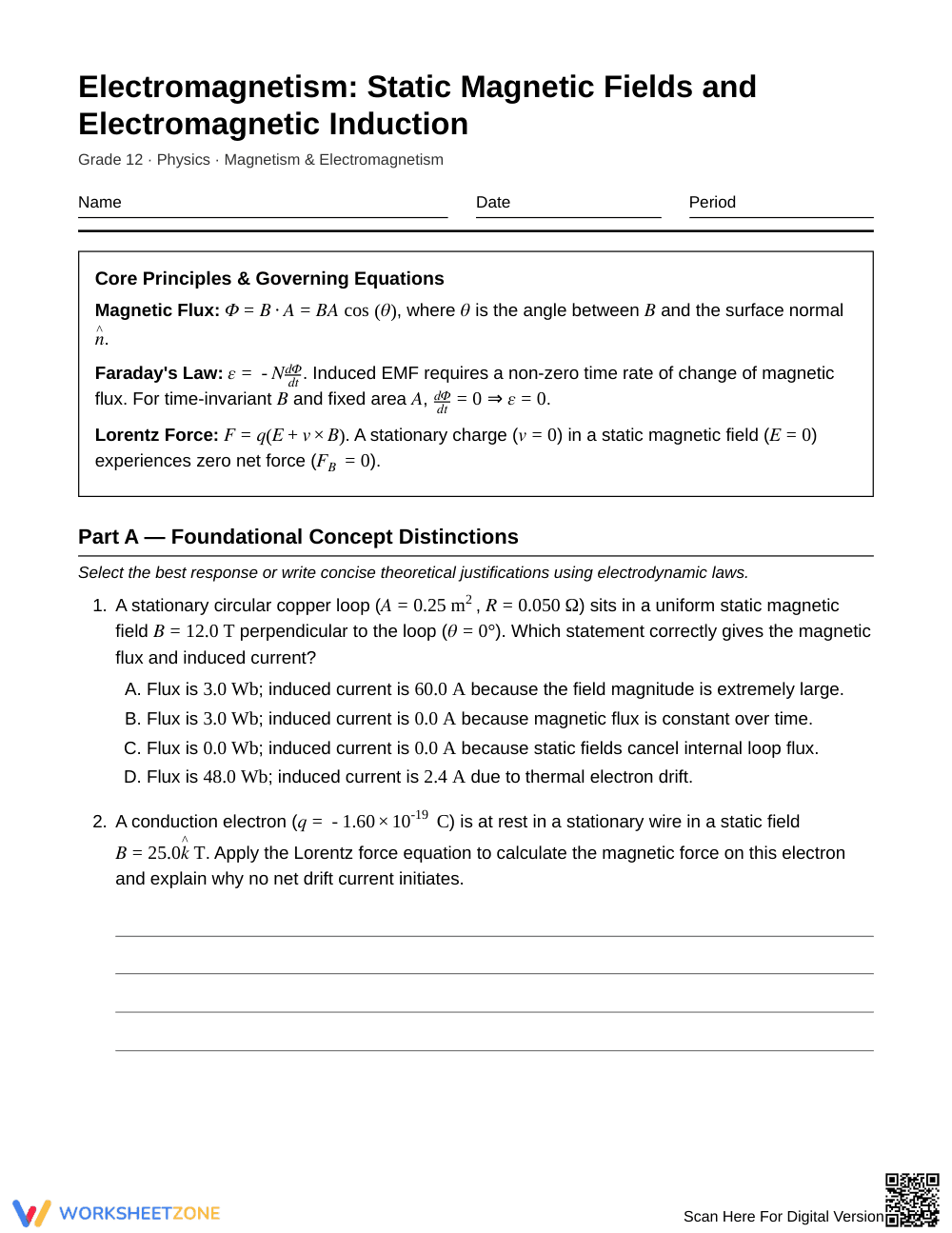
This Grade 12 physics worksheet equips students to explain why a strong static magnetic field does not induce an electric current. Through quantitative tasks on Faraday's Law and the Lorentz force, learners resolve the misconception that field magnitude drives induction, proving that current requires a time-varying magnetic flux.
At a Glance
- Grade: 12 · Subject: Physics
- Standard: Electromagnetism — Relate magnetic flux variations to induced electromotive force
- Skill Focus: Explain Why a Strong Static Field Need Not Induce Current
- Format: 5 pages · 14 problems · Answer key included · PDF
- Best For: AP Physics electromagnetism review
- Time: 45–60 minutes
What's Inside
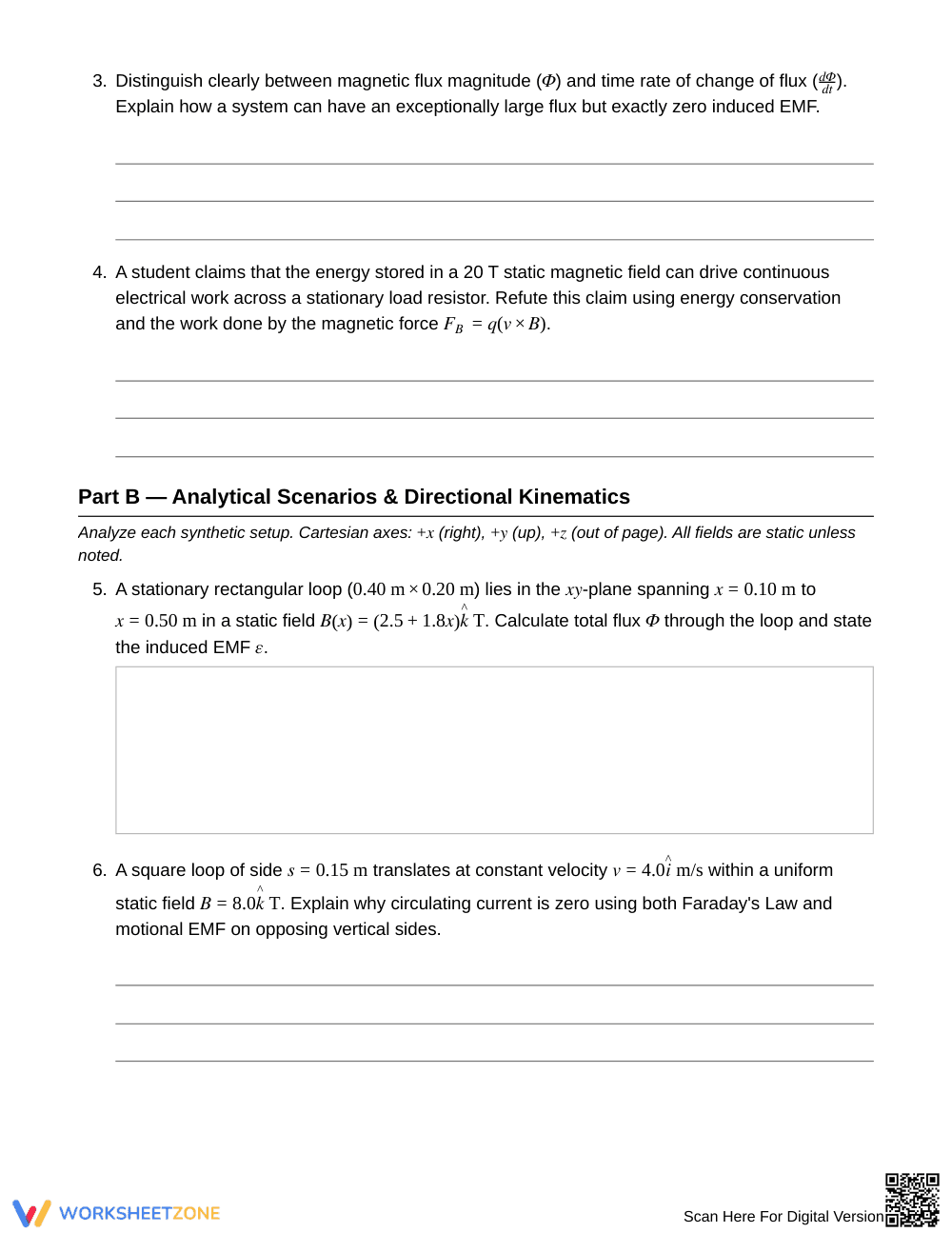
Across 5 student pages, this resource features 14 analytical problems and a 3-page answer key. A governing equation box outlines magnetic flux, Faraday's Law, and the Lorentz force. Student tasks include conceptual multiple-choice checks, spatial flux calculations, moving conductors, and synthetic model evaluations.
Skill Progression
- Guided Practice (Part A, Problems 1–4): Students address foundational concept distinctions, evaluating stationary loops and rest charges in fields up to 25.0 Tesla.
- Supported Practice (Part B, Problems 5–8): Learners analyze spatial field gradients, translating loops, and rail circuits to explain directional kinematics and zero-induced currents.
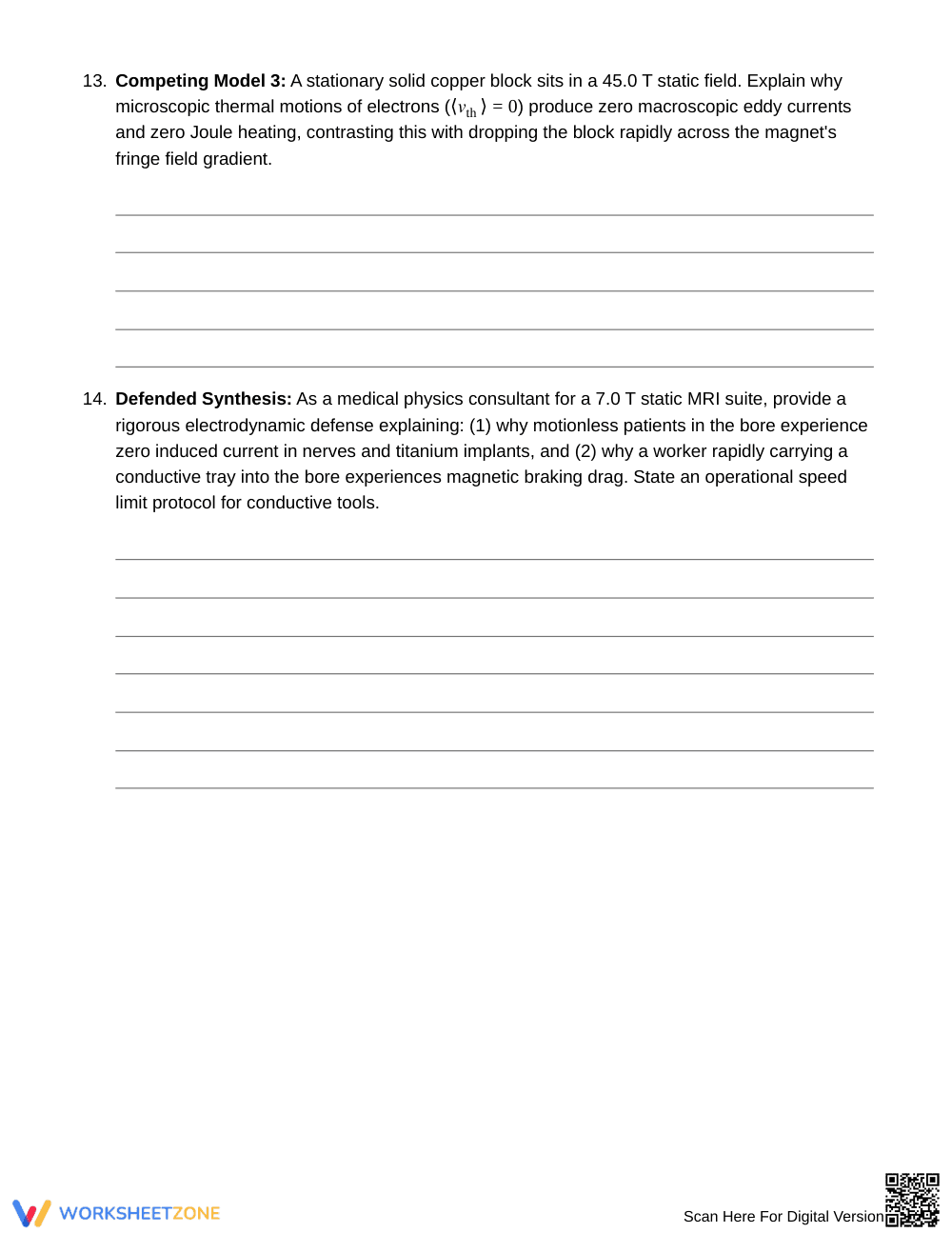
- Independent Practice (Part C, Problems 9–14): Students solve multi-step problems, evaluate competing theoretical models, and defend clinical safety protocols in a 7.0 Tesla MRI suite.
This sequence utilizes the gradual-release framework, advancing students from basic flux definitions to advanced electrodynamic synthesis.
Standards Alignment
This resource aligns with high school physics standards for electromagnetism. Students demonstrate how forces on charges depend on magnetic fields and explain why non-zero induced electromotive force requires changing magnetic flux. Both standard codes can be copied directly into lesson plans, IEP goals, or district curriculum mapping tools.
How to Use It
Use this worksheet after direct instruction on Faraday's Law. In a collaborative lesson, assign Part B for partner analysis, observing whether students realize stationary loops in spatial gradients have zero induced electromotive force. For exam preparation, assign Part C as an evaluative checkpoint. Expected completion time is 45 to 60 minutes.
Who It's For
This worksheet is tailored for Grade 12 AP Physics and honors physics students. Differentiate by providing the governing equations for students needing reference support, while challenging advanced learners to complete the theoretical proofs in Part C. Pair this resource with a laboratory demonstration using strong neodymium magnets.
According to Fisher & Frey (2014), purposeful instructional scaffolding enables high school physics students to master counterintuitive conceptual distinctions through structured gradual release. This Grade 12 physics worksheet targets electromagnetic induction concepts, requiring students to demonstrate why exceptionally strong static magnetic fields fail to produce electric currents without a time-varying flux. Across 14 rigorous tasks spanning 5 pages, students calculate magnetic flux magnitudes and evaluate the Lorentz force on stationary conduction charges. By progressing from guided multiple-choice questions to unsupported multi-step scenarios, including MRI clinical suite safety protocols and non-uniform field gradients, learners replace the persistent intuition that field strength drives current with formal electrodynamic principles based on Faraday's Law. The complete 3-page explanatory answer key provides teachers with clear diagnostic benchmarks to evaluate student mastery of electromagnetic interactions.


